Home » Archives for Marleen Van Der Zijl » Page 3
Strawberry frozen in clear ice showing ice crystals and food freezing process.
What Happens to Food When You Freeze It? The Real Science Behind Ice Crystals & Freezer Burn

What Happens to Food When You Freeze It?

You just made a massive pot of chili. Do you put it straight in the fridge and risk warming up your milk, or leave it on the counter overnight and risk food poisoning?

Most of us choose the freezer instead, thinking we are being smart and saving money. But weeks or months later you thaw it and it is watery, bland, dry, or strangely mushy.

Here is exactly what is happening inside your food the second it starts to freeze and the simple things you can do today so your future meals still taste amazing.

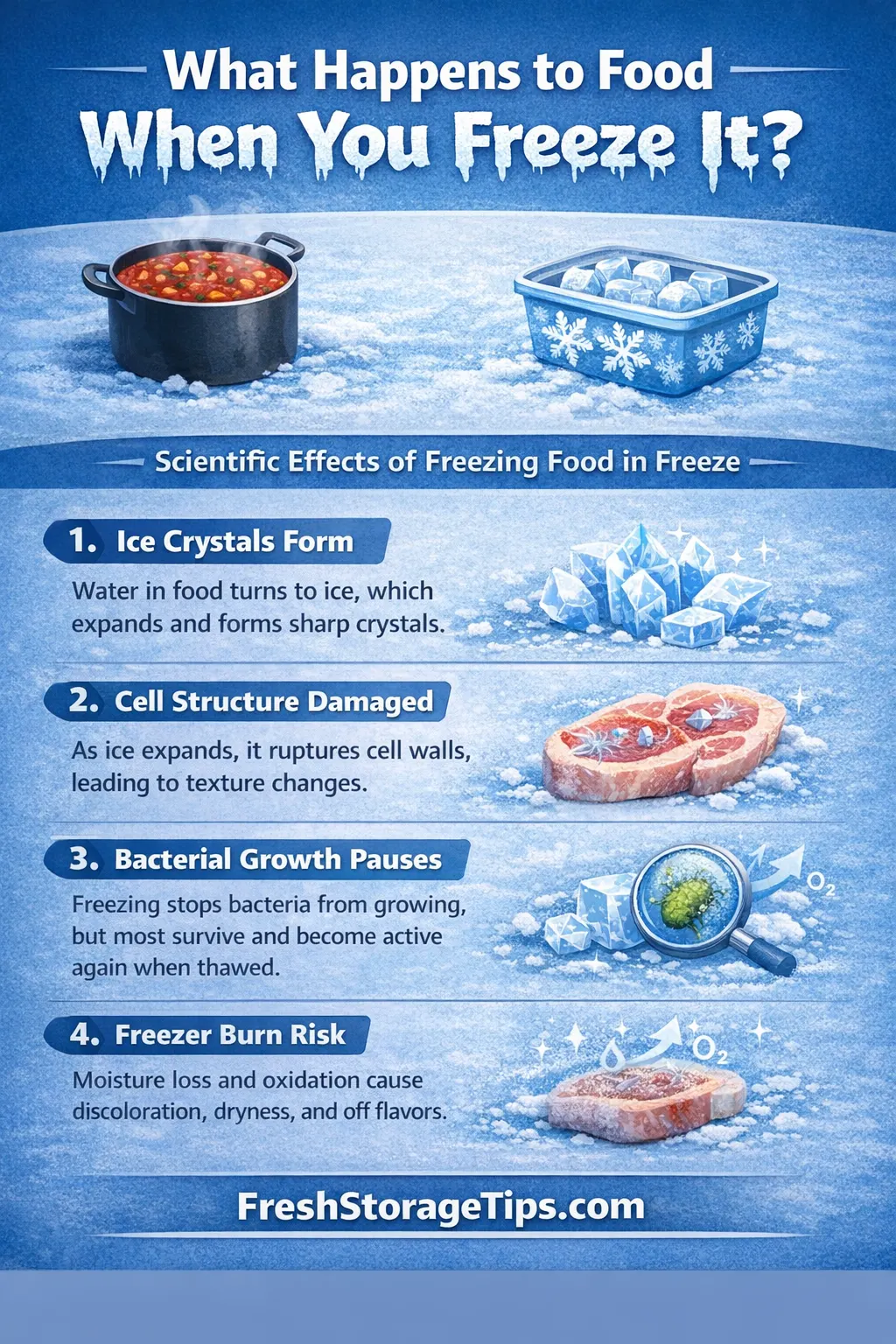
The Quick Science: Freezing does not reliably kill bacteria; it stops their growth. The true enemy of frozen food is water. As food freezes, the water inside it expands into jagged ice crystals. The slower your food freezes, the larger these crystals grow, physically piercing the cellular walls and leaving you with mushy, watery meals when thawed. By cooling your food rapidly, removing all oxygen, and keeping your freezer strictly at 0°F (-18°C), you force tiny ice crystals to form, perfectly preserving the original texture and flavor.

Safety Warning: Glass expands just like water does. If you are freezing liquids like homemade chicken stock in glass mason jars, you must leave at least an inch and a half of empty space at the top. If you fill it completely to the brim, the expanding ice will shatter the glass into your food.

A block of frozen vegetables showing visible ice crystals and frost on the surface.

The Microscopic Battlefield

I used to stand in my kitchen looking at a giant pot of leftover soup, totally paralyzed by indecision. If I left it on the stove, it would go bad. If I shoved it into the deep freeze in flimsy plastic tubs, it always came out tasting like a giant block of metallic ice. It was a massive waste of money, and it made me feel like a terrible cook. But then I started researching the actual physics of temperature control. Preserving leftovers is not about guessing. It is about biology. Every single ingredient behaves differently when the temperature drops.

Let us talk about what actually happens at a microscopic level. Imagine a beautifully ripe strawberry. It is essentially a tiny water balloon held together by delicate plant cell walls. When you place that strawberry into a standard home appliance, the water inside those cells begins to freeze. But water is incredibly unique. Unlike almost every other substance on earth, water expands when it gets cold. As the temperature drops, the water molecules arrange themselves into rigid, expansive crystalline structures.

If this chilling process happens slowly, which is exactly what happens in a crowded home appliance, those ice crystals grow very large and jagged. They act like microscopic swords, completely piercing and shattering the fragile cell walls of the strawberry. While the fruit remains solid, you do not notice the physical damage. But the moment you take it out and let it thaw on your kitchen counter, all the internal structure collapses. The sweet juices bleed out into a sad red puddle, leaving you with a mushy, unrecognizable blob. The secret to success is speed. Fast freezing equals tiny ice crystals, which means the cell walls stay perfectly intact.

The Sublimation Trap: Understanding Freezer Burn

The second major biological issue is known in the scientific community as sublimation. You probably know it by its much more common name: freezer burn. Have you ever pulled a beautiful piece of chicken from the back of the shelf only to find it covered in dry, gray, leathery patches? That meat is not necessarily dangerous to eat, but it will taste absolutely terrible.

Sublimation occurs when frozen water turns directly into a vapor without ever melting into a liquid first. Your appliance works by constantly circulating extremely dry, cold air to prevent heavy frost from building up on the internal mechanical coils. If your food is not sealed properly, that aggressive dry air literally sucks the moisture right out of your meat and vegetables. The gray patches are areas where the tissue has been completely dehydrated and oxidized.

To fight this process, you have to build an impenetrable wall between your groceries and the circulating air. This is why tossing a thin, original plastic grocery store package onto the shelf is a guaranteed way to ruin your dinner. Air is the enemy of longevity. If you want your steaks to taste just as good six months from now, you have to remove the oxygen completely.

Step-by-Step: How to Freeze Food Correctly

To stop your groceries from turning to mush, you need a precise system. Follow these exact steps to perfectly preserve your meals:

  1. Chill the Food Rapidly: Never place hot pots directly into the appliance. Use an ice bath in your sink to bring the temperature down safely and quickly before packing.
  2. Portion into Sensible Sizes: Divide your large meals into smaller, individual servings. Smaller portions freeze much faster, which prevents large ice crystals from forming and ruining the texture.
  3. Remove All Oxygen: Oxygen causes freezer burn. Use a vacuum sealer or the water displacement method to push all the air out of your bags before sealing them tight.
  4. Label and Freeze Flat: Write the contents and the date on a dissolvable label. Lay the bags perfectly flat on a baking sheet until solid, then stack them like books to save space.

The Enzyme Equation: Why You Must Blanch Vegetables

Have you ever thrown a handful of fresh, raw green beans into a cold bag, only to pull them out a month later and find them brown, tough, and tasting like dirt? You fell victim to enzymatic degradation.

Plants contain living enzymes that cause them to ripen, mature, and eventually rot. While plunging them into zero-degree temperatures slows these enzymes down dramatically, it does not stop them entirely. If left unchecked, these enzymes will continue to slowly destroy the color, texture, and nutritional value of your vegetables over time.

The only way to stop this is to deactivate the enzymes before they go into the cold. This is done through a process called blanching. By dropping your vegetables into rapidly boiling water for just one or two minutes, and then immediately plunging them into a bowl of ice water to stop the cooking process, you effectively kill the enzymes. The vegetables stay bright green, perfectly crisp, and retain all of their vitamins for up to a full year.

Infographic detailing the timeline of freezing and how large ice crystals destroy cellular walls in food.

The Seafood Protocol: Storing Fish Safely

Fish and shellfish are the absolute ultimate test of your kitchen skills. Seafood contains highly unsaturated fats that are incredibly prone to oxidation and going rancid, even when frozen completely solid. If you want to know exactly how long you can store fish, the USDA guidelines are incredibly strict for a very good reason.

But the safety clock starts ticking the moment you are standing at the local market. I highly recommend reading the expert advice on the safe selection and handling of fish and shellfish to ensure you buy the freshest catch possible. Once you get it home, you should immediately reference this incredibly helpful downloadable FDA safety chart to understand exact timelines for different aquatic species.

The professional marine scientists at NOAA also offer a brilliant guide on how to store and handle seafood, noting that removing oxygen is the absolute most important step you can take. Furthermore, the FDA strongly warns about the severe risks of bacterial cross-contamination when selecting and serving fresh and frozen seafood safely. Always keep raw fish wrapped in multiple protective layers and store it far away from your ice cream.

If you are lucky enough to catch your own dinner, the Iowa DNR has a fantastic resource detailing exactly how to approach cleaning and cooking fish so you prepare the delicate fillets perfectly before they hit the ice.

Finally, if you want to geek out on the deep microbiology, this fascinating PMC research article explains exactly how bacterial growth is halted at 0°F (-18°C), but bacteria are not killed and can become active again when thawed. Furthermore, enzymatic degradation continues if the temperature fluctuates even a tiny bit, which is why absolute temperature stability is so critical.

Foods That Hate the Cold

Before you start filling up bags with every leftover you own, you must understand that certain foods simply do not survive the extreme transition. Understanding your short-term environment is vital. If you constantly wonder why food spoils fast in your fridge, the problem often starts when you place massive, piping hot containers directly onto the glass shelves. The heat radiates outward, ruining your fresh milk and delicate greens. The exact same thermal principle applies to your deep freeze.

Dairy products are incredibly fragile. If you want to know how to store cheese properly, keep it firmly in the main cooling compartment. The freezing process violently breaks the fat emulsions, turning a beautiful block of cheddar into a crumbly, un-meltable mess. Likewise, if you are looking at how to store fried chicken, the crisp exterior will turn into a soggy sponge as the moisture inside the meat freezes and pushes outward into the breading. Keep fried foods away from the ice.

Safe Thawing: The Final Step

All of your hard work packaging and chilling your food is completely wasted if you thaw it incorrectly. The absolute worst thing you can do is take a frozen block of chicken and leave it sitting on your kitchen counter all day while you are at work.

As the ambient air warms the food, the outer layers of the chicken will reach room temperature and enter the bacterial danger zone (above 40 degrees Fahrenheit) hours before the dense center is fully thawed. You are essentially creating a perfect breeding ground for salmonella on the surface of your meat. The only two safe ways to thaw food are slowly in the refrigerator overnight, or submerged in a leak-proof bag under cold running water.

Video Guide: 40 Foods That Freeze Well

Save Time and Money

This fantastic visual guide breaks down dozens of common household ingredients that survive the cold surprisingly well. Knowing what works prevents you from throwing away perfectly good groceries.

Storage Tip: Pay close attention to how they handle baked goods and doughs. Freezing raw cookie dough in individual balls is one of the smartest meal-prep hacks available. You can bake them straight from solid ice without ever letting them thaw, giving you fresh cookies on demand.

Interactive Freezing Timeline Chart

Filter by the type of grocery. Properly prepared items can last a surprisingly long time without losing quality.

Grocery Item Ideal Prep Method Safe Time Risk or Tip
Raw Beef Steaks Vacuum Sealed 8-12 Months Remove all oxygen to stop freezer burn.
Fresh Berries Flat Freeze on Tray 10 Months They will get mushy; use for smoothies.
Chicken Stock Glass Jars (Leave Space) 6 Months Leave top space so expanding ice does not break glass.
Cooked Meatballs Airtight Bag 3 Months Chill completely before packing to stop condensation.
Green Beans Blanch Then Pack 12 Months Boil briefly to kill enzymes that cause browning.
Marleen's Kitchen Tools for Freezing Food

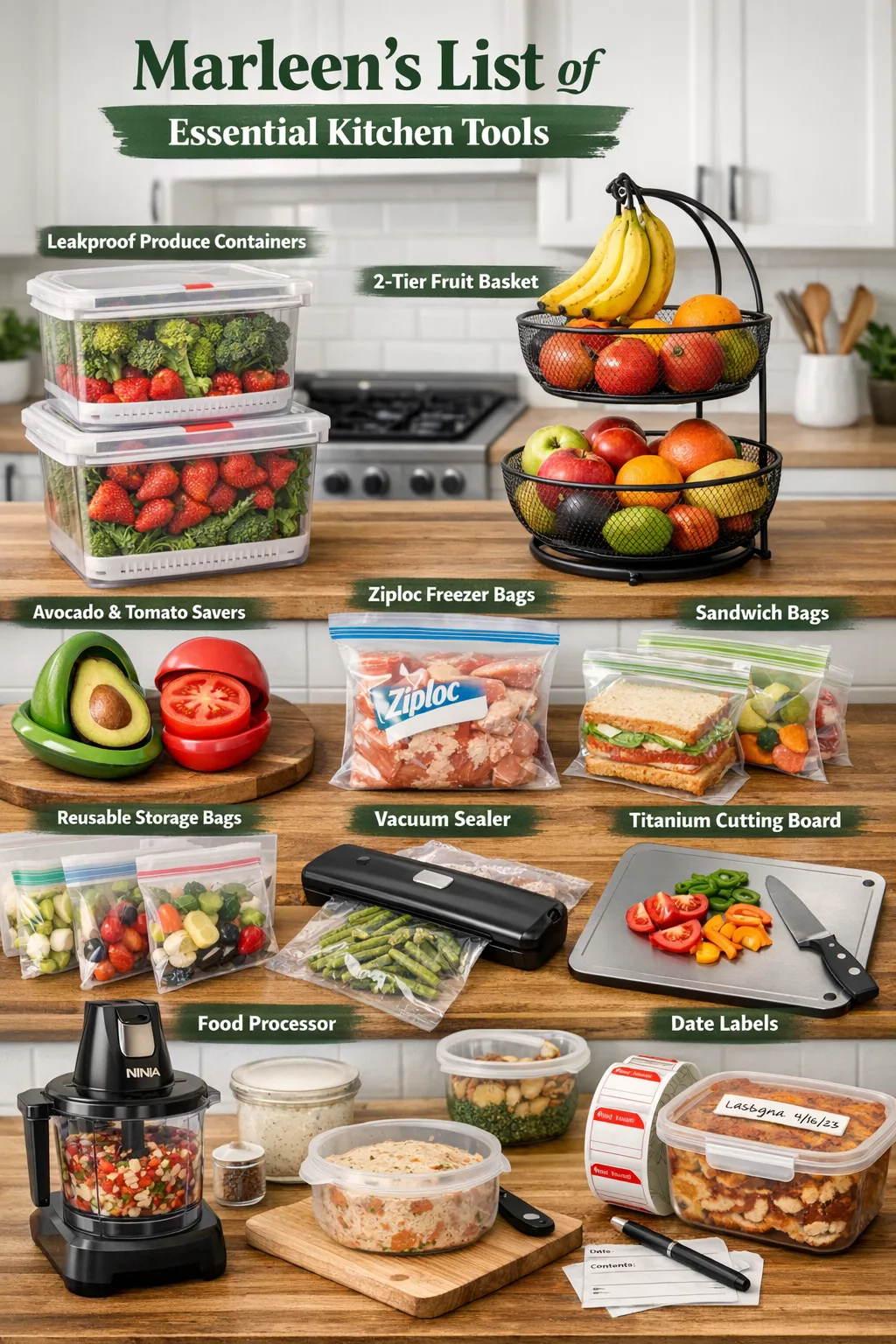
Marleen’s List of Essential Kitchen Tools

I used to absolutely hate trying to find something for dinner in my kitchen. I would open the heavy door and just stare at a massive, chaotic mountain of unlabeled, frosty plastic bags. I never had any idea what was inside them. Was it a bag of frozen strawberries or a chunk of raw beef? I could not tell because everything was covered in a thick layer of ice. Worse, when I finally decided to thaw something out, it was almost always ruined by freezer burn. I realized that I was literally throwing hundreds of dollars into the trash every single year simply because I refused to buy the proper tools to protect my investment. You cannot buy premium, expensive groceries and then store them in flimsy, cheap sandwich bags.

Transforming your long-term storage space requires a completely new mindset and a few very specific, highly durable items. The absolute biggest game changer for me was finally investing in a high-quality vacuum machine. By physically extracting every single drop of oxygen from the packaging, you completely stop the dehydration process that ruins your meats. Once the air is gone, you need a way to track the dates. Sticky notes always fall off in the cold, so using labels that actually dissolve under warm water changed my entire organizational system. I also realized that relying on the factory dial was a terrible idea, so a dedicated digital cooking thermometer became my best friend for verifying safe internal temperatures. For massive batch cooking days, a heavy-duty food processor saves me hours of chopping vegetables before I pack them away in my specialized moisture-regulating saver tubs. These simple, highly effective tools pay for themselves in just a few weeks by ensuring your expensive groceries actually make it to your dinner plate tasting perfectly fresh.

Digital Thermometer for Cooking

The absolute only way to verify your appliance is securely under 0°F and your meats are thawed to safe temperatures.

View on Amazon

Food Storage Containers

Stop using flimsy plastic! These heavy-duty stackable containers block out the dry air that causes massive freezer burn.

View on Amazon

Food Product Saver Tubs

These specialized tubs regulate moisture perfectly, stopping your expensive chopped vegetables from turning into icy blocks.

View on Amazon

Dissolvable Labels for Food

Never guess when you cooked that meal again. Write the exact date, and the label washes completely off in the warm sink!

View on Amazon

Food Processor

Chop and prep your bulk vegetables in seconds before you blanch them and store them perfectly in your clear bins.

View on Amazon

Vacuum Sealer for Food

The ultimate professional kitchen tool for physically removing oxygen and extending the shelf life of your raw meats by months.

View on Amazon

As an Amazon Associate, I earn from qualifying purchases.

Sources & Transparency

This technical guide references vital food safety guidelines from the FDA and the USDA regarding proper cellular storage temperatures. Data on sublimation risks, seafood handling, and bacterial activity was deeply consulted via the National Oceanic and Atmospheric Administration (NOAA) and the National Institutes of Health (NIH) public safety databases.

Last updated:

Update Log

  • : Published comprehensive guide on the physics of freezing, freezer burn, and oxygen removal.
2 comments
0 FacebookTwitterPinterestEmail
Why your fridge may be ruining your food showing spoiled produce, incorrect temperature settings, and food safety storage mistakes

Why Your Fridge Is Probably Ruining Your Food

by Marleen Van Der Zijl
Why Your Food Spoils Fast in the Fridge (And How to Fix It)

Why Your Food Spoils Fast in the Fridge (And How to Fix It)

You trust your fridge.

You toss groceries in, close the door, and assume everything inside is protected. The milk goes in the door. Leftovers get pushed to the back. Vegetables sit in drawers you barely think about.

It feels cold, so it must be working. But if you are constantly wondering why food spoils fast in your fridge, the appliance itself is likely the culprit.

Most home fridges are slightly too warm, overcrowded, and badly organized. And that combination slowly shortens the life of your food without you noticing.

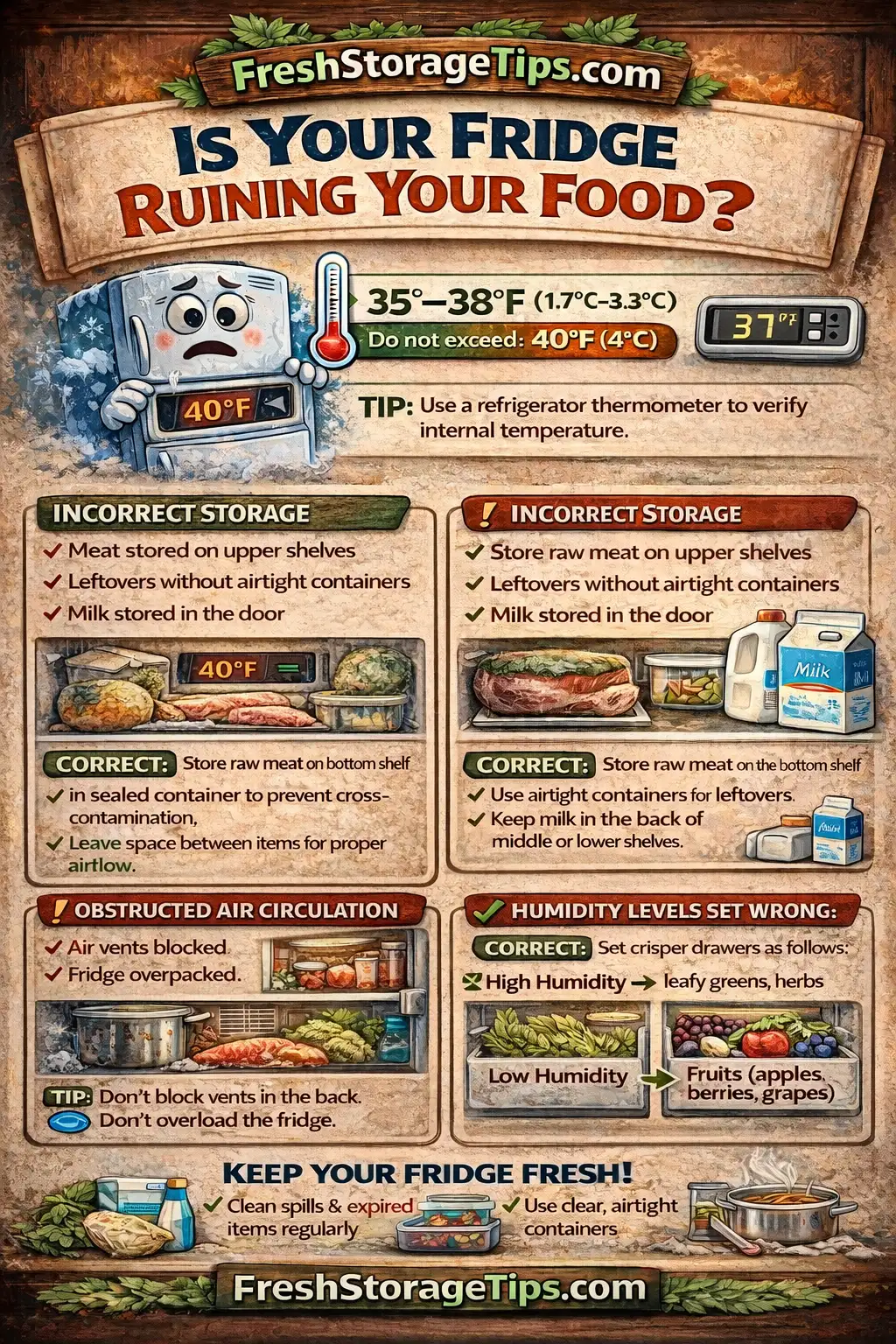
The Quick Fix: If your refrigerator is above 4°C (40°F), overpacked, or poorly organized, it speeds up spoilage instead of slowing it down. Correct temperature, airflow, and proper shelf placement make the difference between food lasting days and going bad early.

Food Safety Tip: Always keep a simple digital thermometer inside your main compartment. Relying on the arbitrary “1 through 5” dial setting is dangerous. You want absolute proof that the internal environment remains safely under 40 degrees Fahrenheit at all times.

An open, heavily unorganized refrigerator packed with groceries.

The Illusion of the Cold Box

I used to be so guilty of treating my kitchen appliances like magic boxes. I would come home from the local supermarket, my canvas bags completely overflowing, and I would just play a chaotic game of Tetris trying to make every single item fit inside. I honestly thought that as long as the heavy door managed to click shut, my family’s meals were completely safe from harm. I was so incredibly wrong.

Most of us never actually check the internal climate of our most expensive kitchen tool. We feel a blast of chilly air against our face when we grab a snack, and we assume everything is perfectly fine. But feelings are deeply deceiving. Your appliance works incredibly hard to fight off the ambient heat of your home, and every single time my kids leave the door wide open while deciding what to drink, warm air rushes in, completely destroying the delicate temperature balance.

When your groceries sit in an environment that hovers just above the safety line, they do not immediately smell foul. Instead, they just quietly degrade. The beautiful leafy greens you bought for salads start to wilt days early. The expensive cream starts to taste slightly sour long before the date printed on the carton. Getting the temperature exactly right, understanding how air moves, and knowing exactly where to place specific items makes a massive difference in your monthly grocery budget.

The Microclimates of Your Shelves

Think of the inside of your unit as a large house with several different weather patterns. You would never dream of putting your winter boots in a sunny greenhouse, so why would you place delicate, expensive proteins in the warmest part of your appliance? Let’s break down exactly how these zones work.

  • The Top Shelves: This area has the most consistent temperature because it is usually far away from the cooling vents, but it is not the coldest spot. Heat naturally rises, even in a confined space. This makes the top shelf the perfect resting place for things that are already fully cooked. I always put my prepared meals, hummus, and deli meats up here. It is also the absolute best place to keep things like how to store fried chicken, ensuring the breading stays somewhat stable without freezing against the back wall.
  • The Bottom Shelf: Because cold air is heavy and sinks, this is your safety zone. This is the chilliest area available to you. It is exactly where you should keep raw meat, poultry, and anything that poses a terrible risk of dripping. By keeping raw items on the lowest level, you completely eliminate the nightmare scenario of raw chicken juices falling onto your fresh, ready-to-eat salad greens down below.
  • The Door Compartments: This is the warmest, most unstable place in the entire machine. Every time you open it, the items in the door are subjected to room-temperature air. Please, stop putting your milk and eggs here! I reserve the door purely for things that have high acid or high sugar content, like ketchup, mustard, soy sauce, and soda. If you want to know more about keeping dairy perfectly safe, check out my guide on how to store cheese. It will totally change how you handle your cheddar blocks!
Infographic showing the warmest and coldest zones inside a standard refrigerator.

Visual Glance: The Zone Layout

This simple timeline graphic shows how long things truly last when placed in the correct zones versus the wrong zones. If you put a gallon of milk in the door, you are shaving days off its lifespan.

Unlike bananas, which happily sit on the counter in a bowl, most of your delicate produce needs specific humidity controls. Your crisper drawers are designed to manage moisture, not temperature. One should be set to high humidity for thin greens that wilt easily, and the other to low humidity for things that off-gas and rot quickly, like apples. I learned the hard way that mixing these up results in slimy spinach. You can read more about my fruit successes in my general fruit storage overview.

Step-by-Step: How to Organize Your Fridge for Maximum Freshness

To stop your groceries from spoiling early, you need a system. Follow these exact steps to reset your appliance:

  1. Empty and Wipe Down: Take everything out of the appliance. Wipe the shelves with warm, soapy water to remove sticky spills and invisible bacteria that accelerate rot.
  2. Check the Temperature: Place a digital thermometer on the middle shelf. Ensure it reads strictly below 40 degrees Fahrenheit to keep bacteria from multiplying.
  3. Assign the Zones: Put raw meats on the very bottom shelf. Move dairy and eggs to the middle, and keep pre-cooked leftovers on the top. Only use the door for highly acidic condiments.
  4. Create Airflow: Load your groceries back in, leaving at least an inch of space between items and the back wall so cold air can circulate freely.

Temperature Consistency Showdown

Not all shelves are created equal. Here is how stable the temperatures really are based on location.

Bottom Shelf
Very Cold / Highly Stable
Top Shelf
Consistent / Moderate Cold
Crisper Drawers
Cold / High Humidity
The Door
Warm / Highly Unstable

Video Guide: The Meat Lifespan

Understanding Protein Storage

This fantastic video from America’s Test Kitchen covers exactly how long meat can sit on your shelves before it becomes a danger to your family. Meat is one of the most expensive items we buy, so letting it spoil is a terrible waste of money.

Storage Tip: Notice how they discuss the “danger zone” of temperatures. If your appliance is struggling to keep up because it is too full, your meat is slowly inching toward that zone even while sitting on the shelf.

Always place your raw proteins on a rimmed baking sheet or plate on the very bottom shelf. This catches any accidental leaks from the plastic wrapping, saving you from a massive cleaning headache later on.

Interactive Fridge Placement Chart

Filter by the type of grocery. Placing items on the correct shelf drastically extends their freshness.

Grocery Item Ideal Location Safe Time Risk or Tip
Milk & Cream Middle Shelf Back 7-14 Days Never place in the door; it sours quickly.
Raw Chicken Bottom Shelf 1-2 Days Keep on a rimmed plate to stop drips.
Leafy Greens High-Humidity Crisper 5 Days Add a paper towel to absorb excess moisture.
Eggs Middle Shelf 3 Weeks Keep in original carton to block odors.
Deli Meats Top Shelf / Deli Drawer 3-5 Days Wrap tightly to prevent drying out.

The Ultimate Test: Storing Seafood

If you genuinely want to know if your appliance is truly doing its job correctly, look at how it handles fresh fish. Seafood is incredibly delicate and spoils faster than almost anything else we buy. If your storage environment is struggling to maintain a deep chill, your fish will let you know immediately by filling your entire kitchen with a terrible, sour odor.

According to the experts, raw fish only lasts a very short time before turning dangerous. But the safety clock actually starts ticking the very moment you are standing at the seafood counter. I always make sure to follow the recommended guidelines for safe selection and handling of fish and shellfish to ensure I am never bringing home something that is already on the verge of spoiling. Once I get it into my kitchen, I reference this incredibly helpful downloadable FDA safety chart to remind myself of the specific timelines for different species. If you ever wonder exactly how long you can store fish, the answer from the USDA is usually just one or two days at most before it absolutely needs to be cooked or thrown into the freezer.

The wonderful folks at NOAA explain exactly how to store and handle seafood properly, noting that placing it on crushed ice in the absolute coldest part of your fridge is the only way to go. I actually put my wrapped salmon in a small container, fill another larger bowl with ice cubes, and set the container directly on top of the ice. The FDA also strongly warns about the severe risks of cross-contamination when selecting and serving fresh and frozen seafood safely. You must keep it wrapped incredibly tight!

And if you or your family caught the fish yourselves, like my husband sometimes tries to do on lazy summer weekends, the Iowa DNR has fantastic practical advice on cleaning and cooking fish safely so you do not accidentally get sick from your own catch. Finally, deep scientific studies on bacterial growth in cold environments, such as those detailed in this comprehensive PMC research article, prove that even a tiny two-degree temperature fluctuation can completely ruin delicate proteins. Keep it cold, keep it low, and eat it fast.

Safety: The Overcrowding Trap

Have you ever played grocery Tetris? You know, when you buy way too much at the weekend market and have to shove things into every available inch of the fridge? I used to think a totally full appliance meant I was doing a great job providing abundance for my family. What I was actually doing was creating a warm box of rotting food.

  • ⚠️ Blocked Vents: Refrigerators do not just make things cold; they blow cold air around. If you pack a huge leftover box tightly against the back vents, the air cannot flow. The front gets warm, and the back freezes solid.
  • ⚠️ Trapped Gases: Produce releases ethylene gas. If the air isn’t moving, this gas gets trapped around your vegetables, causing them to rot at double the speed.
  • 👀 The One-Inch Rule: A good rule of thumb is to leave about an inch of empty space between your food containers and the internal walls. If you cannot clearly see the back wall, you have far too much stuff in there!

I ruined a huge batch of fresh fruit this way once. I blocked the main air vent with a giant casserole dish, and by Tuesday, my delicate berries were destroyed. If you want to know the right way to handle berries so they survive, look at my tips on how to store strawberries and how to keep cherries fresh. They desperately need airflow!

Fridge Myths Busted

Let’s clear up some terrible kitchen folklore that is costing you money:

  • 🚫 Myth: Hot food ruins your fridge. Reality: Modern appliances can handle warm leftovers perfectly fine. Waiting hours for food to cool on the counter invites dangerous bacterial growth. Put it away while it is still slightly warm!
  • 🚫 Myth: The colder, the better. Reality: Dropping the dial to its absolute lowest setting will just freeze your lettuce and ruin the texture of your dairy. Aim for a stable 37°F (3°C).
  • 🚫 Myth: Baking soda lasts forever. Reality: That open box of baking soda you put in the back to absorb smells stops working after about a month. You need to replace it, or better yet, use dedicated charcoal absorbers.
Marleen's Kitchen Tools for Fridge Organization

Marleen’s List of Essential Kitchen Tools

I used to dread putting groceries away. Stuff would constantly get lost in the dark corners, my sour cream would freeze solid against the back wall, and I regularly threw away fuzzy leftovers I forgot about. It was a disaster that cost my family hundreds of dollars in wasted food.

Dealing with a busy kitchen requires systems that actually make sense. The built-in crisper drawers are rarely enough. By investing in the right food storage containers, vacuum sealers, and a reliable digital thermometer, you instantly create stability, airflow, and total visibility. These simple tools turn the chaos of “what is for dinner” into a beautifully streamlined space—and best of all, they pay for themselves by stopping early spoilage dead in its tracks!

Digital Thermometer for Cooking

The only way to verify your fridge is under 40°F and your meats are cooked to a safe internal temp.

View on Amazon

Food Storage Containers

Stop using cloudy, mismatched plastic! These stackable containers keep leftovers colder and prevent cross-contamination.

View on Amazon

Food Product Saver Tubs

These specialized bins regulate moisture perfectly to stop your expensive lettuce and berries from turning to slime.

View on Amazon

Dissolvable Labels for Food

Never guess when you cooked that meal again. Write the date, and the label washes completely off in the sink!

View on Amazon

Food Processor

Chop and prep your bulk vegetables in seconds before storing them perfectly in your new clear bins.

View on Amazon

Vacuum Sealer for Food

The ultimate kitchen tool for preventing freezer burn and extending the shelf life of your expensive raw meats.

View on Amazon

As an Amazon Associate, I earn from qualifying purchases.

Sources & Transparency

This guide references vital food safety guidelines from the FDA and the USDA regarding proper storage temperatures. Data on seafood risks and handling was heavily consulted via the National Oceanic and Atmospheric Administration (NOAA) and the National Institutes of Health (NIH) public databases.

Food goes bad because of bacteria, mold and oxidation, three processes that all accelerate above 40°F. Mold is the most visible sign of spoilage and you can learn exactly why food gets moldy and which conditions cause it to grow fastest. Even inside the fridge, food spoils if stored incorrectly. Find out why food spoils fast in the fridge and the specific habits that speed it up. Most storage mistakes that speed up spoilage are avoidable once you understand the science behind what bacteria and mold actually need to thrive.

Last updated:

Update Log

  • : Published comprehensive guide on appliance temperature zones and airflow management.
Marleen van der Zijl, author of FreshStorageTips.com

About the author: Marleen van der Zijl

Marleen is a mother who loves summer picnics but hates food waste. She shares her tested kitchen hacks to help you keep big produce fresh and delicious.

4 comments
0 FacebookTwitterPinterestEmail
fresh tips How to Store Watermelon

How to Store Watermelon

by Marleen Van Der Zijl
How to Store Watermelon: Keep It Sweet and Crisp (Whole or Cut)

How to Store Watermelon: Keep It Sweet and Crisp

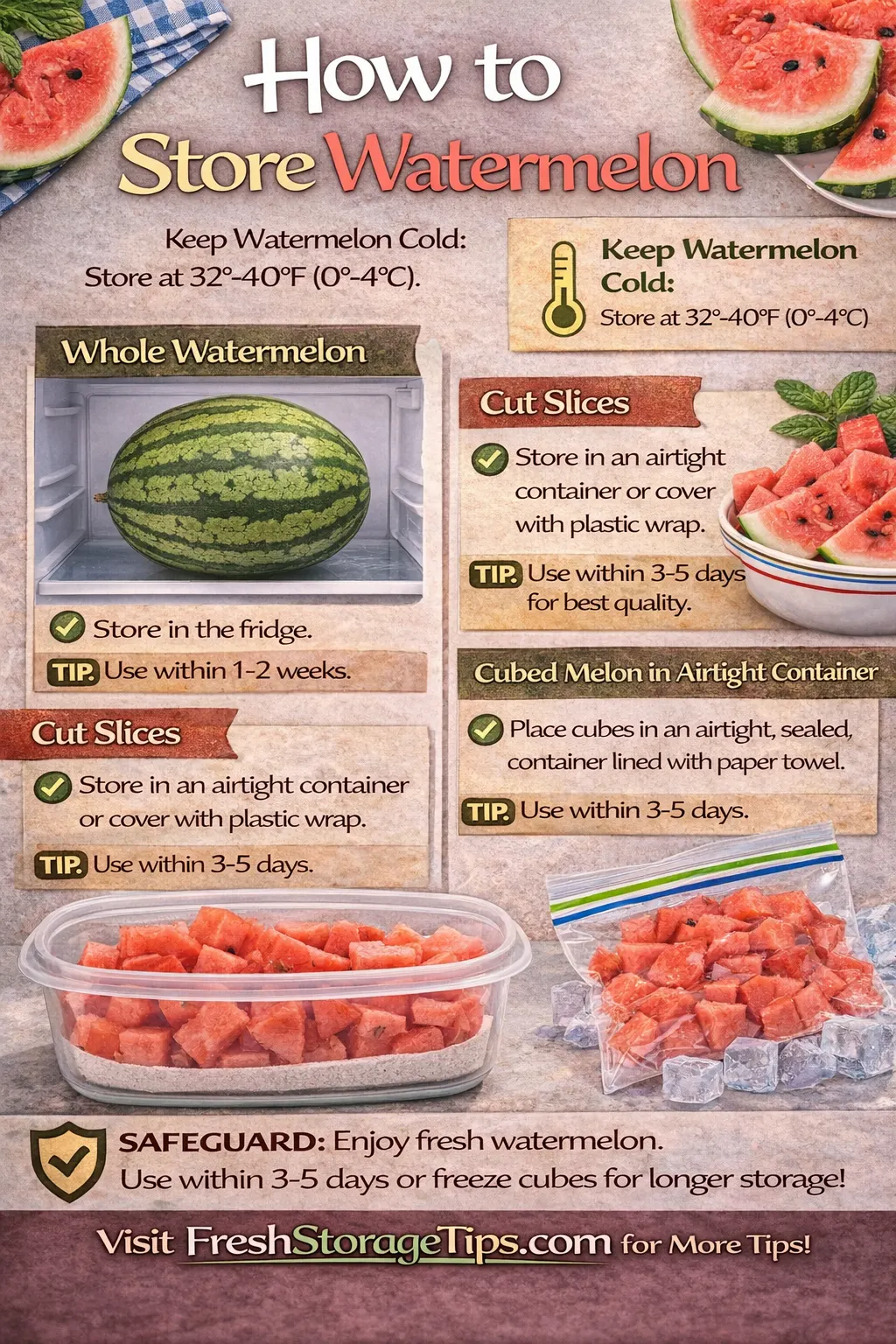
How to Store Watermelon: Keep a whole, uncut watermelon on your counter at room temperature for 7 to 10 days to preserve its flavor and nutrients. Once cut, store the pieces in an airtight container in the refrigerator for 3 to 4 days. If you wrap a large cut section, use plastic wrap and seal it tightly against the flesh to prevent it from absorbing fridge odors.

Food Safety Tip: Melons grow on the ground and can pick up pathogens. The CDC recommends scrubbing the rind with a clean produce brush before cutting to prevent transferring bacteria from the knife to the fruit flesh.

Slices of fresh red watermelon on a wooden board.

The Giant of the Summer Kitchen

There is no greater symbol of summer than a massive, striped watermelon sitting on the kitchen counter. It promises hydration, sweetness, and sticky fingers for the kids. However, bringing home a 15-pound fruit presents a unique logistical challenge for any household. Where do you put it? And once you cut into it, how do you keep the rest from turning into a sad, mealy mess?

I remember one July when I bought a huge melon for a neighborhood barbecue that ended up getting canceled. I shoved the whole thing in the fridge, thinking it would keep for weeks. When I finally cut it open, the vibrant red color had dulled, and the texture was grainy and flavorless. I was so disappointed. It turns out that cold temperatures can actually hurt the quality of a whole melon.

Whether you have a seeded giant or a personal-sized seedless variety, the rules for keeping it fresh are specific. You have to balance the need for temperature control with the fruit’s biological desire to retain its nutrients. Let’s look at how to manage this giant fruit from the grocery store to your plate.

The Science: Lycopene and Temperature

Watermelon is not just water and sugar. It is a complex biological package that continues to change even after it is picked from the vine.

  • Lycopene Preservation: Studies cited by agricultural researchers show that watermelons stored at room temperature (around 70°F) continue to develop lycopene. This is the pigment that gives them their red color and antioxidant properties. If you chill the melon immediately after harvest, you halt this process. The melon essentially goes into shock and stops improving its nutritional profile.
  • Chilling Injury: While we love a cold slice of melon, the whole fruit suffers if kept too cold for too long. If a whole watermelon is kept below 50°F (10°C) for more than a few days, the cell structure begins to break down. This leads to color loss and that unpleasant “mealy” texture we all hate. The fridge is fine for a day or two to chill it before serving, but not for long-term storage.
  • Ethylene Sensitivity: Watermelons are sensitive to ethylene gas. This is a ripening hormone emitted by fruits like apples, bananas, and tomatoes. If you store your melon next to a bunch of bananas on the counter, the rind will soften and the flesh will become mushy much faster. Give the melon its own space.
Infographic showing Watermelon storage times: Whole 10 days, Cubed 3 days, Frozen 12 months.

Visual Glance: The Freshness Timeline

This timeline helps you manage your consumption. Once that rind is breached, the clock starts ticking very fast.

Compared to other summer fruits, watermelon is quite durable until cut. It lasts longer on the counter than when you store strawberries or keep cherries fresh. However, once you cube it, it degrades faster than bananas in the fridge. Treat cut melon as a perishable item that needs to be eaten within days.

Storage Method Showdown

How you store the fruit determines the texture you get. Here is the breakdown.

Whole (Counter)
7–10 Days
Whole (Fridge)
2 Weeks (Flavor Loss)
Cubed (Airtight)
3–4 Days
Wrap on Plate
2 Days
Frozen Chunks
10–12 Months

Video Guide: Picking and Prepping

The Thump and The Cut

This video covers the basics, from selection to storage. Picking a good melon is the first step to successful storage. You want a heavy melon with a creamy yellow field spot.

Cutting Tip: The video demonstrates efficient ways to break down the melon. Notice how they handle the rind. Removing the rind before storing the meat allows you to fit more fruit into your containers. Storing huge wedges with the rind on wastes valuable fridge space and exposes more surface area to drying out.

Remember to wash the outside before you slice. This prevents the knife from dragging dirt from the skin into the sweet red meat.

Interactive Storage Chart

Filter by the state of your watermelon. Whole melons behave differently than juice or cubes.

Form Best Method Safe Time Risk or Tip
Whole Melon Countertop 10 Days Keep away from direct sunlight.
Cubed Flesh Airtight Tub 3–4 Days Drain liquid at bottom to prevent mush.
Half Melon Plastic Wrap 3 Days Wrap tightly to stop fridge odors.
Chunks Freezer Bag 10 Months Texture changes; use for smoothies.
Juice Sealed Jar 2 Days Separates easily; shake before drinking.

Safety: When to Toss It

Melon spoilage can cause food poisoning, specifically from bacteria like Listeria or Salmonella. Referencing FDA guidelines, here is what to watch for:

  • ⚠️ Sour Smell: Fresh watermelon smells sweet and floral. If it smells sour, tangy, or fermented, the sugars are breaking down. Do not eat it.
  • ⚠️ Slimy Texture: If the surface of the cubes feels slippery or gooey, bacteria have colonized the fruit. Rinse it? No. Discard it.
  • 👀 Flesh Color: The flesh should be bright pink or red (or yellow for some varieties). If the color looks dark, dull, or watery, the cell structure has collapsed.

Watermelon Myths Busted

Let’s clear up some kitchen folklore:

  • 🚫 Myth: Storing it whole in the fridge makes it sweeter. Reality: Cold stops the ripening process. For maximum sweetness, keep it on the counter until the day you cut it.
  • 🚫 Myth: Thumping tells you everything. Reality: The thump test helps, but looking for the “field spot” (creamy yellow patch) and a dried brown stem is a more reliable indicator of ripeness.
  • 🚫 Myth: Seeds are bad for storage. Reality: Seeded watermelons often have firmer flesh and store slightly better than seedless varieties, which can be more prone to mealiness.

Deep Dive: Freezing Technique

If you have too much melon, freezing is a great option, but you must manage your expectations regarding texture. The water expands and breaks the cells, so thawed melon will be soft.

The IQF Method (Individually Quick Frozen):

  1. Cut: Dice the melon into small cubes or use a melon baller.
  2. Tray: Line a baking sheet with parchment paper. Spread the pieces out so they are not touching.
  3. Freeze: Place the tray in the freezer for 2 to 3 hours until solid.
  4. Bag: Transfer the frozen chunks into a freezer bag. Remove as much air as possible.

These frozen chunks are perfect “ice cubes” for drinks or can be blended directly into smoothies.

Handling a Cut Half

Sometimes you only need half a melon. To store the other half, leave the rind on. Wrap the exposed flesh tightly with plastic wrap. Ensure there are no air gaps. You can also place a plate upside down over the cut side if it fits on your fridge shelf. Store it cut-side up if wrapped, or cut-side down on a plate (with a paper towel to catch juice). Consume within 3 days for the best quality.

The Rind is Edible

Don’t throw away the rind! It is essentially a cucumber relative. You can pickle the white part of the rind for a crunchy, tangy snack that lasts for months in the fridge. It reduces waste and gives you a whole new ingredient to enjoy.

Marleen's Kitchen Tools

Marleen’s Kitchen Essentials

I absolutely love watermelon season, but I used to dread the actual process of breaking down a 20-pound fruit. It felt like a wrestling match in my kitchen. Juice would run off the counter, the melon would roll around dangerously, and I would end up with uneven chunks and a sticky floor. It wasn’t until I upgraded my equipment that I actually started enjoying the prep work. Dealing with large produce requires tools that are up to the task.

The items I have curated below are specifically chosen for handling giant fruits safely and efficiently. A standard 8-inch chef’s knife often isn’t enough for a large melon; a longer slicing knife gives you the leverage to make clean, safe cuts through the thick rind in one motion. Stability is also key. A large, non-slip cutting board with a juice groove changes everything. It catches the sticky liquid before it hits your floor and gives you enough surface area to work without cramping.

Once the melon is cut, storage becomes the next hurdle. Flimsy plastic bags leak and don’t stack well. I swear by large, rectangular glass or high-quality plastic containers with locking lids. They maximize fridge space and keep the melon from absorbing the smell of last night’s lasagna. If you are freezing melon for smoothies, a good blender and sturdy freezer bags are essential. These tools turn the chaos of “watermelon day” into a streamlined, satisfying routine that leaves you with a fridge full of healthy snacks ready to grab.

Long Slicing Knife

Essential for cutting through large melons safely in one stroke.

View on Amazon

Large Cutting Board

Look for one with a deep juice groove to catch the mess.

View on Amazon

Glass Storage Set

Large rectangular containers stack well and won’t stain.

View on Amazon

Melon Baller

Fun for making fruit salads or freezing perfect smoothie balls.

View on Amazon

Produce Brush

Vital for scrubbing the rind clean before you cut into it.

View on Amazon

Silicone Bags

Great for storing smaller portions of cubes for lunchboxes.

View on Amazon

High-Power Blender

Turn those frozen watermelon chunks into instant sorbet.

View on Amazon

Compost Bin

A countertop bin makes handling the massive rinds easy.

View on Amazon

Colander Set

Use these to drain the cubes before storing to prevent sogginess.

View on Amazon

Date Labels

Track exactly when you cut the melon so you eat it in time.

View on Amazon

As an Amazon Associate, I earn from qualifying purchases.

Sources & Transparency

This guide references food safety guidelines from the CDC Fruit & Veggie Safety page. Data on lycopene retention and chilling injury was consulted via Washington State University Agricultural Extension.

A whole watermelon lasts up to 2 weeks at room temperature, but once cut it should go straight into the fridge and be eaten within 3 to 5 days. Oranges also store best at room temperature until cut and can last 1 to 2 weeks on the counter without losing quality. Other summer fruits like cherries need the fridge immediately and only last 1 to 2 days at room temperature, which is the opposite of watermelon. Avocados follow the same counter-first rule as whole watermelon and only move to the fridge once they reach full ripeness.

Last updated:

Update Log

  • : Added tips for storing cut halves and the importance of draining cubes before sealing.
Marleen van der Zijl, author of FreshStorageTips.com

About the author: Marleen van der Zijl

Marleen is a mother who loves summer picnics but hates food waste. She shares her tested kitchen hacks to help you keep big produce fresh and delicious.

0 comments
0 FacebookTwitterPinterestEmail
How to Store Sole Fish the Right Way (Fresh & Firm)

How to Store Sole Fish the Right Way

by Marleen Van Der Zijl
How to Store Sole Fish the Right Way (Fresh & Firm)

How to Store Sole Fish the Right Way

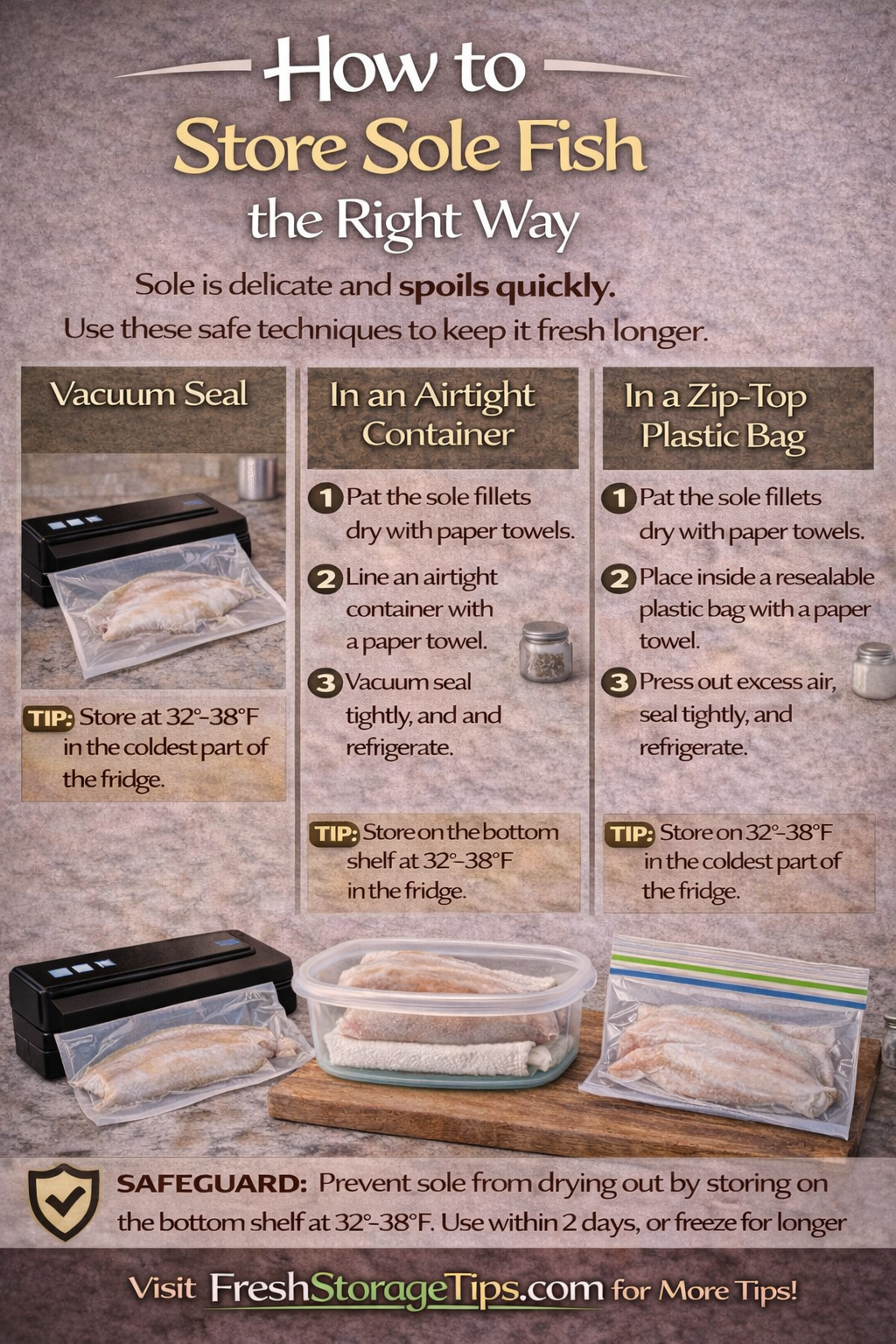
How to Store Sole Fish: Remove the fish from the store packaging and pat it thoroughly dry. Create a cold storage rig by placing a colander inside a bowl and filling it with crushed ice. Lay the sole fillets on top of the ice (separated by a plastic sheet) and cover the bowl tightly with wrap. Store in the coldest part of the fridge and drain the water daily. This keeps it fresh for 3 to 4 days.

Food Safety Tip: Flatfish bacteria multiply rapidly in warm environments. The FDA recommends maintaining a temperature below 40°F (4°C) at all times to prevent spoilage.

Fresh whole Dover Sole on a marble counter ready for prep.

The Queen of the Flatfish

Sole is often considered the royalty of the seafood world, especially the prized Dover Sole. It has a firm yet delicate texture and a sweet, nutty flavor that pairs perfectly with brown butter and lemon. Whether you are cooking a fancy Sole Meunière or a simple pan-fry of Petrale Sole, this fish is an investment. It is not cheap, and treating it poorly after you get it home is a crime against your wallet and your taste buds.

I remember my first time cooking real Dover Sole. I was so intimidated by the price tag that I wrapped it in three layers of plastic and shoved it to the back of the fridge. When I took it out two days later, it had a distinct ammonia smell. I was heartbroken. I later learned that I had essentially suffocated the fish while keeping it too warm.

Unlike round fish such as Red Snapper, flatfish like sole have a unique biology. They are thin, they have different skin textures, and they spoil differently. The key to preserving that sweet flavor is aggressive temperature control without waterlogging the meat. Let’s look at how to treat this queen of the sea with the respect she deserves.

The Science: Rigor Mortis and Texture

Sole has a fascinating relationship with freshness that sets it apart from other fish.

  • The Dover Sole Exception: Most fish are best eaten immediately. However, true Dover Sole has a very stiff rigor mortis. Chefs often prefer to let whole Dover Sole “rest” on ice for 1 or 2 days after catching. This allows the muscles to relax, making the skin easier to remove and the texture more tender. If you cook it too fresh (straight from the water), it can actually be tough. This is unique to this species.
  • Enzymatic Activity: For other varieties like Lemon Sole or Petrale Sole, the rules are standard. Enzymes in the gut and flesh are adapted to cold ocean temperatures. In a 40°F fridge, these enzymes digest the connective tissue, turning the fillet mushy. You must get the temp down to 32°F using ice to pause this breakdown.
  • Bacterial Surface Area: Fillets of sole are very thin. This gives them a huge surface area relative to their volume. This means bacteria have more space to colonize compared to a thick loin of swordfish. This is why washing and drying them before storage is non-negotiable.
Infographic showing Sole storage times: Ice Rig 4 days, Store Wrap 1 day, Freezer 6 months.

Visual Glance: The Freshness Timeline

This timeline helps you plan your elegant dinner. Sole is delicate, but with the right care, it gives you a few days of grace.

In the kitchen, sole is more fragile than grouper or sea bass. It is comparable to flounder, as they are biologically cousins. However, true Dover Sole has a thicker skin that offers slightly better protection than the thin skin of a fluke.

Storage Method Showdown

Using the ice method is the only way to get restaurant-quality results at home.

Ice Rig (Draining)
3–4 Days
Vacuum Sealed (Fridge)
2 Days
Butcher Paper
1 Day
Glazed & Frozen
6 Months
Countertop
1 Hour (Unsafe!)

Video Guide: Skinning the Beast

The Skin Barrier

This video featuring Chef Cunningham is excellent because it shows the specific challenge of Dover Sole: the skin. The skin is tough, almost like sandpaper.

Storage Takeaway: If you buy a whole fish, store it with the skin on. The skin acts as a natural wetsuit, protecting the delicate meat inside from drying out and oxidizing in the fridge. Only skin it right before you cook it.

Watch how he removes the skin; it requires a bit of force. This toughness is exactly why whole Dover Sole keeps better than delicate pre-skinned fillets.

Interactive Storage Chart

Filter by the type of sole you have. Whole fish and fillets have different requirements.

Form Best Method Safe Time Risk or Tip
Whole (Skin On) Ice Rig 4–5 Days Skin protects meat from air.
Fresh Fillets Ice Rig 2–3 Days Very delicate; do not stack high.
Sole Meunière Airtight Tub 3 Days Butter sauce may separate when reheating.
Vacuum Sealed Deep Freeze 6 Months Lean fish dries out fast in freezers.
Thawed Fridge Plate 24 Hours Cook immediately. Texture degrades fast.

Safety: The Sniff Test

Because sole is so mild, spoilage is easy to detect. Referencing FoodSafety.gov, watch for these signs:

  • ⚠️ Ammonia Smell: Fresh sole smells sweet or neutral. A sharp nose-stinging chemical smell means it is rotting. Discard it.
  • 👀 Yellowing Edges: The flesh should be white or pinkish-translucent. If the edges are turning yellow or brown, it is oxidizing.
  • ⚠️ Tacky Slime: A little moisture is fine. Thick, sticky slime that trails from your finger is a bacterial colony. Do not wash it; throw it out.

Sole Myths Busted

Let’s clear up some kitchen folklore:

  • 🚫 Myth: Fresh is always best. Reality: As noted, Dover sole benefits from 24-48 hours of rest on ice to relax the muscles. “Right out of the water” can be tough.
  • 🚫 Myth: Thaw in hot water. Reality: Sole is thin. Hot water will cook the edges instantly while the middle stays frozen. Use cold water or the fridge.
  • 🚫 Myth: All sole is the same. Reality: “Dover Sole” from the Pacific (Microstomus pacificus) is actually a flounder and is much softer than true European Dover Sole (Solea solea). Pacific sole spoils faster!

Deep Dive: Building the Ice Rig

This setup is essential for keeping the fish at 32°F. Here is the step-by-step:

  1. Equipment: Find a colander or perforated hotel pan that nests inside a solid bowl.
  2. Ice Layer: Fill the colander halfway with crushed ice.
  3. Placement: Lay the fillets on the ice. I recommend putting a piece of plastic wrap between the ice and the fish. Direct water contact can bleach the color of delicate sole.
  4. Cover: Seal the top of the bowl tightly with plastic wrap to prevent the fridge fan from drying out the fish.
  5. Drain: Check it daily. Pour out the water from the bottom bowl. If you skip this, the fish will sit in “bacteria soup.”

Freezing: The Glaze Technique

Fillets of sole are often too thin to vacuum seal without crushing them. The “glaze” method is better.

  1. Dip the fillet in ice water.
  2. Lay it flat on a parchment-lined tray and freeze for 1 hour.
  3. Dip it again and freeze again.
  4. Repeat until a thin shell of ice covers the fish.
  5. Bag the glazed fillets. This ice shell acts as a sacrificial layer against freezer burn.

Pairing Partners

Sole is almost always served with butter and herbs. Make sure your accompaniments are fresh. Check how to store butter so it is free of fridge odors, and keep your parsley crisp using herb storage tips.

Marleen's Kitchen Tools

Marleen’s Kitchen Essentials

I know that cooking premium seafood at home can feel like a high-wire act. You spend good money on beautiful ingredients like Dover Sole, and the pressure to get it right is intense. The fear of ruining it—either by letting it spoil or by overcooking it—keeps many people from enjoying these healthy meals. But over the years, I have discovered that confidence in the kitchen comes directly from having the right tools.

When you have a system in place to store and prep your fish, the anxiety disappears. The items I have curated below are the exact tools I rely on to maintain the quality of my seafood. A vacuum sealer is an absolute must-have. Air is the enemy of delicate fish, causing freezer burn and off-flavors. Sealing your fish air-tight can extend its freezer life from weeks to months. For fresh storage, having the right pans to build an “ice rig” is crucial. You need to keep the fish at 32 degrees, but you must keep it dry. A colander-and-bowl system is simple but effective.

Beyond storage, the right prep tools make the actual cooking process a breeze. A fish spatula is one of my favorite kitchen items; its thin, flexible metal edge allows you to flip even the most delicate fillet without it breaking apart. Fish bone tweezers are essential for safety, ensuring your elegant dinner isn’t interrupted by a stray bone. And proper labeling tools help you manage your freezer stock so nothing goes to waste. These small investments turn your kitchen into a space where you can handle luxury ingredients with ease and joy.

Vacuum Sealer

The best way to protect expensive fish from freezer burn.

View on Amazon

Perforated Pan Set

Essential for building a professional ice drainage rig in your fridge.

View on Amazon

Fish Spatula

Thin and flexible to slide under delicate sole fillets.

View on Amazon

Ziploc Freezer Bags

Perfect for the water displacement method if you lack a sealer.

View on Amazon

Fish Bone Tweezers

Safely remove pin bones without tearing the raw meat.

View on Amazon

Silicone Bags

Leakproof storage for marinating fillets in the fridge.

View on Amazon

Lemon Saver

Keep cut lemons fresh for serving with your Sole Meunière.

View on Amazon

Titanium Board

Odor resistant board that won’t absorb fish smells.

View on Amazon

Ninja Processor

Great for making fresh herb sauces or breadcrumbs.

View on Amazon

Date Labels

Track exactly when you froze your catch.

View on Amazon

As an Amazon Associate, I earn from qualifying purchases.

Sources & Transparency

This guide references food safety storage limits from the FDA Fish and Fishery Products Hazards Guide. Guidance on bacterial growth and seafood storage was consulted via NOAA Fisheries.

Sole lasts just 1 to 2 days in the fridge and should be cooked the same day you buy it when possible. Flounder is so similar to sole that fishmongers handle them identically — the same day-of-purchase rule applies to both. Haddock has the same short fridge window as sole but a slightly firmer texture that holds up a little better to freezing. If you need a fish option that keeps much longer, frozen fish products are a practical backup when fresh sole is not available.

Last updated:

Update Log

  • : Added specific instructions for handling whole Dover Sole skin and the benefits of resting the fish.
Marleen van der Zijl, author of FreshStorageTips.com

About the author: Marleen van der Zijl

Marleen is a mother who appreciates the finesse of a good seafood dinner. She shares her professional kitchen secrets to help you store premium ingredients with confidence.

2 comments
0 FacebookTwitterPinterestEmail
How to Store Flounder Without Spoiling marleen advice

How to Store Flounder Without Spoiling (Keep It Delicate & Fresh)

by Marleen Van Der Zijl
How to Store Flounder Without Spoiling (Keep It Delicate & Fresh)

How to Store Flounder Without Spoiling

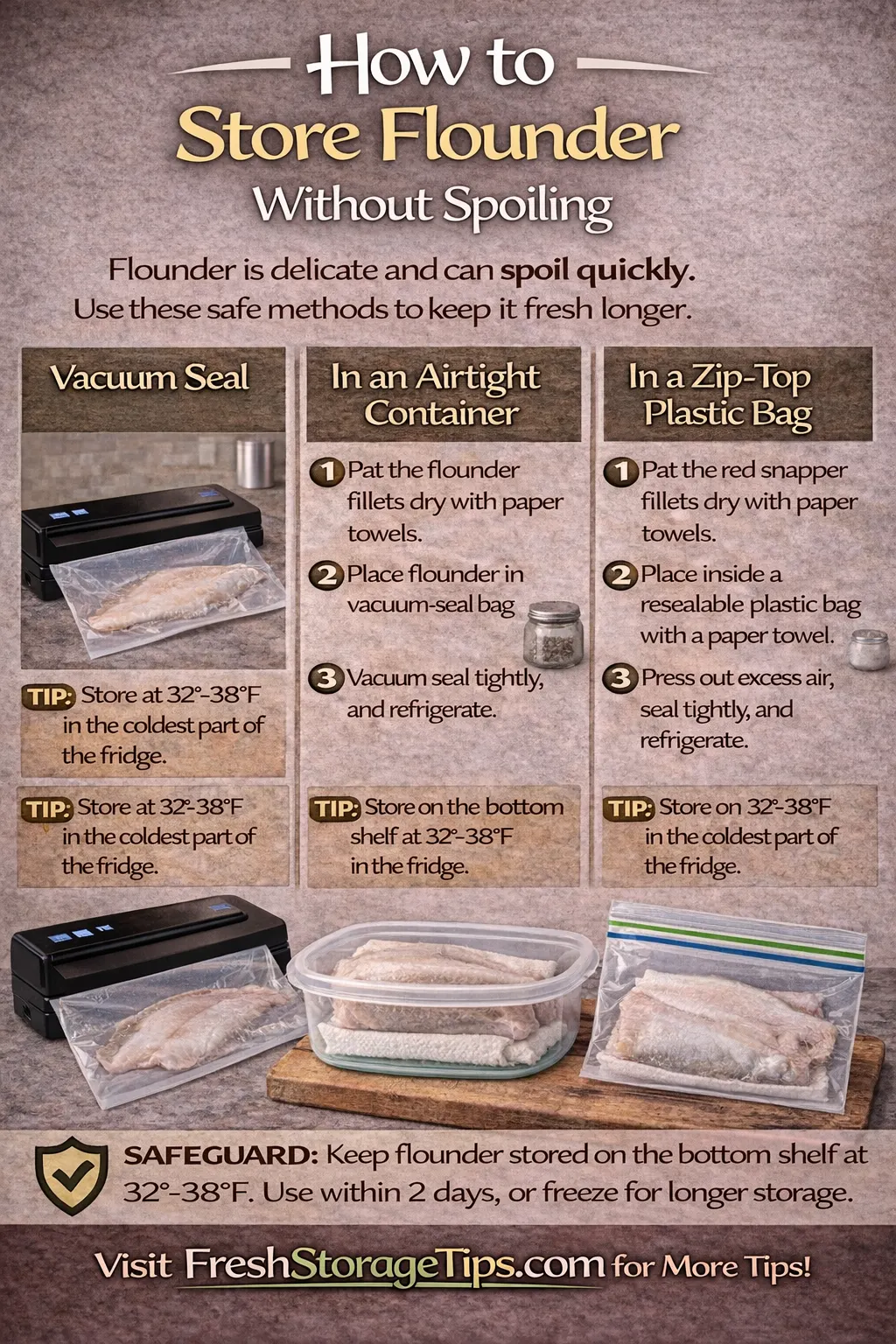
How to Store Flounder: Rinse the fillets to remove surface slime and pat them bone-dry. Place them in a colander set over a bowl filled with crushed ice. Ensure the melting ice water drains away from the fish. Cover the bowl tightly with plastic wrap and store it in the coldest part of your refrigerator. This method keeps the delicate meat fresh for 3 to 4 days.

Food Safety Tip: Flatfish like flounder have a large surface area relative to their weight. This makes them cool down fast but also warm up fast. According to the FDA, keep them constantly below 40°F (4°C) to prevent bacterial blooms.

Thin white flounder fillets on a bed of ice.

The Delicate Flatfish Dilemma

Flounder, also known as Fluke or Sole depending on the region, is one of the most delicate fish in the sea. Its meat is sweet, mild, and incredibly thin. While this makes it cook in seconds, it also means it spoils faster than almost any other fish. The thinness of the fillet means there is no dense core to hold the cold; the entire piece warms up the moment you take it out of the cooler.

I learned the hard way that you cannot treat flounder like a steak. I once bought beautiful local flounder for a Tuesday night dinner, left it in the grocery bag, and by Wednesday evening, it was a sticky, smelly mess. The disappointment was real. Unlike a thick swordfish steak that can withstand a little temperature fluctuation, flounder is unforgiving.

To keep this fish pristine, you have to manage two things: temperature and slime. Yes, slime. Flatfish have a natural protective coating that turns into a bacterial breeding ground once the fish is caught. Removing this and keeping the meat at exactly 32°F is the only way to ensure your dinner tastes like the ocean, not the pier. Let’s look at the specific steps to save your catch.

The Science: Thin Fillets and Slime

Flounder presents unique storage challenges due to its biology as a bottom-dwelling flatfish.

  • Surface Area to Volume Ratio: Because flounder fillets are so thin, they have a massive surface area compared to their weight. This means bacteria have more “real estate” to attack. In a standard 40°F fridge, surface bacteria multiply rapidly, spoiling the thin meat all the way through in hours, not days.
  • The Slime Factor: Flatfish produce a heavy mucus layer to protect their skin from the ocean floor. When harvested, this slime remains. According to seafood preservation research, this mucus is often the first place spoilage bacteria colonize. Rinsing it off and drying the fish is a critical preservation step that many home cooks skip.
  • Enzymatic Softening: The enzymes in flounder are adapted to cold water. If the fish warms up, even slightly, these enzymes dissolve the connective tissue. Since flounder connective tissue is already weak (which is why it is so tender), any enzymatic activity turns the fillet into mush. Aggressive icing is the only solution.
Infographic showing Flounder storage times: On Ice 4 days, Store Bag 1 day, Frozen 6 months.

Visual Glance: The Freshness Timeline

This timeline helps you plan. Flounder is a “buy today, eat today” fish unless you use the ice method.

In the seafood hierarchy, flounder is more fragile than sea bass or grouper. It is comparable to pollock in texture but even thinner. Treat it as the most perishable item in your grocery cart.

Storage Method Showdown

Using an “Ice Rig” is non-negotiable for keeping flounder fresh past 24 hours.

Ice Rig (Draining)
3–4 Days
Vacuum Sealed (Fridge)
2 Days
Store Packaging
1 Day
Glazed & Frozen
6 Months
Countertop
1 Hour (Unsafe!)

Video Guide: The Speed of Processing

Handling the Catch

This video is fascinating because it shows how quickly a professional can process a flounder. The speed is key—the less time the fish spends warm in the air, the better.

Storage Takeaway: Notice how thin the fillets are as they come off the bone. There is almost no fat to protect them. This reinforces why you cannot just throw them in a bag.

If you catch your own flounder (fluke), getting them on ice immediately is the most important step. If you buy them, ask the fishmonger for a bag of ice to keep them cold on the ride home. Every minute counts.

Interactive Storage Chart

Filter by the state of your fish. Whole flounder keeps slightly better than fillets because the skin protects the meat.

State Best Method Safe Time Risk or Tip
Fresh Fillet Ice Rig 3 Days Pat dry first to remove slime.
Whole (Gutted) Ice Rig 4 Days Pack belly cavity with ice.
Fried/Baked Paper Towel + Box 3 Days Reheat in oven to re-crisp skin.
Vacuum Sealed Deep Freeze 6 Months Use parchment between layers.
Thawed Fridge Plate 24 Hours Cook immediately; do not refreeze.

Safety: The Sniff Test

Spoiled flounder is not subtle. Referencing FoodSafety.gov, here is what to look for:

  • ⚠️ Ammonia Smell: Fresh flounder smells sweet and mild. If it smells sharp, chemical, or like ammonia, the proteins are rotting. Toss it.
  • ⚠️ Sticky Slime: While flatfish are naturally slimy, fresh slime is clear and slippery. Spoiled slime is thick, tacky, and cloudy/milky. If it feels like glue, it is bad.
  • 👀 Yellowing: The flesh should be translucent white or pinkish. If it turns opaque yellow or beige, it is oxidized and likely spoiled.

Flounder Myths Busted

Let’s clear up some kitchen folklore:

  • 🚫 Myth: Fresh is better than frozen. Reality: Thin fillets freeze very fast, preserving quality. High-quality frozen flounder is often better than “fresh” fish that sat in a display case for 3 days.
  • 🚫 Myth: Rinse with vinegar to clean. Reality: Acid cooks the delicate meat instantly (ceviche style). Use cold water to rinse off slime, then dry it.
  • 🚫 Myth: Thaw in water. Reality: Never thaw naked flounder fillets directly in water. They will absorb it like a sponge and fall apart. Keep them in a sealed bag.

Deep Dive: Building the Ice Rig

This is the secret to professional storage. Here is the step-by-step:

  1. Tools: You need a colander (or perforated pan) and a slightly larger bowl that the colander can sit in.
  2. Ice Base: Fill the colander halfway with crushed ice.
  3. Placement: Lay the unwrapped, dried fillets on top of the ice. Use a sheet of plastic wrap as a barrier to prevent the ice from denting the soft meat.
  4. Cover: Put more ice on top, or seal the bowl tightly with plastic wrap.
  5. Drain Daily: The ice will melt. This washes away bacteria, but you must pour the water out of the bottom bowl daily. If the fish sits in the water, it absorbs it and becomes mushy.

This keeps the fish at 32°F, maximizing shelf life.

Freezing: The Glaze Method

If you don’t have a vacuum sealer, “glazing” is the best way to freeze flounder without freezer burn.

  1. Dip the fillet in ice water.
  2. Lay it flat on a baking sheet and freeze for 1 hour.
  3. Remove it, dip it in water again, and freeze again.
  4. Repeat until a thin shell of ice coats the fish.
  5. Place the glazed fillets in a freezer bag. The ice shell protects the meat from the dry air.

Thawing Without Damage

Thawing flounder requires patience. The USDA recommends thawing in the refrigerator overnight. Place the fillets on a plate.

Warning: Do not microwave thaw flounder. The edges will cook and turn rubbery while the center stays frozen. If you are in a rush, put the sealed bag in cold water for 20 minutes.

Pairing Partners

Flounder is mild and loves butter and lemon. When you are storing your fish, check your other ingredients. Make sure you know how to store butter so it hasn’t picked up fridge odors, and keep your lemons fresh using fruit storage tips.

Marleen's Kitchen Tools

Marleen’s Kitchen Essentials

I grew up in a coastal town where fresh fish was a weekly staple, not a luxury. But even with that access, I saw how quickly a beautiful piece of flounder could go bad if it wasn’t handled right. It gave me a lifelong appreciation for the “cold chain”—that unbroken line of refrigeration from the boat to your plate. Maintaining that chain in your own kitchen is the single most important thing you can do to improve your seafood cooking.

The tools I have curated below are designed to help you do exactly that. A vacuum sealer is my top recommendation for anyone who buys seafood. Oxygen is the enemy of delicate fish like flounder, causing fat oxidation and freezer burn that ruins the texture. By removing the air, you can keep fillets tasting fresh-caught for months. For fresh storage, perforated pans are essential for building the “ice rig.” You need a system that allows melting ice to drain away, keeping the fish cold but dry. A soggy fish is a spoiled fish.

Beyond storage, preparation tools matter. A flexible fish spatula is a game-changer for thin fillets. Its wide, thin metal edge slides under the fish without tearing it, which is crucial for delicate flounder. Fish bone tweezers are a safety essential, ensuring your family dinner doesn’t end with a bone in someone’s throat. And high-quality freezer bags and date labels help you manage your inventory so you never waste food. These tools turn your kitchen into a professional workspace where you can handle seafood with confidence.

Vacuum Sealer

The best way to freeze delicate fillets without freezer burn.

View on Amazon

Perforated Pan Set

Build a professional ice drainage rig in your fridge.

View on Amazon

Fish Spatula

Thin and flexible metal flipper that won’t tear soft fish.

View on Amazon

Ziploc Freezer Bags

Essential for the water displacement method if you lack a sealer.

View on Amazon

Fish Bone Tweezers

Safely remove pin bones without tearing the raw meat.

View on Amazon

Silicone Bags

Leakproof storage for marinating fillets in the fridge.

View on Amazon

Lemon Saver

Keep cut lemons fresh for squeezing over broiled fish.

View on Amazon

Titanium Board

Odor resistant board that won’t absorb fish smells.

View on Amazon

Ninja Processor

Great for making breadcrumb stuffing for stuffed flounder.

View on Amazon

Date Labels

Track exactly when you froze your catch.

View on Amazon

As an Amazon Associate, I earn from qualifying purchases.

Sources & Transparency

This guide references food safety storage limits from the FDA Fish and Fishery Products Hazards Guide. Guidance on bacterial growth and seafood storage was consulted via NOAA Fisheries.

Flounder lasts 1 to 2 days in the fridge and up to 3 months in the freezer when wrapped in moisture-proof packaging. Sole and flounder are closely related flatfish with the same short shelf life — buying either on the day you plan to cook gives the best result. Haddock is a lean white fish with a similar fridge window to flounder, though it holds up slightly better when frozen for longer periods. When fresh flounder is not available, frozen fish products keep for up to 18 months and are a reliable alternative.

Last updated:

Update Log

  • : Added specific instructions for removing slime from flatfish and the “glazing” freezing method.
Marleen van der Zijl, author of FreshStorageTips.com

About the author: Marleen van der Zijl

Marleen is a mother who loves delicate seafood dishes. She shares her professional kitchen secrets to help you store fish safely and confidently.

0 comments
0 FacebookTwitterPinterestEmail
marleen advice How to Store Red Snapper Safely

How to Store Red Snapper Safely (Whole or Fillet)

by Marleen Van Der Zijl
How to Store Red Snapper Safely (Whole or Fillet)

How to Store Red Snapper Safely

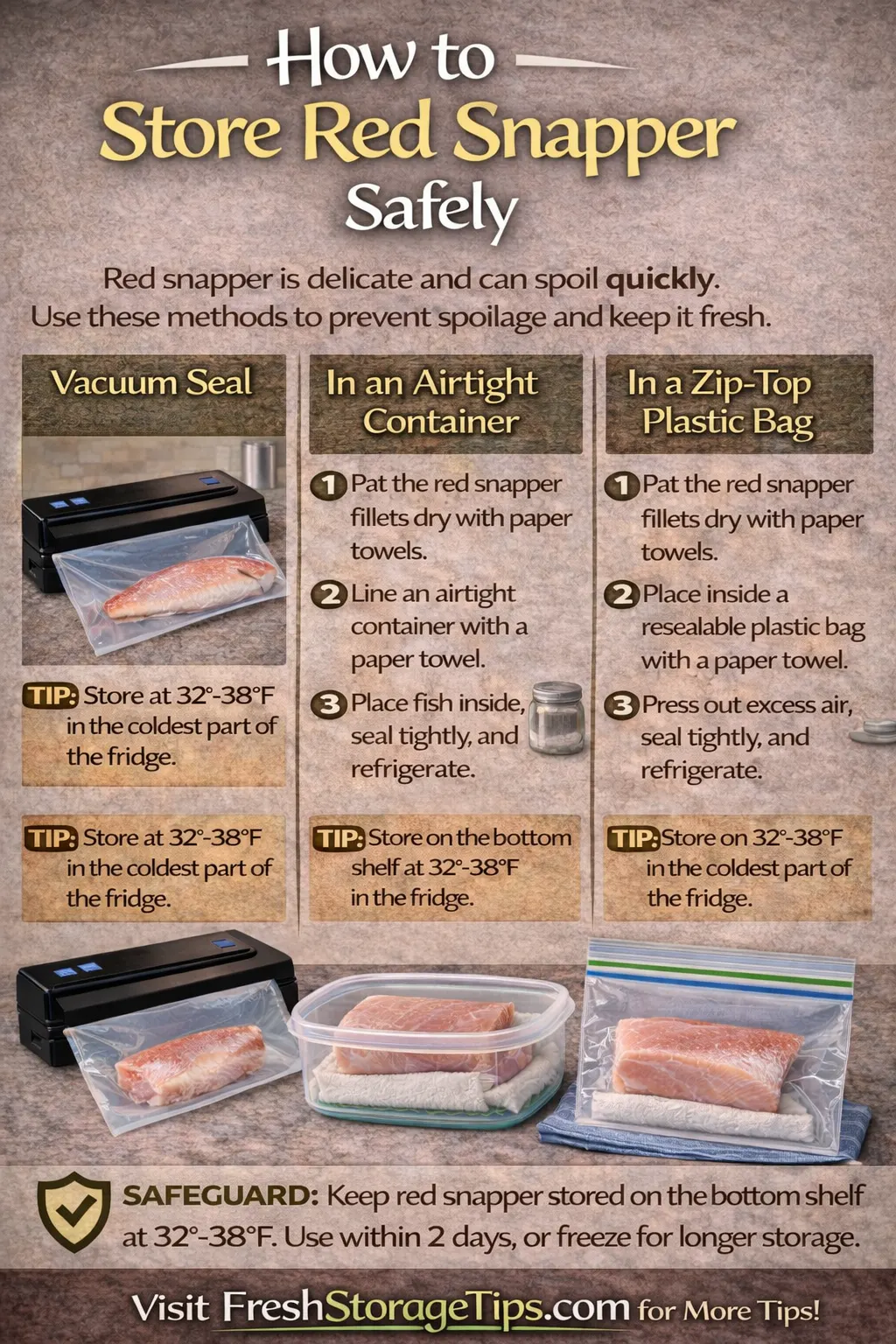
How to Store Red Snapper: Remove the fish from its packaging and pat it thoroughly dry. Prepare a drainage system by setting a colander over a bowl and filling it with crushed ice. Lay the snapper (whole or fillet) on the ice and cover it with more ice. Wrap the entire bowl in plastic wrap and store it on the bottom shelf of the refrigerator. Drain the water daily. This keeps it fresh for 3 to 5 days.

Food Safety Tip: Fish bacteria multiply rapidly above 40°F. The FDA advises keeping seafood as close to 32°F (0°C) as possible to inhibit spoilage and maintain safety.

A whole red snapper fish on a bed of ice.

The Jewel of the Gulf

Red Snapper is one of the most recognizable and prized fish in the sea. Its vibrant red skin and sweet, nutty flesh make it a centerpiece meal, whether you are roasting it whole or searing crispy-skin fillets. Because it is often sold whole, it presents a different storage challenge than your standard pre-cut fillets. Buying a whole fish is a commitment, and watching it go bad before you can cook it is a tragedy.

I remember the first time I bought a whole snapper from a local market. It looked stunning with its bright red scales. I put it on a plate in the fridge, uncovered. Two days later, the eyes were sunken and cloudy, and the smell was overpowering. I realized too late that whole fish carry more bacteria (especially in the belly cavity) and require aggressive cooling to stay fresh.

Unlike chicken or beef, which are fine at 40°F, snapper needs to be at 32°F. This is the temperature of melting ice. By mimicking the way fishmongers store their catch, you can extend the life of your snapper significantly. This allows you to buy it on a Tuesday and serve a show-stopping meal on Friday.

The Science: Why Snapper Spoils

To keep Red Snapper pristine, we have to fight biology. It is a warm-water fish, but once it is dead, it needs extreme cold to halt decomposition.

  • Enzymatic Activity: Even after the fish is caught, enzymes in the gut and flesh remain active. They begin to digest the fish from the inside out. This makes the meat mushy. Direct contact with ice slows these enzymes down to a crawl.
  • Bacterial Load: If you buy a whole snapper, the skin and the gut cavity are the main sources of bacteria. According to studies on seafood preservation, removing the guts and gills immediately is crucial because that is where spoilage starts. If you leave the organs in, the fish will spoil in half the time.
  • Lipid Oxidation: While snapper is a lean fish, the fat layer under the skin can oxidize if left exposed to air. This creates a “fishy” taste. Vacuum sealing or tight glazing prevents oxygen from reaching the fat.
Infographic showing Red Snapper storage times: On Ice 5 days, Bagged 2 days, Frozen 10 months.

Visual Glance: The Freshness Timeline

This timeline helps you plan. Snapper is robust compared to some fish, but it is not immortal.

In the world of seafood, Red Snapper is sturdier than pollock or haddock, which fall apart easily. Its skin offers a layer of protection. It stores similarly to sea bass or grouper, thriving when buried in ice. Treat it better than you treat your general seafood mixes.

Storage Method Showdown

There is a massive difference between “fridge cold” and “ice cold.” Here is the proof.

Ice Rig (Draining)
4–5 Days
Vacuum Sealed (Fridge)
2–3 Days
Butcher Paper
1–2 Days
Glazed & Frozen
10–12 Months
Countertop
2 Hours (Unsafe!)

Video Guide: Freezing for Long Term

The Glazing Technique

In this video, the method of preparing snapper for the freezer is explained. If you catch a lot of fish or buy in bulk, vacuum sealing is great, but glazing is an old-school alternative that works wonders for whole fish or fillets.

The Process: Dip the fish in ice water, freeze it for an hour, dip it again, and freeze again. Repeat this until a thick shell of ice coats the fish. This ice shell acts as a sacrificial layer.

The freezer air attacks the ice shell instead of the fish meat, preventing freezer burn for months. This is how commercial fisheries keep their product pristine.

Interactive Storage Chart

Filter by the cut. Whole fish need more attention to the cavity, while fillets are easier to manage.

State Best Method Safe Time Risk or Tip
Whole (Gutted) Ice Rig 4–5 Days Pack ice inside the belly cavity.
Fresh Fillet Ice Rig 2–3 Days Keep dry; do not let it float in water.
Roasted/Fried Airtight Tub 3 Days Skin will lose crispness. Reheat in oven.
Vacuum Sealed Deep Freeze 10 Months Remove air to prevent fat oxidation.
Thawed Fridge Plate 24 Hours Do not refreeze raw snapper.

Safety: Checking Your Snapper

Bad fish can make you very sick. According to FoodSafety.gov, these are the signs of spoilage:

  • ⚠️ Cloudy Eyes: On a whole fish, the eyes are the first giveaway. They should be clear, bright, and bulging. If they are sunken, gray, or cloudy, the fish is old.
  • ⚠️ Ammonia Smell: Snapper should smell mild. If you catch a whiff of ammonia or sulfur, the proteins are decomposing. Discard it.
  • 👀 Brown Gills: Lift the gill cover. The gills should be bright red or pink. If they are brown, gray, or slimy, the fish has been out of water too long.

Snapper Myths Busted

Let’s clear up some kitchen folklore:

  • 🚫 Myth: Leaving guts in keeps it fresh. Reality: Absolutely not. The enzymes in the stomach digest the fish from the inside out. Gutting it immediately is the most important step for preservation.
  • 🚫 Myth: Rinse with vinegar to clean. Reality: Acid cooks the meat (ceviche style). Use cold water to rinse, then dry it thoroughly. Keep vinegar for the cooking process.
  • 🚫 Myth: Freezer burn is mold. Reality: Freezer burn is dehydration. It is safe to eat but tastes like cardboard. You can trim it off, but prevention (glazing or vacuum sealing) is better.

Deep Dive: Building the Ice Rig

The “Ice Rig” is the only way to store fresh fish for more than a day. Here is the step-by-step:

  1. Tools: Find a colander that fits inside a larger bowl. There must be space between the two bottoms.
  2. Ice Base: Fill the colander halfway with crushed ice.
  3. Placement: Lay the snapper on the ice. If storing a whole fish, stuff the belly cavity with ice as well. This cools it from the inside out.
  4. Cover: Bury the fish in more ice.
  5. Drain Daily: The ice will melt. This is good because it washes away bacteria. However, you must pour the water out of the bottom bowl every day so the fish doesn’t sit in dirty water.

This method keeps the fish at 32°F, maximizing shelf life.

Thawing Frozen Snapper

Thawing correctly is vital. The USDA recommends thawing in the refrigerator for 24 hours. Place the fish on a plate to catch any liquid.

The Cold Water Method: If you are in a rush, place the sealed bag in a bowl of cold water. Change the water every 30 minutes. Do not use warm water, or the fish will start to cook and spoil.

What About the Scales?

If you buy a whole snapper, ask the fishmonger to scale it for you. Storing a fish with scales is fine, but scaling a cold, stiff fish at home makes a huge mess. If you must scale it at home, do it under running water to keep the scales from flying everywhere. Store the scaled fish wrapped tight.

Marleen's Kitchen Tools

Marleen’s Kitchen Essentials

I believe that cooking whole fish like Red Snapper is one of the most rewarding skills a home cook can master. It looks impressive on the table, it is often cheaper than buying fillets, and the flavor is superior because cooking on the bone keeps the meat moist. However, I also know it can be intimidating. The scales, the bones, and the storage requirements can scare people back to the frozen fish stick aisle.

The tools I have curated below are designed to remove that intimidation factor. They are the exact items I use to handle whole fish safely and cleanly. A good pair of kitchen shears is essential for trimming sharp fins before you start cooking, preventing painful pricks. A sturdy fish scaler with a cover helps you prep the fish without covering your entire kitchen in flying scales. For storage, the “ice rig” requires a perforated pan or colander that fits inside a catch bowl. This simple setup is the secret to keeping fish fresh for days, not hours.

Furthermore, managing your freezer inventory is key to saving money. A vacuum sealer is the best investment for preserving the quality of fish you might not cook immediately. Oxygen causes freezer burn and fat oxidation, which leads to that “old fish” taste. Removing the air keeps the snapper tasting fresh-caught for up to a year. Clear labels help you track dates so you can rotate your stock like a pro. These tools turn the challenge of handling whole fish into a manageable, satisfying routine that allows you to feed your family better food for less money.

Vacuum Sealer

The gold standard for freezing fish without freezer burn.

View on Amazon

Perforated Pan Set

Build a professional ice drainage rig in your fridge.

View on Amazon

Fish Spatula

Thin metal flipper that won’t break delicate whole fish.

View on Amazon

Ziploc Freezer Bags

Great for the water displacement method if you lack a sealer.

View on Amazon

Fish Bone Tweezers

Safely remove pin bones without tearing the raw meat.

View on Amazon

Silicone Bags

Leakproof storage for marinating fillets in the fridge.

View on Amazon

Lemon Saver

Keep cut lemons fresh for serving with your snapper.

View on Amazon

Titanium Board

Odor resistant board that won’t absorb fish smells.

View on Amazon

Ninja Processor

Great for making stuffing for whole roasted fish.

View on Amazon

Date Labels

Track exactly when you froze your catch.

View on Amazon

As an Amazon Associate, I earn from qualifying purchases.

Sources & Transparency

This guide references food safety storage limits from the FDA Fish and Fishery Products Hazards Guide. Guidance on bacterial growth and seafood storage was consulted via NOAA Fisheries.

Red snapper lasts 1 to 2 days in the fridge at 32 to 38°F and up to 6 months in the freezer when double-wrapped in plastic and foil. Sea bass has almost the same shelf life as red snapper and benefits from the same cold, damp storage method in the fridge. Grouper is the closest match to red snapper in terms of texture, fat content and how quickly it spoils. Fattier fish like salmon spoil faster than red snapper because fat oxidises more quickly always use the sniff test before cooking any fish stored for more than a day.

Last updated:

Update Log

  • : Added tips for storing whole fish (gutting and gill removal) and the glazing freezing method.
Marleen van der Zijl, author of FreshStorageTips.com

About the author: Marleen van der Zijl

Marleen is a mother who loves the presentation of a whole roasted snapper. She shares her professional kitchen secrets to help you store and prep seafood with confidence.

1 comment
0 FacebookTwitterPinterestEmail
advice How to Store Grouper So It Stays Fresh

How to Store Grouper So It Stays Fresh

by Marleen Van Der Zijl
How to Store Grouper So It Stays Fresh (Keep It Firm)

How to Store Grouper So It Stays Fresh

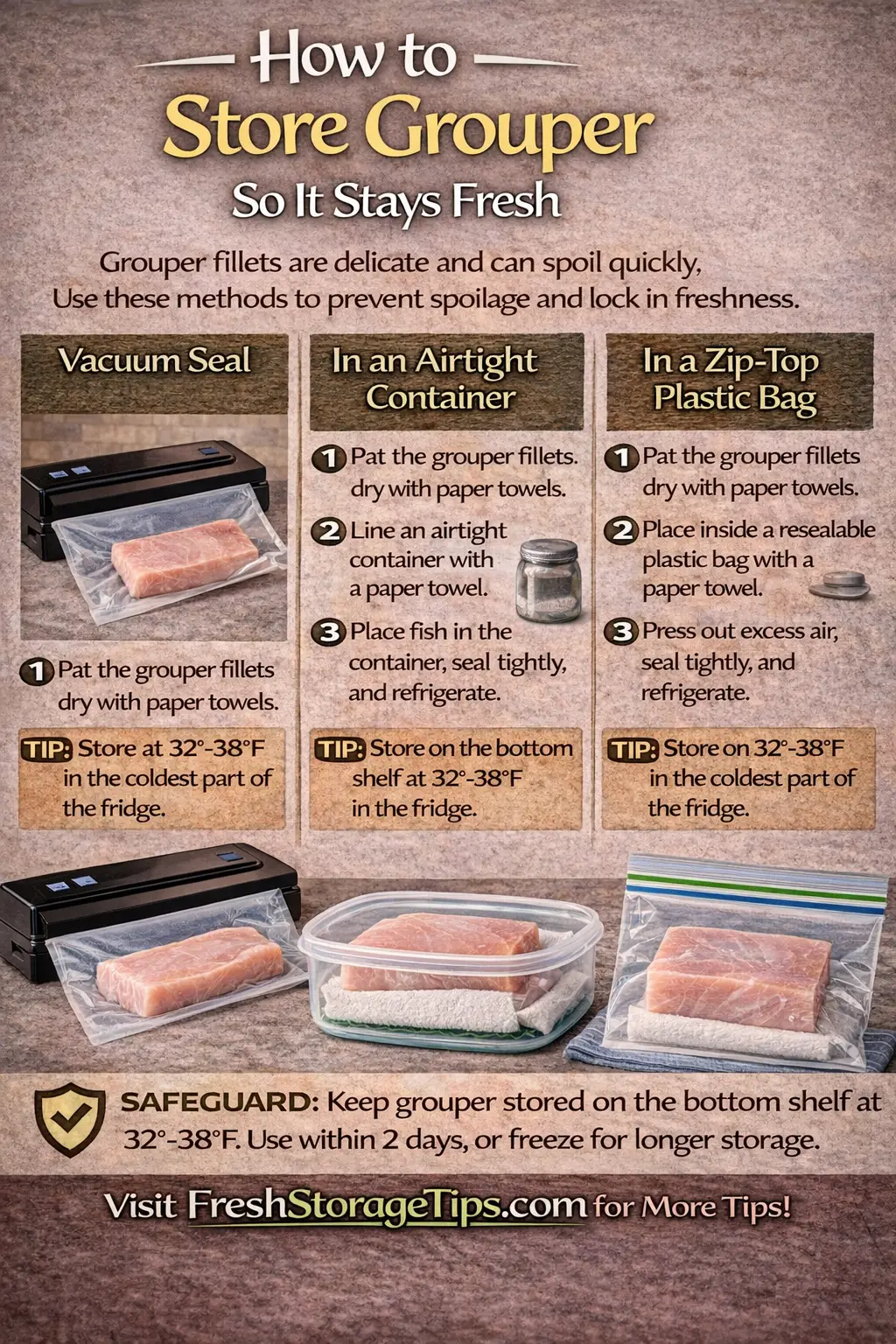
How to Store Grouper: Remove the fish from the store packaging and dry it thoroughly. Set up a “false bottom” in a bowl using a colander and fill it with crushed ice. Lay the grouper fillets, cheeks, or collars on the ice and cover the bowl with plastic wrap. Store in the coldest part of the fridge (usually the back bottom shelf). This method keeps the fish safe for 3 to 5 days.

Food Safety Tip: Grouper is a large reef fish. According to the FDA, maintaining a temperature below 40°F (4°C) is critical to prevent the growth of spoilage bacteria.

Fresh white grouper fillets and cheeks on a cutting board.

The Prize of the Reef

Grouper is one of the most sought-after fish in the sea. Whether it is a Black Grouper, a Red Grouper, or the deep-water Yellow Edge Grouper, the meat is prized for its large flakes, sweet flavor, and moisture retention. It is firm enough to grill but tender enough to flake with a fork. Bringing home a fresh grouper fillet, or perhaps even a whole fish if you are lucky enough to fish yourself, is a special occasion.

I remember the first time my husband came home with a fresh catch. We were so excited that we just put the bag in the fridge, thinking it would be fine until the weekend. By Saturday, that sweet smell of the ocean had turned sour. We had to throw away pounds of premium meat. It was a hard lesson to learn. A standard refrigerator is simply not cold enough for raw fish.

To keep grouper tasting like it just came out of the water, you have to treat it differently than chicken or pork. You need to manage the temperature aggressively. Fish spoils from the outside in, and the enzymes inside the meat are waiting for a temperature rise to start breaking down the fibers. Let’s look at how to pause that process so you can enjoy every bite.

The Science: Large Flake Preservation

Grouper has a unique muscle structure compared to other fish. Understanding this helps you store it better.

  • Connective Tissue: Grouper has thick connective tissue that gives it those large, distinct flakes. When this tissue breaks down due to enzymes or heat, the fish becomes mushy. Keeping the temperature at 32°F (0°C) keeps this tissue firm. Standard fridge temperature (40°F) is too warm to stop this softening process.
  • Surface Bacteria: The skin and surface of the fish naturally carry bacteria. According to seafood safety studies, these populations explode in humid, stagnant air (like a closed plastic bag). You need air circulation or direct ice contact to inhibit them.
  • Oxidation: While grouper is a lean fish, the surface can dry out and oxidize, turning yellow or beige if left uncovered. You want to protect it from the dry air of the fridge fan while keeping it cold.
Infographic showing Grouper storage times: Ice Method 5 days, Bagged 2 days, Frozen 12 months.

Visual Glance: The Freshness Timeline

This timeline helps you plan your seafood dinners. Grouper is robust, but it still has limits.

In terms of shelf life, grouper generally outlasts more delicate fish like pollock or haddock because the meat is denser. It stores similarly to halibut or sea bass. However, it is not as oily as salmon, so it can dry out if you aren’t careful.

Storage Method Showdown

Using the ice method is the professional standard. Here is how it compares to other ways you might try to store it.

Ice Rig (Draining)
4–5 Days
Vacuum Sealed (Fridge)
2–3 Days
Butcher Paper
1–2 Days
Vacuum Sealed (Freezer)
10–12 Months
Countertop
2 Hours (Danger!)

Video Guide: Breaking Down the Whole Fish

Beyond the Fillet

This video is incredible because it shows you parts of the grouper you might not see at a standard supermarket. The fishmonger breaks down a massive Yellow Edge Grouper.

Storage Takeaway: Pay attention to the “cheeks” and the “throat” (or collar). These are considered delicacies. Because they are irregular shapes, they can be harder to store than flat fillets. The best way to store these odd cuts is to vacuum seal them individually or bury them deep in the ice rig to ensure the cold penetrates their dense structure.

He also mentions removing the “bloodline” or red meat. For storage purposes, trimming this red meat off before you store the fish can extend its life, as the bloodline spoils faster than the white meat.

Interactive Storage Chart

Filter by the cut of the grouper. Cheeks are denser than fillets and freeze exceptionally well.

Cut Best Method Safe Time Risk or Tip
Fresh Fillet Ice Rig 4 Days Keep dry; moisture ruins texture.
Grouper Cheeks Vacuum Seal 5 Days Dense meat lasts longer than fillets.
Fried/Blackened Paper Towel + Box 3 Days Reheat in oven to crisp up.
Frozen Fillet Deep Freeze 12 Months Remove bloodline before freezing.
Thawed Fridge Plate 24 Hours Cook immediately once thawed.

Safety: The Sniff Test

Consuming spoiled fish can cause serious illness. Referencing FoodSafety.gov, here are the signs your grouper has turned:

  • ⚠️ Ammonia Odor: This is the most reliable sign. If you open the bag and it smells sharp, chemical, or like ammonia, the proteins are decomposing. Toss it.
  • ⚠️ Milky Coating: Run your finger over the fillet. It should feel moist but clean. If there is a thick, milky, or sticky slime, bacteria are present.
  • 👀 Dullness: Fresh grouper is translucent and glistening. If it looks matte, opaque, or dry, it is past its prime. It might be safe, but it will be tasteless.

Grouper Myths Busted

Let’s clear up some kitchen folklore:

  • 🚫 Myth: It stores like Mahi Mahi. Reality: While similar, grouper is generally thicker and has larger flakes. It is slightly more forgiving of temperature than Mahi Mahi, but still needs ice.
  • 🚫 Myth: You can refreeze it. Reality: Refreezing raw fish destroys the cell structure. The moisture expands, breaks the cell walls, and turns your firm grouper into mush. Cook it first, then refreeze.
  • 🚫 Myth: The red meat is poison. Reality: The bloodline is safe to eat, but it has a stronger, iron-like flavor. Most people trim it off for a cleaner taste, but it is not harmful.

Deep Dive: Building the Ice Rig

This is the secret to keeping fish fresh for nearly a week. Here is the step-by-step:

  1. Equipment: You need a colander (or perforated pan) and a slightly larger bowl that the colander can sit in.
  2. Ice Base: Fill the colander halfway with ice.
  3. Placement: Lay your dried grouper fillets on top of the ice. You can put a piece of plastic wrap between the fish and ice if you prefer.
  4. Cover: Put more ice on top, or seal the bowl tightly with plastic wrap.
  5. Drain: This is crucial. Every day, pour the melted water out of the bottom bowl. If the fish sits in water, it will absorb it and become waterlogged and bland.

This keeps the fish at 32°F, which is much colder than the 40°F air in your fridge.

Freezing Without Freezer Burn

If you cannot eat the grouper within 3 days, freeze it. The best method is vacuum sealing. This removes all air, preventing ice crystals from forming on the meat. If you don’t have a sealer, use the “water immersion” method: put the fish in a Ziploc bag, lower it into a bowl of water (keeping the opening above water) to push the air out, and seal it.

Pairing Partners

Grouper is often served with acidic or fresh sides. When you are storing your fish, check your other ingredients. Make sure you know how to store fresh herbs like cilantro or parsley, and ensure your lemons are fresh by checking fruit storage tips.

Marleen's Kitchen Tools

Marleen’s Kitchen Essentials

I have always believed that the difference between a good home cook and a great one is often just the tools they have at their disposal. When you are dealing with premium ingredients like fresh Grouper, having the right equipment isn’t a luxury; it is a necessity to protect your investment. I used to think I could get by with just plastic wrap and a plate, but I lost so much money on spoiled fish that I finally upgraded my kitchen setup.

The items I have selected below are the exact tools I use to maintain the “cold chain” for my seafood. A vacuum sealer is my number one recommendation. Oxygen causes oxidation and freezer burn, turning a beautiful white fillet into a dry, yellow disappointment. Removing the air keeps the fish pristine for months. For fresh storage, having a dedicated set of perforated pans or colanders to build an “ice rig” is vital. You need to keep the fish at 32 degrees, but you also need to keep it dry. A standard bowl just lets the fish swim in bacteria-laden meltwater.

Beyond storage, preparation is key. A flexible fish spatula is essential for handling flaky fish like grouper without breaking it apart in the pan. Fish bone tweezers are a safety must-have, especially if you have children. And clear, durable freezer bags and date labels help you manage your inventory so you never have to guess how old that package in the freezer is. These tools give you the confidence to buy whole fish or large fillets, knowing you can store and prep them like a professional.

Vacuum Sealer

The ultimate tool for preventing freezer burn on expensive fish.

View on Amazon

Perforated Pan Set

Perfect for building a professional ice drainage rig in your fridge.

View on Amazon

Fish Spatula

Thin and flexible to slide under delicate grouper fillets.

View on Amazon

Ziploc Freezer Bags

Essential for the water displacement method if you lack a sealer.

View on Amazon

Fish Bone Tweezers

Safely remove pin bones without tearing the raw meat.

View on Amazon

Silicone Bags

Leakproof storage for marinating fillets in the fridge.

View on Amazon

Lemon Saver

Keep cut lemons fresh for squeezing over cooked fish.

View on Amazon

Titanium Board

Odor resistant board that won’t absorb fish smells.

View on Amazon

Ninja Processor

Great for making fresh herb sauces or fish cakes.

View on Amazon

Date Labels

Track exactly when you froze your catch.

View on Amazon

As an Amazon Associate, I earn from qualifying purchases.

Sources & Transparency

This guide references food safety storage limits from the FDA Fish and Fishery Products Hazards Guide. Guidance on bacterial growth and seafood storage was consulted via NOAA Fisheries.

Fresh grouper lasts 1 to 2 days in the fridge and up to 6 months in the freezer when wrapped tightly. Sea bass has an almost identical shelf life to grouper and can be stored using exactly the same ice-bed method in the coldest part of your fridge. Swordfish is a meatier fish that also stays fresh for 1 to 2 days refrigerated, though its thicker flesh means it holds up slightly better if your fridge runs a little warm. For other firm white fish with comparable storage windows, halibut follows the same ice-bed storage method as grouper.

Last updated:

Update Log

  • : Added specific sections on storing grouper cheeks and throats, and the importance of the ice rig.
Marleen van der Zijl, author of FreshStorageTips.com

About the author: Marleen van der Zijl

Marleen is a mother who knows the value of fresh ingredients. She shares her professional kitchen secrets to help you store expensive seafood safely and deliciously.

2 comments
0 FacebookTwitterPinterestEmail
How to Store Swordfish Without

How to Store Swordfish Without It Drying Out

by Marleen Van Der Zijl
How to Store Swordfish Without It Drying Out (Juicy Steaks)

How to Store Swordfish Without It Drying Out

How to Store Swordfish: Remove the steaks from the store packaging and pat them dry. Place them in a colander over a bowl of crushed ice, ensuring water drains away from the meat. Cover the bowl tightly with plastic wrap to prevent drying and store in the bottom of the fridge. This keeps the fish fresh and safe for 3 to 4 days.

Food Safety Tip: Swordfish is susceptible to histamine development (scombroid poisoning) if it gets warm. The “The FDA recommends keeping swordfish below 40°F (4°C) at all times to reduce the risk of histamine formation.”

Thick swordfish steaks with lemon and herbs on a bed of ice.

The Steak of the Sea

Swordfish is often called the “steak of the sea” because of its incredibly dense, meaty texture. Unlike flaky white fish, swordfish holds up on the grill just like a beef steak. It is a premium protein, often costing upwards of $25 per pound, which makes bringing it home a bit stressful. You want to ensure that investment makes it to the dinner table in perfect condition.

I recall buying two beautiful swordfish steaks for a weekend barbecue. I left them in the butcher paper in the fridge for two days. When I unwrapped them, the edges were curled and dry, and there was a faint chemical smell. I had to trim away nearly a quarter of the steak to get to the good meat. It was a waste that could have been avoided.

Because swordfish is a large, predatory fish, it has different biological properties than smaller fish. It spoils differently and carries specific risks if not kept ice-cold. Whether you are marinating it for kebabs or grilling it whole, temperature control is the single most important factor. Let’s look at how to keep your swordfish juicy and safe.

The Science: Histamines and Texture

Storing swordfish correctly is a matter of both food safety and texture preservation. It belongs to a category of fish that requires strict temperature management.

  • Scombroid Poisoning Risk: Swordfish, like tuna and Mahi Mahi, is susceptible to scombroid poisoning. This happens when bacteria on the fish convert an amino acid called histidine into histamine. This conversion happens rapidly at temperatures above 40°F. Once histamine forms, you cannot cook it out. It causes an allergic-like reaction. Keeping the fish on ice (32°F) is the only way to stop this process completely.
  • Dense Muscle Fibers: Swordfish has a tight muscle structure. In the dry environment of a refrigerator, moisture evaporates from the surface quickly, creating a tough, jerky-like “pellicle” on the outside. This is why tight wrapping is essential after the fish is chilled.
  • Bloodline Oxidation: You will notice a dark red area on the steak. This is the bloodline, a muscle rich in myoglobin. This area oxidizes (turns brown) and develops a strong “fishy” flavor much faster than the white meat. Trimming this before storage or cooking can improve the flavor profile significantly.
Infographic showing Swordfish storage times: On Ice 4 days, Fridge 2 days, Freezer 9 months.

Visual Glance: The Freshness Timeline

This timeline helps you plan your grilling schedule. Swordfish is robust, but it still has a ticking clock.

Compared to other fish, swordfish is hardier than delicate haddock or pollock. Its dense meat allows it to last an extra day or two if handled correctly. It behaves similarly to salmon, though it has less fat to protect it from drying out.

Storage Method Showdown

The “Ice Rig” is the only method I recommend for fish this expensive. Here is why.

Ice Rig (Draining)
3–4 Days
Vacuum Sealed (Fridge)
2–3 Days
Butcher Paper
1–2 Days
Vacuum Sealed (Freezer)
6–9 Months
Countertop
2 Hours (Unsafe!)

Video Guide: Chef Tips for Swordfish

Handling the Meat

In this video, Chef Evan Deluty demonstrates how to handle swordfish. While he focuses on cooking, pay attention to the texture of the raw fish he uses.

Storage Takeaway: Notice how firm and moist the meat is. If your swordfish looks dried out or is separating, it has been stored improperly. He also discusses the “bloodline” (the dark red part). For storage, bacteria love this nutrient-rich bloodline. If you plan to store the fish for more than 2 days, trimming that red part off before storage can actually help the rest of the white meat stay fresh longer.

Treating the fish gently and keeping it cold ensures that when it hits the hot pan, it sears beautifully rather than steaming in its own breakdown fluids.

Interactive Storage Chart

Filter by the state of your fish. Cooked swordfish is excellent in salads and stores easily.

State Best Method Safe Time Risk or Tip
Fresh Steak Ice Rig 3–4 Days Trim red bloodline for milder flavor.
Grilled/Seared Airtight Tub 3–4 Days Great cold in salads; don’t overheat.
Thawed Plate in Fridge 24 Hours Cook immediately. Do not refreeze.
Vacuum Sealed Deep Freeze 9 Months Remove air to prevent oxidation.
Store Wrapped Fridge Shelf 1–2 Days Transfer to ice ASAP.

Safety: The Nose Knows

Swordfish spoilage is dangerous due to histamine risks. Referencing FoodSafety.gov, here are the warning signs:

  • ⚠️ Ammonia Smell: Fresh swordfish smells mildly salty. If you detect ammonia, sulfur, or a “sour” odor, it is unsafe. Do not attempt to wash it off.
  • ⚠️ Slimy Surface: The flesh should be moist but not sticky. If there is a tacky, slimy coating that feels slick, bacteria colonies are established.
  • 👀 Brown Edges: If the white meat is turning brown or gray at the edges (unrelated to the bloodline), it is oxidizing and drying out. Trim these parts before cooking if the smell is okay.

Swordfish Myths Busted

Let’s clear up some kitchen folklore:

  • 🚫 Myth: Lemon juice preserves it. Reality: Acid “cooks” the surface (ceviche) and changes the texture. It does not prevent histamine formation. Store plain.
  • 🚫 Myth: Thaw in the microwave. Reality: This ruins the texture of dense fish like swordfish, making it rubbery. Thaw in the fridge or cold water only.
  • 🚫 Myth: The red part is bad. Reality: The red bloodline is safe to eat, though it has a stronger, iron-like flavor. Some people remove it for a milder taste, but it is not “spoiled.”

Deep Dive: Building the Ice Rig

This is the best way to keep swordfish at 32°F in a 40°F fridge. Here is how:

  1. Get Two Bowls: Find a colander that fits inside a larger solid bowl. There must be space between them for drainage.
  2. Add Ice: Fill the colander halfway with crushed ice.
  3. Place Fish: Lay the unwrapped, dried steaks on top of the ice. Use a sheet of plastic wrap as a barrier if you prefer.
  4. Cover: Place more ice on top or cover the bowl tightly with plastic wrap.
  5. Drain Daily: As the ice melts, the water drips into the bottom bowl. Empty this daily. Standing water breeds bacteria.

This method keeps the fish safe and prevents the formation of histamines.

Freezing Swordfish: Vacuum is King

Because swordfish steaks are thick and dense, they freeze very well. However, they are prone to oxidation. A vacuum sealer is the best tool here.

If you don’t have one, use the water displacement method: put the fish in a Ziploc bag, submerge the bag in water (without letting water inside) to push the air out, and seal. This is better than just zipping it shut.

Thawing Without Loss

Thawing swordfish slowly is crucial. Place the frozen steak on a plate in the fridge for 24 hours. If you are in a rush, submerge the sealed bag in cold water for 30-45 minutes. Never use warm water, or the texture will become mushy.

Marleen's Kitchen Tools

Marleen’s Kitchen Essentials

Swordfish is a premium protein, often costing as much as a good ribeye steak. When I spend that kind of money on a meal, I want to ensure it is perfect. I used to be afraid of freezing expensive fish, thinking it would ruin the texture. But once I invested in the right tools, I realized that I could buy seafood on sale, freeze it properly, and enjoy a high-end dinner on a Tuesday night for half the price.

The items I have selected below are the exact tools I use to protect my investment. A vacuum sealer is the most important one. Swordfish steaks are thick and have a bloodline that oxidizes easily. A vacuum sealer removes the oxygen that causes this discoloration and “fishy” taste, keeping the steak fresh in the freezer for months. For fresh storage, perforated pans allow me to build the “ice rig” I mentioned earlier. This keeps the fish at a safe 32°F without waterlogging it, which is something a standard Tupperware container simply cannot do.

Beyond storage, I have included prep tools that make cooking easier. A sturdy fish spatula is essential for flipping heavy swordfish steaks on the grill without them sticking or breaking. Fish bone tweezers are a safety must-have; finding a bone in a steak can ruin the experience. And clear freezer labels help you practice “first-in, first-out” inventory management, so you never waste food. These tools pay for themselves by preventing waste and giving you the confidence to cook restaurant-quality seafood at home.

Vacuum Sealer

The #1 tool for freezing steaks without oxidation or burn.

View on Amazon

Perforated Pan Set

Build a professional ice drainage rig in your fridge.

View on Amazon

Fish Spatula

A thin, flexible turner that slides under steaks easily.

View on Amazon

Ziploc Freezer Bags

Essential for the water displacement method if needed.

View on Amazon

Fish Bone Tweezers

Remove tough bones from the steak safely.

View on Amazon

Silicone Bags

Leakproof storage for marinating steaks in the fridge.

View on Amazon

Lemon Saver

Keep cut lemons fresh for squeezing over grilled fish.

View on Amazon

Titanium Board

Odor resistant board that won’t absorb fish smells.

View on Amazon

Ninja Processor

Great for making pestos or rubs for the fish.

View on Amazon

Date Labels

Track exactly when you froze your steaks.

View on Amazon

As an Amazon Associate, I earn from qualifying purchases.

Sources & Transparency

This guide references food safety storage limits from the FDA Fish and Fishery Products Hazards Guide. Guidance on bacterial growth, histamine formation, and seafood storage was consulted via NOAA Fisheries.

Swordfish lasts 1 to 2 days in the fridge and 3 to 4 months in the freezer — slightly less than leaner fish because its higher fat content means it can go rancid faster. Sea bass is leaner and similar in texture to swordfish, with the same 1 to 2 day fridge window. Grouper is another firm-fleshed fish that stores identically to swordfish in both the fridge and freezer. The most commonly stored fish at home is salmon, which lasts up to 3 months frozen here’s how that compares to swordfish.

Last updated:

Update Log

  • : Added critical safety information regarding scombroid poisoning and detailed the “Ice Rig” method.
Marleen van der Zijl, author of FreshStorageTips.com

About the author: Marleen van der Zijl

Marleen is a mother who loves a good seafood dinner. She shares her professional kitchen secrets to help you store expensive ingredients safely.

3 comments
0 FacebookTwitterPinterestEmail
How to Store Pollock

How to Store Pollock for Best Freshness

by Marleen Van Der Zijl
How to Store Pollock for Best Freshness (Flaky & Mild)

How to Store Pollock for Best Freshness

How to Store Pollock: Remove the fillets from the store packaging immediately. Pat them dry with paper towels. Place the fish in a colander set over a bowl of crushed ice, ensuring the meltwater drains away from the fillets. Cover tightly with plastic wrap and store in the coldest part of your fridge. Use within 2 to 3 days.

Food Safety Tip: Pollock is a delicate cold-water fish. The FDA advises keeping seafood below 40°F (4°C), but getting it closer to 32°F (0°C) with ice is critical for maintaining its soft texture.

Fresh raw pollock fillets on a bed of crushed ice.

The Underrated White Fish

Pollock often gets a bad reputation as merely the filling for fish sticks or imitation crab, but a fresh fillet of Alaskan Pollock is a wonderful ingredient in its own right. It is flaky, mild, and incredibly sustainable. However, it is also one of the softest and most fragile fish in the market. If you treat it like a hearty steak of salmon, you will be disappointed.

I remember buying a large pack of fresh pollock fillets because the price was unbeatable. I left them in their foam tray in the fridge for two days. When I opened the package, the fillets had practically disintegrated into a mushy, watery mess that smelled strong. I learned then that pollock has a much shorter shelf life than its cousin, the cod. It requires gentle handling and very cold temperatures to hold its shape.

pollock has a slightly looser muscle structure and marginally more surface fat than cod and a looser muscle structure, it breaks down rapidly once out of the water. To keep it firm enough for frying or baking, you need to master the art of the “Ice Rig.” This simple setup mimics the conditions of a professional fishmonger’s case right in your home kitchen.

The Science: Soft Flesh Spoilage

To keep pollock fresh, we have to fight its natural biology. It is a Gadoid fish (related to cod and haddock), but it has unique challenges.

  • Enzymatic Softening: The enzymes in pollock are adapted to deep, cold waters. In your 40°F fridge, these enzymes are hyperactive. They break down the connective tissue between the flakes much faster than in other fish. This is why pollock turns “mushy” so quickly. Reducing the temperature to 32°F puts these enzymes to sleep.
  • Higher Oil Content: While still considered a white fish, pollock has slightly more oil than cod. This oil is rich in omega-3s, but it also oxidizes when exposed to air, leading to “fishy” odors faster. Keeping the fish wrapped tight or buried in ice protects these oils.
  • Bacterial Growth: Surface bacteria multiply exponentially as the temperature rises. According to studies on seafood preservation, keeping fish at 32°F instead of 40°F can double its usable shelf life. For a fish as delicate as pollock, this is the difference between a delicious dinner and the garbage bin.
Infographic showing Pollock storage times: On Ice 3 days, Fridge 1 day, Freezer 6 months.

Visual Glance: The Freshness Timeline

This timeline helps you plan your meals. Pollock is not a fish you can buy on Sunday for a Friday dinner. It needs to be eaten quickly.

Compared to other white fish, pollock is more fragile than haddock and significantly softer than sea bass. It shares a similar vulnerability with halibut, but because the fillets are usually thinner, they dry out even faster.

Storage Method Showdown

Using ice is the only way to get more than 24 hours of quality shelf life.

Ice Rig (Draining)
2–3 Days
Vacuum Sealed (Fridge)
1–2 Days
Store Packaging
1 Day
Glazed & Frozen
6 Months
Countertop
2 Hours (Unsafe!)

Video Guide: From Catch to Cook

Handling Delicate Fish

This video from The Fish Locker gives a great overview of handling pollock. Notice how careful he is with the fillets. Unlike salmon which can take some rough handling, pollock fillets can tear under their own weight.

Storage Takeaway: When you store pollock, do not stack too many fillets on top of each other. The weight of the top fillets can crush the bottom ones, squeezing out moisture and ruining the texture. Store them in a single layer if possible, or separate layers with plastic wrap.

The video also highlights the importance of removing the skin for certain preparations, which should be done just before cooking to keep the flesh protected during storage.

Interactive Storage Chart

Filter by the state of your fish. Frozen pollock blocks (often used for fish sticks) store differently than fresh fillets.

State Best Method Safe Time Risk or Tip
Fresh Fillet Ice Rig 2–3 Days Do not let it sit in water!
Fried/Battered Paper Towel + Box 2–3 Days Batter will soften. Reheat in oven.
Baked/Poached Airtight Tub 3–4 Days Use in fish cakes or chowder.
Frozen Block Deep Freeze 6 Months Keep sealed to prevent drying.
Thawed Plate in Fridge 24 Hours Cook immediately. Do not refreeze.

Safety: The Sniff Test

Because pollock spoils faster than other fish, you need to be vigilant. Referencing FoodSafety.gov, check for these signs:

  • ⚠️ Ammonia Smell: This is unmistakable. If the fish smells like window cleaner or strong chemicals, the proteins are decomposing. Toss it.
  • ⚠️ Gray/Dull Color: Fresh pollock should be glistening and translucent white/pink. If it looks dull, matte, or distinctly gray, it is old.
  • ⚠️ Mushy Texture: Press the fillet gently. It should spring back. If your finger leaves an indentation or the meat feels like paste, do not eat it.

Pollock Myths Busted

Let’s clear up some common misconceptions:

  • 🚫 Myth: It’s just “poor man’s cod.” Reality: Alaskan Pollock is a sustainable, delicious fish. While cheaper, it requires more care in storage than cod because it is softer.
  • 🚫 Myth: Freezing ruins it. Reality: Pollock actually freezes very well because it is lean. High-quality frozen pollock is often better than “fresh” fish that has been sitting out.
  • 🚫 Myth: The gray layer is bad. Reality: Pollock has a darker “fat line” or layer under the skin. This is normal and safe, though some people trim it off for a milder flavor.

Deep Dive: Building the Ice Rig

This method is essential for pollock. Here is exactly how to do it step-by-step:

  1. Get Two Bowls: Find a colander or perforated pan that fits inside a larger solid bowl. There must be space between them.
  2. Add Ice: Fill the colander halfway with crushed ice.
  3. Place Fish: Lay the unwrapped, dried fish on top of the ice. You can use a sheet of plastic wrap as a barrier if you prefer the ice not to touch the meat directly.
  4. Cover: Place more ice on top (if you have enough) or simply cover the bowl tightly with plastic wrap.
  5. Drain Daily: This is critical. As the ice melts, the water drips into the bottom bowl. Empty this daily. Standing water turns pollock into mush.

This method keeps the fish at exactly 32°F, maximizing shelf life.

Thawing Frozen Pollock

If you have frozen your pollock, thawing it correctly is vital to prevent it from falling apart. The USDA recommends thawing in the refrigerator. Place the fish on a plate and let it sit for 24 hours.

Warning: Do not thaw pollock in warm water. The flesh is so delicate that warm water will begin to cook the outside and break down the structure, leading to a fillet that disintegrates in the pan.

Pairing Partners

Pollock is mild and loves strong flavors. When storing your ingredients, make sure your accompaniments are fresh too. It pairs well with fresh dill or parsley. Also, since it is often battered, knowing how to store flour ensures your coating is crisp, not stale.

Marleen's Kitchen Tools

Marleen’s Kitchen Essentials

I feel like pollock is the unsung hero of the seafood world. It is affordable, sustainable, and versatile, yet many home cooks avoid it because they think it is “cheap” or “mushy.” The truth is, the difference between a mushy fillet and a flaky, delicious dinner usually comes down to the tools you use to store and prep it. Treating an affordable ingredient with the same respect you would give a lobster transforms the final result.

The items I have selected below are designed to handle delicate proteins. Pollock is softer than cod or haddock, which means it falls apart easily if mishandled. A wide, flexible fish spatula is absolutely non-negotiable in my kitchen; it supports the entire length of the fillet so it doesn’t break when you flip it. For storage, the “ice rig” requires specific equipment—perforated pans or colanders that fit inside catch bowls. You cannot just use a plate; you need drainage to keep the fish dry and cold.

Furthermore, because pollock freezes so well, investing in a vacuum sealer allows you to buy in bulk when prices drop. Removing oxygen prevents the oxidation that leads to that “old fish” taste. High-quality freezer bags and clear labeling ensure you know exactly what is in your freezer, preventing food waste. By equipping your kitchen with these professional-grade but affordable tools, you elevate your everyday cooking. You stop wasting money on spoiled fish and start enjoying healthy, delicious seafood meals more often. It is a small investment that pays off every time you cook.

Vacuum Sealer

The best way to freeze delicate white fish without freezer burn.

View on Amazon

Perforated Pan Set

Essential for building the ice drainage rig in your fridge.

View on Amazon

Fish Spatula

A thin, flexible turner that won’t break soft pollock fillets.

View on Amazon

Ziploc Freezer Bags

Perfect for the water displacement method if you lack a sealer.

View on Amazon

Fish Bone Tweezers

Safely remove pin bones without tearing the raw meat.

View on Amazon

Silicone Bags

Leakproof storage for marinating fillets in the fridge.

View on Amazon

Lemon Saver

Keep cut lemons fresh for squeezing over fried pollock.

View on Amazon

Titanium Board

Non-porous board that won’t absorb fish odors.

View on Amazon

Ninja Processor

Great for making breadcrumbs or fish cake mix.

View on Amazon

Date Labels

Track exactly when you froze your catch.

View on Amazon

As an Amazon Associate, I earn from qualifying purchases.

Sources & Transparency

This guide references food safety storage limits from the FDA Fish and Fishery Products Hazards Guide. Guidance on bacterial growth and seafood storage was consulted via NOAA Fisheries.

Fresh pollock lasts 1 to 2 days in the fridge and up to 6 months in the freezer when wrapped properly. Haddock is in the same fish family as pollock and has the same short fridge window — both are best bought and cooked on the same day when fresh. Most commercial fish sticks are made from pollock, which is why the frozen product lasts up to 18 months while the fresh version only keeps for a couple of days. Delicate white fish like sole needs the same urgent refrigeration as pollock and should never sit out at room temperature.

Last updated:

Update Log

  • : Added specific care instructions for the delicate texture of Pollock and updated freezing tips.
Marleen van der Zijl, author of FreshStorageTips.com

About the author: Marleen van der Zijl

Marleen is a mother who knows that budget-friendly fish can taste gourmet if treated right. She shares her professional kitchen secrets to help you eat well for less.

3 comments
0 FacebookTwitterPinterestEmail
Newer Posts
Older Posts
Fresh Storage Tips
Privacy Overview

This website uses cookies so that we can provide you with the best user experience possible. Cookie information is stored in your browser and performs functions such as recognising you when you return to our website and helping our team to understand which sections of the website you find most interesting and useful.