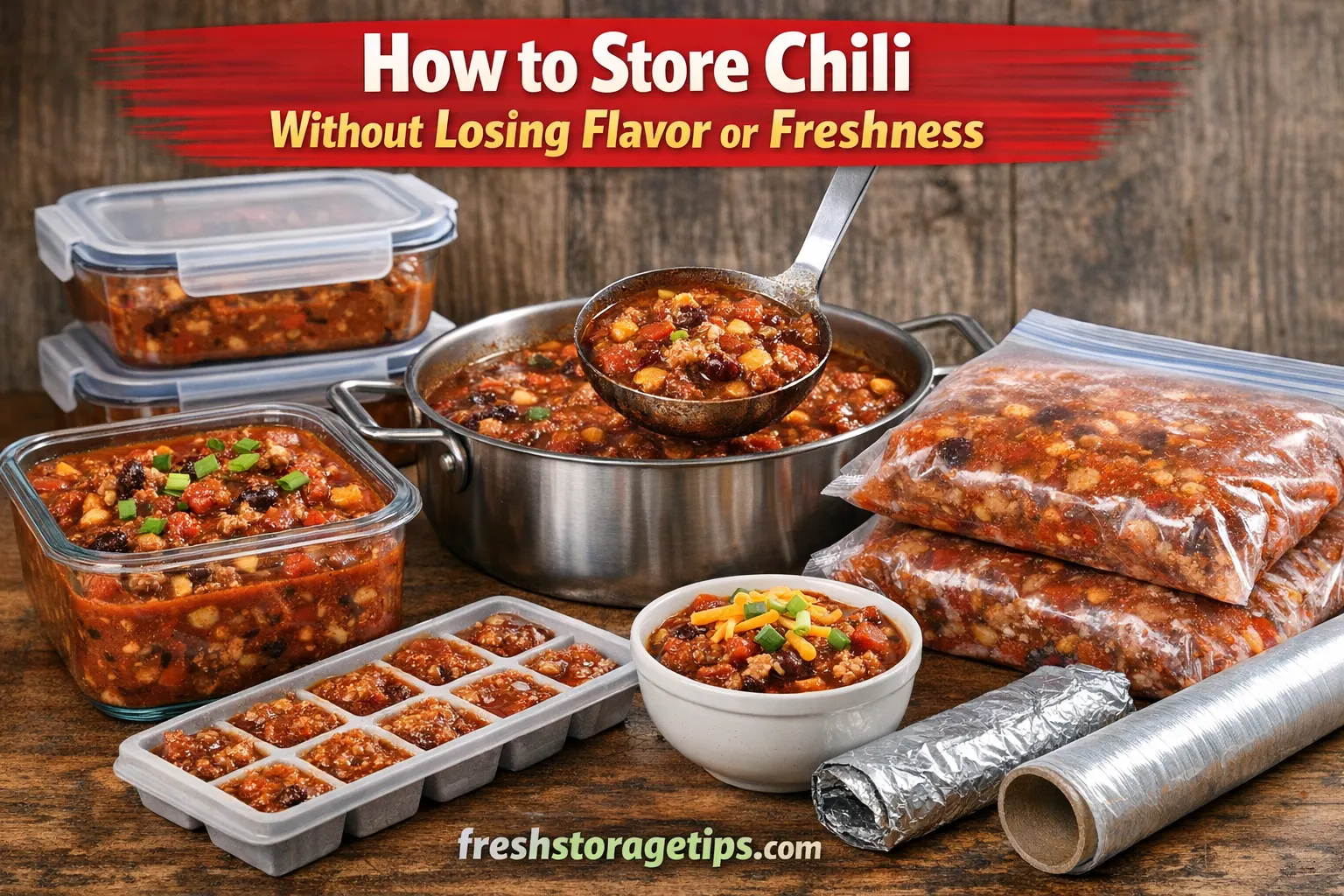
How to Store Chili Without Losing Flavor or Freshness
Chili lasts 3 to 4 days in the fridge and up to 3 months in the freezer. Of all the cooked meals you can batch-cook at home, chili is one of the most forgiving to store. Unlike pasta, which goes gluey, or leafy dishes that wilt, chili actually improves with time. The spices deepen, the fats mellow and the texture becomes more unified overnight. According to the USDA FSIS guidelines on leftover food safety, cooked dishes with meat, beans and vegetables must be refrigerated within 2 hours and consumed or frozen within 4 days.
Bottom line: Cool quickly, store in airtight containers, refrigerate within 2 hours. Fridge for up to 4 days. Freeze in portions for up to 3 months. Chili freezes better than almost any other cooked dish.
- Fridge: 3 to 4 days in an airtight container at 40‑°F
- Freezer: Up to 3 months for best quality
- Room temperature limit: 2 hours maximum before refrigerating
- Best eaten: Day 2 or 3, when flavours have fully developed
- Cooling before storage: Ice bath method, not straight into the fridge as one large pot
 By
By Most people focus on the cooking when it comes to chili and treat the storage as an afterthought. That is a mistake, but not for the reason you might expect. The risk is not just food safety. It is flavour. Chili stored incorrectly loses its heat distribution, its sauce consistency and the layered depth that took hours to develop. Freezing does not kill bacteria, it preserves them in a dormant state — which means the quality of your chili going into the freezer directly determines the quality coming out. Freeze at peak freshness, not at the end of day 3.
Refrigerate within 2 hours in airtight containers. Eat within 3 to 4 days. Freeze in meal-sized portions for up to 3 months. Reheat on the hob with a splash of water or stock to restore consistency. The unique advantage of chili storage is that refrigerated chili tastes better on day 2 than day 1. See why food goes bad for the science behind what happens to proteins, fats and acids in stored cooked food at different temperatures.
Full chili shelf life chart
Chili shelf life is consistent across most recipes because the limiting factors are the same in every version: the cooked meat or beans, the sauce moisture and the temperature it is stored at. The times below follow FDA safe food handling guidelines and FoodSafety.gov cold food storage charts.
| Situation | Storage method | How long | Key note |
|---|---|---|---|
| Chili con carne (meat-based) | Airtight container, fridge at 40‑°F | 3 to 4 days | Refrigerate within 2 hours. Best quality on day 2 to 3. |
| Vegetarian or vegan chili | Airtight container, fridge at 40‑°F | 3 to 4 days | Same window as meat-based. Beans are the limiting factor, not absence of meat. |
| Chili with dairy toppings | Store separately, fridge | 1 to 2 days for toppings | Sour cream and cheese toppings shorten shelf life if stored mixed in. Keep toppings separate. |
| Any chili, freezer | Airtight container or freezer bag, 0‑°F | Up to 3 months best quality | Leave 1 inch headspace for expansion. Safe indefinitely but quality drops after 3 months. |
| Chili left at room temperature | Any, above 40‑°F | 2 hours maximum | Bacteria double every 20 minutes in the danger zone. A large pot retains heat for hours. |
| Reheated chili | Fridge, after reheating | Do not return to fridge | Reheat only the portion you will eat. Never reheat the full batch and return the rest. |
How to cool chili safely before storing it
The large pot problem
A large pot of hot chili is one of the most common kitchen food safety errors in home cooking. The problem is physics. A 5-litre pot of chili placed directly into the fridge takes 4 to 6 hours to cool at the centre to below 40‑°F. During that time, the inner core of the chili sits in the bacterial danger zone between 40‑°F and 140‑°F, where bacteria multiply rapidly. The outer layers cool quickly but the centre stays dangerously warm for hours.
Simultaneously, that mass of hot food raises the temperature of the surrounding fridge for several hours, putting other stored food at risk. This is why the USDA recommends dividing hot food into shallow containers before refrigerating rather than cooling in the original cooking pot.
The ice bath method
Divide the chili into shallow containers no deeper than 3 inches. Place the containers in a sink filled with cold water and ice. Stir each container every few minutes to release heat from the centre. After 15 to 20 minutes the chili will have dropped from cooking temperature to close to room temperature and can go straight into the fridge. From that point it will reach 40‑°F within 1 to 2 hours rather than 4 to 6.
This fast cooling method is the same principle used in commercial kitchens and is a requirement under most food safety certification systems. If you regularly cook large batches of chili, soups and stews, this step is the one that separates safe batch cooking from risky batch cooking. The same rule applies to other dense cooked dishes: leftover pizza needs to move to a shallow container within 2 hours for the same reason.
Fridge storage: getting it right
Container choice matters more than most people think
Chili stored in a bowl covered with cling film will taste noticeably worse by day 3 than chili stored in a glass or hard plastic container with a rubber-sealed lid. The difference is twofold: a proper seal prevents moisture evaporation from the surface, which concentrates the sauce and changes the consistency, and it prevents fridge odour absorption into the spiced sauce.
Glass containers are the best option for chili because glass does not stain or absorb the tomato and chili pigments and does not retain the smell after washing. Hard plastic with a tight-fitting lid works well. Avoid storing chili in metal containers as the acidity of the tomato sauce can react with some metals over 24 to 48 hours and affect the flavour.
Portion sizing for the fridge
Divide chili into meal-sized portions before refrigerating rather than storing the full batch in one large container. The reason is reheating: you should only reheat the portion you plan to eat. Reheating the full batch and returning leftovers to the fridge creates a repeated heating-and-cooling cycle that accelerates bacterial growth and degrades quality. Portioning at the storage stage eliminates this problem entirely. This is the same principle that applies to ground beef storage, where portioning before freezing determines how practically usable the product is when you need it.
Freezing chili: the best long-term method
Why chili is one of the best foods to freeze
Chili is one of the most freezer-friendly cooked dishes you can make. Unlike pasta which absorbs sauce and becomes mushy on thawing, or dishes with cream sauces that separate when frozen, chili maintains its texture and flavour through the freeze-thaw cycle remarkably well. The beans absorb flavour during freezing rather than losing it. The sauce thickens slightly on thawing which most people find actually improves the consistency.
The spice profile also holds up better in frozen chili than in most other spiced dishes. Fat-soluble flavour compounds from cumin, paprika, garlic and chili peppers bind to the cooking fat during freezing and redistribute evenly on reheating. This is why chili that has been frozen and thawed often tastes as good as, and sometimes better than, chili that went directly from the pot to the fridge.
The correct freezer method step by step
- Cool completely first. Never freeze hot or warm chili. Use the ice bath method described above. Freezing warm food partially thaws surrounding food and causes frost formation inside the container.
- Divide into meal-sized portions. Freeze in 1 to 2 serving portions so you thaw only what you need. Refreezing thawed chili without cooking it again is not recommended.
- Leave 1 inch of headspace. Chili expands slightly as it freezes. A full-to-the-brim container will crack the lid or force it open in the freezer, exposing the chili to freezer air and causing freezer burn.
- Use freezer-grade containers or bags. Standard fridge containers are not designed for the temperature stress of freezing and can crack. Freezer bags pressed flat to remove air are a space-efficient alternative to rigid containers.
- Label with date, contents and portion size. Frozen chili all looks the same after a month. A label with the freeze date and a note on whether it is meat-based or vegetarian removes all guesswork.
My freeze test: day-1 vs day-3 chili in the freezer
I made a large batch of beef and bean chili and divided it evenly. Half went into the freezer on day 1, half stayed in the fridge and went into the freezer at the end of day 3. Both were thawed 6 weeks later and reheated identically.
Day-1 frozen: Sauce was bright, deeply flavoured and had a clean finish. The beans held their shape well. The beef was tender with no off notes.
Day-3 frozen: Sauce was noticeably darker and had a slightly heavier, more fermented undertone. The beans were softer and had begun to break down into the sauce. Still safe and edible, but clearly a step below the day-1 batch in quality.
The conclusion was clear: if you know you are going to freeze chili, freeze it on day 1, not at the end of the fridge window. The difference in quality is noticeable, and the food safety margin is also better.
Why chili tastes better the next day: the food science
This is not a myth or kitchen folklore. There is a genuine chemical explanation for why refrigerated chili tastes better on day 2.
Capsaicin distribution
Capsaicin, the compound responsible for chili heat, is fat-soluble. When chili is freshly made, capsaicin is unevenly distributed. Some mouthfuls hit a pocket of concentrated heat while others are mild. Overnight refrigeration allows capsaicin to fully dissolve into the cooking fat and redistribute evenly throughout the dish. Day-2 chili has a more consistent, integrated heat level that is typically perceived as more balanced and deeper than the just-cooked version.
Maillard reaction compounds and acid mellowing
The aromatic compounds created during browning of the meat and the caramelisation of the onion continue to develop and mellow in the fridge. Simultaneously, the acidity from tomatoes and any vinegar in the recipe softens as it reacts with the proteins and fats in the sauce. The result is a rounded, less sharp flavour profile than the immediately post-cooking version. This is the same mechanism that makes braised dishes like batch-cooked pantry staples taste better with time: slow flavour development continues even after the heat source is removed.
“Chili keeps for a week in the fridge. It is so spiced that bacteria cannot grow in it.”
Spices do not make food microbiologically safe. Chili powder, cumin, garlic and paprika have mild antimicrobial properties in concentrated form but at the levels used in cooking, they have no meaningful impact on bacterial growth in a stored cooked dish. The USDA 3 to 4 day fridge rule applies to chili exactly as it does to any other cooked protein and bean dish. The flavour development that makes chili taste good on day 3 is chemistry. The bacteria that make it unsafe on day 5 are biology. Both happen regardless of how much spice is in the pot.
How to reheat chili without ruining the texture
The hob method: best for quality
Reheating chili on the hob over medium-low heat produces the best texture and flavour result. Transfer your portion to a small saucepan, add a splash of water or stock (2 to 3 tablespoons per serving), and heat gently, stirring regularly. The added liquid replaces the moisture lost during refrigeration and restores the sauce to its original consistency. Heat to a full simmer and hold for at least 2 minutes to ensure the entire portion reaches 165‑°F throughout.
Hob, medium-low
Full control over temperature and consistency. Add stock to restore sauce texture. Best flavour result. Can stir in fresh toppings just before serving.
Oven at 325‑°F
Good for larger portions. Cover tightly with foil to prevent surface drying. Add a splash of liquid before covering. Slower but hands-free.
Microwave
Convenient but uneven heating. The edges overheat while the centre stays cold. Always stir halfway through and check that the centre is hot before eating. Add liquid to prevent surface drying.
Reheating from frozen
Thaw overnight in the fridge for the best result. If you need it faster, place the sealed container in cold water to speed thawing, then reheat on the hob as above. Never thaw chili at room temperature or in hot water. Thawing in the fridge maintains bacterial dormancy throughout and is the only safe method that does not risk the danger zone. This connects directly to the same principle explained in detail at does freezing kill bacteria — what is preserved in the freezer is released on thawing, which is why the thaw method matters as much as the freeze method.
Safe reheating temperature
Reheat all chili to an internal temperature of 165‑°F throughout before eating. Use a meat thermometer at the centre of the portion. Chili is thick and dense, which means the surface can be very hot while the interior is still cold. Steam coming from the top does not confirm safe internal temperature.
Chili storage infographic
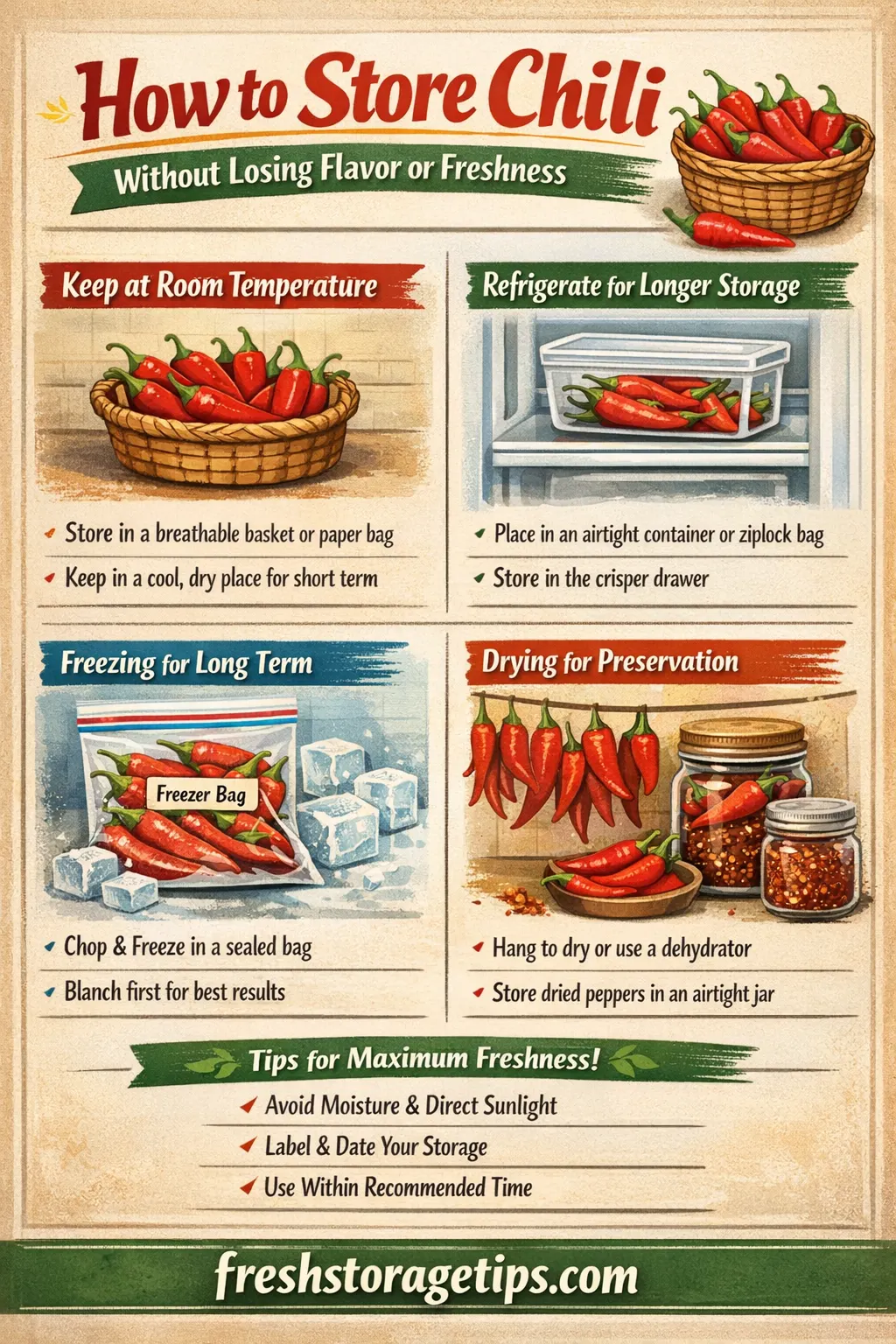
The infographic shows the full chili storage sequence: the cooling step before refrigeration, the container choice, the fridge and freezer windows, and the reheating methods. It also shows the dairy topping exception — sour cream, grated cheese and crema should always be stored separately from the chili itself because their shelf life is shorter and they change the texture of the sauce when mixed in and refrigerated.
One comparison the infographic highlights is how chili stacks up against other common leftovers in terms of freezer suitability. Pizza freezes well for 1 to 2 months, cooked pasta for 2 months, cooked ground beef for 2 to 3 months — but chili holds its quality for a full 3 months and often emerges from the freezer in better condition than these other options. For anyone planning a weekly batch-cooking routine, chili is the highest-value freezer meal in terms of storage stability, flavour preservation and versatility. Understanding how to pair that with good pantry staple storage, like long-term rice storage, creates a genuinely self-sufficient home kitchen.
“Chili is the only dish where storing it correctly does not just preserve the flavour — it actively improves it. Day 2 is better than day 1, and the freezer is better than day 4.”
Six habits that keep chili fresh, safe and better-tasting
Divide hot chili into shallow containers and place in an ice bath for 15 to 20 minutes before refrigerating. A large pot of chili placed directly in the fridge takes 4 to 6 hours to cool at the centre and raises the fridge temperature for surrounding foods.
Sour cream, grated cheese, fresh coriander and lime have shorter shelf lives than the chili itself and change the sauce texture when refrigerated mixed in. Store them in a separate small container and add fresh at serving time.
If you made a large batch intending to freeze most of it, freeze on day 1, not at the end of the fridge window. Day-1 frozen chili is consistently better quality than day-3 frozen chili when thawed. The bacteria count and the flavour both start at their best on day 1.
Chili expands as it freezes. Leave at least 1 inch between the surface of the chili and the lid of the container. A container filled to the brim will either crack the lid or force it open, exposing the chili to freezer air and causing freezer burn within weeks.
Reheat single-meal portions rather than the full batch. Reheating and re-refrigerating chili repeatedly shortens its safe window and degrades the texture significantly. Portioning at storage time eliminates this completely.
Refrigerated chili loses moisture to evaporation. Adding 2 to 3 tablespoons of water, beef stock or tomato juice per serving before reheating on the hob restores the sauce to its original consistency. This single step makes reheated chili taste noticeably better than reheating it dry.
This video covers the practical storage and reheating steps for chili including the cooling method, container choice and how to restore sauce consistency when reheating from fridge or freezer.
Tools that make chili storage simple and safe
The equipment that handles batch-cooked chili from pot to freezer properly.
Glass Containers with Rubber Seal
Glass does not stain from tomato and chili pigments, does not absorb sauce smells and provides a true airtight seal. The best everyday container for fridge-stored chili. Goes from fridge to microwave without lid.
View on AmazonFreezer-Grade Bags (Large)
Press flat before freezing to create stackable portions that thaw evenly. Freezer-grade bags are thicker than standard zip bags and resist cracking at 0‑°F. Essential for storing portions efficiently.
View on AmazonInstant-Read Thermometer
Confirm reheated chili reaches 165‑°F at the centre of the portion. Thick chili is particularly deceptive: hot on the surface with a cold centre is common when reheating large portions in the microwave.
View on AmazonFreezer Labels
Label every container with the recipe name, date and whether it is meat-based or vegetarian. Frozen chili in an unlabelled container is unidentifiable after 2 weeks. Labels remove the guesswork entirely.
View on AmazonAs an Amazon Associate I earn from qualifying purchases — at no extra cost to you.
Questions people actually ask
Chili lasts 3 to 4 days in the fridge when stored in an airtight container at 40‑°F or below. Refrigerate within 2 hours of cooking. After 4 days, discard it regardless of smell or appearance.
Yes. Chili freezes exceptionally well for up to 3 months for best quality. Divide into portion-sized airtight containers or freezer bags, leaving 1 inch of headspace for expansion. Label with the date. Quality declines after 3 months but it stays safe indefinitely at 0‑°F.
Overnight refrigeration allows spices, fats and acids to fully merge and mellow. Capsaicin from chili peppers distributes more evenly through the liquid. Fat-soluble flavour compounds from cumin, paprika and garlic disperse into the cooking fat during cooling. The result is a more integrated, rounded flavour than the just-cooked version.
Divide chili into shallow containers to increase surface area and speed cooling. Place the containers in an ice bath in the sink for 15 to 20 minutes before transferring to the fridge. Never put a large pot of hot chili directly into the fridge as the centre stays warm for hours and raises the fridge temperature around it.
Yes, the same 3 to 4 day fridge rule applies to both. Meat-based chili and vegetarian chili have the same storage window when properly refrigerated. The sauce, beans and vegetables are the limiting factors in both cases, not the meat specifically.