How to Store Strawberries So They Last 3 Weeks (The Vinegar Wash Method)
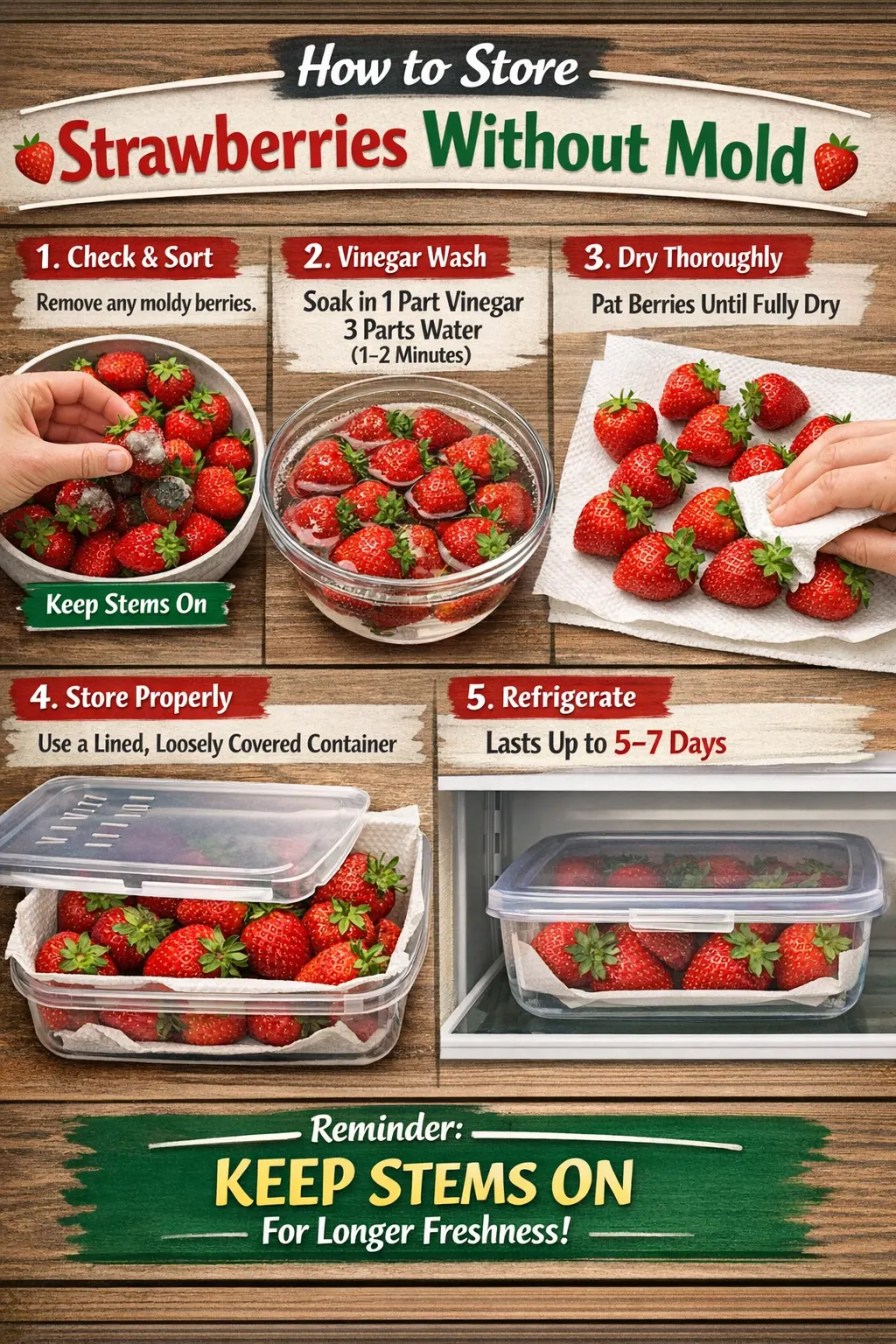
Strawberries last 2 to 3 days in a standard fridge. Using the vinegar wash method, they can last up to 3 weeks when stored correctly. The method: soak unwashed berries for 2 minutes in 1 part white vinegar to 3 parts water, rinse, dry completely, and store in a paper-towel-lined airtight container. The vinegar kills the Botrytis cinerea mould spores already on the berries without affecting the flavour.
 By
By I used to buy a punnet of strawberries on Saturday and find half of them furry by Monday morning. Not because the berries were bad when I bought them — but because the mould spores were already on the surface when they came off the shelf, just waiting for the right moisture conditions. Standard fridge storage provides exactly those conditions within 48 hours.
The vinegar wash changes that equation completely. A 2-minute soak in diluted white vinegar kills the surface mould spores before they can establish. Combined with thorough drying and a paper-towel-lined container, this takes strawberries from a 2-day window to a genuine 3-week shelf life. This page covers the exact method, the science behind it, and how to freeze them for even longer. For the science behind other fruit storage, see our guide on how to store oranges — a completely different set of rules.
No prep: 2 to 3 days in the fridge. Vinegar wash method: up to 3 weeks. Frozen: up to 12 months. The ratio is 1 part white vinegar to 3 parts water, 2-minute soak, rinse, dry completely, paper-towel-lined airtight container. Never store strawberries wet — moisture is what mould needs to establish within hours. Keep stems on until you eat them. See also how to store apples for a comparison with longer-lived fruit.
Why strawberries go mouldy so fast
Strawberries are among the most perishable fruits in any kitchen. A berry that looks perfect at the market can be fuzzy with mould within 48 hours at home. Understanding why makes the vinegar wash method obvious rather than optional.
The mould is already there when you buy them. The grey fuzzy mould that destroys strawberries is caused by Botrytis cinerea — a fungal pathogen whose spores are present on virtually every punnet of strawberries you will ever buy. UC Davis Postharvest Technology Center research on strawberry storage confirms that Botrytis is the primary postharvest pathogen for strawberries worldwide. The spores do not travel to the berries in your kitchen — they arrived at the market. The only question is when they get the moisture they need to germinate.
The plastic clamshell makes it worse. The original packaging traps moisture and creates a microclimate around every berry — exactly the humid conditions Botrytis spores need. A single soft or bruised berry in the punnet releases moisture that accelerates mould across all its neighbours. This is why strawberries seem to deteriorate all at once rather than one at a time.
The vinegar wash method — step by step
Vinegar wash + fridge
Up to 3 weeks. Kills mould spores before they can establish. Combined with thorough drying and paper towel absorption, this is the complete method.
Unwashed, fridge only
3 to 5 days. Better than the original packaging. Does not kill existing spores but slows germination. Good if you will eat them quickly.
Original clamshell, fridge
2 to 3 days. Traps moisture, creates a humid microclimate, and accelerates the exact conditions Botrytis needs. Repackage immediately when you get home.
“The vinegar wash makes strawberries taste like vinegar.”
This is the most common objection and it is not supported by the evidence. The acetic acid in white vinegar is volatile — it evaporates quickly from the berry surface, especially with the rinse step. UC Davis postharvest research and independent studies in food science journals confirm that brief vinegar treatments produce no detectable change in strawberry sugar content (Brix), flavour profile, or anthocyanin levels. The flavour concern almost certainly comes from people who skipped the rinse step or used apple cider vinegar. White vinegar, rinsed, leaves no trace.
Strawberry shelf life at a glance
| Situation | Method | How long | Notes |
|---|---|---|---|
| No prep, original clamshell, fridge | Original packaging, fridge | 2 to 3 days | Trapped moisture accelerates mould. Repackage immediately when you get home. |
| Unwashed, paper-towel container, fridge | Paper-towel-lined airtight container, crisper | 3 to 5 days | Keeps stems on. Good if eating within the week. Does not kill existing spores. |
| Vinegar wash + paper-towel container, fridge | 1:3 vinegar bath, dry, paper-towel container, crisper | Up to 3 weeks | The full method. Replace paper towels after day 7 if damp. Check for soft berries daily. |
| Cut strawberries, fridge | Airtight container, fridge | 1 to 2 days | Cut surface oxidises and absorbs moisture fast. Eat as soon as possible. |
| Frozen (whole), freezer | Flash-freeze on tray, then labelled freezer bag | Up to 12 months | Hull and dry before freezing. Flash-freeze prevents clumping. Use from frozen in smoothies. |
| Room temperature | Any, not refrigerated | 12 to 24 hours | Strawberries are not a counter fruit. Room temperature speeds every spoilage mechanism. |
Storing cut strawberries and what to do with overripe ones
Once a strawberry is cut, the clock accelerates dramatically. The cut surface oxidises, releasing moisture and creating an entry point for the same Botrytis spores that would otherwise sit harmlessly on the outer skin. Cut strawberries in a sealed airtight container in the fridge last 1 to 2 days — that is the realistic window, regardless of method.
Do not apply the vinegar wash to pre-cut strawberries — the acetic acid penetrates the exposed flesh and does affect flavour once the skin barrier is gone. For cut berries, your only tools are an airtight container, the coldest part of the fridge, and speed. Do not slice more than you plan to use in one to two days.
For overripe strawberries that are still flavourful but too soft to eat fresh, the best uses are smoothies, jam, strawberry sauce for desserts, or folding into yoghurt. Keep them away from soft cheeses like brie in the fridge — the moisture they release will affect surrounding dairy. If they are past the point of being usable, freeze them immediately in a bag rather than letting them go to waste on the shelf.
My test: 3 storage methods, same punnet of strawberries, 21 days
I bought one large punnet of strawberries and divided them equally into three groups. All three went into the fridge at the same time.
Group A — original clamshell: Day 2: first fuzzy patch visible on two berries. Day 3: four berries affected, removed them, smell slightly musty from the whole container. Day 4: discarded remaining berries, not worth saving.
Group B — paper-towel-lined container, unwashed: Day 2: all fine. Day 4: one soft spot on one berry, removed it. Day 5: remainder still good, ate them on days 4 and 5. Flavour excellent. No mould on the remaining berries.
Group C — vinegar wash, paper-towel-lined container: Day 5: all firm, no mould, bright red. Day 10: still no mould. Two berries slightly softer but not spoiled, ate those. Day 14: remaining berries still firm and flavourful. Day 18: first soft berry appeared, removed it. Day 21: four berries remaining, all still good. Ate them on a yoghurt. Identical flavour to day 1 — no vinegar taste detectable at any point.
The vinegar wash group outlasted the original clamshell by 18 days and the plain paper-towel method by 16 days from the same punnet of berries.
How to freeze strawberries for up to 12 months
Strawberries freeze exceptionally well for smoothies, baking, and cooking. The texture changes on thawing — they become soft and release juice — which makes them unsuitable for eating fresh but perfect for every cooked or blended application. The National Center for Home Food Preservation confirms that properly frozen strawberries retain flavour and nutritional value for up to 12 months.
Step 1: hull and dry before freezing
Remove the stems and hull (the white core). Do not skip the drying step — wet strawberries freeze with ice crystals on the surface that fuse the berries together into a solid block. Dry each berry individually on a clean towel. Small berries can be frozen whole. Large berries are better halved — they thaw faster and are easier to use in baking portions.
Step 2: flash-freeze in a single layer
Spread the dried berries in a single layer on a lined baking sheet, not touching each other. Freeze for 2 hours until solid. This flash-freezing step is what prevents clumping — once individually solid, the berries can be stored together without fusing. Skip this step and you end up with a single frozen block that requires thawing the entire bag every time you need a handful.
Step 3: bag, label, and store
Transfer the frozen berries to a labelled freezer bag. Squeeze out as much air as possible before sealing, or use a vacuum sealer for maximum quality. Label with the date. Frozen strawberries keep for up to 12 months at peak quality. Use them directly from frozen in smoothies — no thawing needed. For baking, thaw in the fridge overnight in a bowl to catch the liquid, which is excellent in sauces and glazes.
“The mould on your strawberries was there when you bought them. The vinegar wash is just making sure it never gets the chance to grow.”
Six rules that keep strawberries fresh longer
The sooner you kill the Botrytis spores, the longer the window. Doing the wash on day 3 instead of day 1 still works but you have already lost 3 days of potential shelf life to spore activity.
A single damp berry in the container will create the moisture conditions that undo the vinegar wash within 24 hours. A salad spinner lined with paper towels is the fastest drying method.
Removing the hull creates an opening in the berry where moisture enters and Botrytis can establish. Stems-on berries last significantly longer than hulled ones even in the same container.
One soft berry releases moisture and ethylene that accelerates softening across the whole container. Check the container every day and remove anything that is going. This one habit extends the life of the remaining berries noticeably.
Cold dulls the sweetness and flavour compounds in strawberries. A punnet that tastes bland straight from the fridge will taste markedly better after 15 minutes at room temperature. This is not a storage tip but it is worth knowing.
A berry that is too soft to eat fresh is still perfect for smoothies and baking once frozen. The moment you decide a berry is past peak, freeze it rather than letting it sit another day and take up container space.
How strawberries compare to other berries and fruit
Strawberries sit at the most demanding end of the fresh fruit storage spectrum. Compared to other berries and fruit, they have a thinner skin, higher moisture content, and are more susceptible to Botrytis cinerea than almost any other common fruit. Understanding how they compare helps you prioritise which fruit to tackle first when you get home from the market.
Berry and fruit storage comparison — shelf life at a glance
The vinegar bath, rinse, drying, and container setup all shown in real time — the entire method takes about 15 minutes for a full punnet.
What I use for strawberry storage
Simple tools that make a real difference for keeping strawberries fresh and freezing them well.
Airtight Glass Container
The right container for the paper-towel method. Glass does not absorb odours, creates a cleaner seal than plastic, and lets you see the berries without opening the lid to check them.
View on AmazonRemovable Date Labels
Label your container with the vinegar wash date. With a 3-week window, knowing the date removes all guesswork about freshness. Also essential for labelling frozen berry bags.
View on AmazonReusable Freezer Bags
For flash-frozen strawberries. More airtight than standard zip bags, better at preventing freezer burn, and reusable over many seasons. The airtight seal preserves flavour for the full 12 months.
View on AmazonVacuum Sealer
For maximum freezer quality. Removes all air before sealing, eliminating freezer burn entirely. Frozen strawberries vacuum-sealed taste noticeably better than bag-sealed after 6 months.
View on AmazonAs an Amazon Associate I earn from qualifying purchases — at no extra cost to you.
Strawberries last 1 to 3 days in the fridge and only a few hours at room temperature because they bruise easily and absorb moisture from the air. Cherries are slightly more robust and last 5 to 7 days in the fridge using the same unwashed, sealed bag method. Kiwi has a thicker skin than strawberries and lasts up to 2 weeks in the fridge once ripe, making it a more practical option for weekly shopping. Other delicate fruits like avocados are handled gently like strawberries but need the opposite environment, ripening at room temperature before going into the fridge.
Questions people actually ask
Without any special prep, 2 to 3 days before the first mould appears. Using the vinegar wash method — a 2-minute soak in 1 part white vinegar to 3 parts water, thorough drying, and storage in a paper-towel-lined airtight container — extends freshness to 2 to 3 weeks. For comparison, apples in the crisper last 4 to 6 weeks with no special treatment — strawberries are genuinely among the most demanding fruit to store well.
No. The rinse step removes any surface acetic acid, and research confirms that brief vinegar treatments produce no detectable change in strawberry sugar content, flavour profile, or colour. The concern about vinegar taste almost always comes from people who used apple cider vinegar (which does leave a flavour) or skipped the rinse. Plain white vinegar, rinsed, leaves no trace.
Only if you are doing the vinegar wash and can dry them completely. Washing with water alone — without the vinegar — adds moisture to the surface without killing the mould spores, which accelerates rather than slows deterioration. If you cannot dry them thoroughly, store unwashed and rinse only just before eating.
Yes. Hull and dry the berries, flash-freeze in a single layer on a lined baking sheet for 2 hours, then transfer to a labelled freezer bag. They keep for up to 12 months and can be used directly from frozen in smoothies. The texture changes on thawing — soft and juicy — which makes them unsuitable for eating fresh but perfect for every cooked or blended application, as confirmed by the National Center for Home Food Preservation.
In an airtight container in the fridge, eaten within 1 to 2 days. The cut surface oxidises and releases moisture rapidly. Do not apply the vinegar wash to pre-cut berries — the acetic acid penetrates the exposed flesh and will affect flavour once the skin barrier is gone. Slice only what you plan to eat in the next day or two.