
How Long Does Ground Beef Last? (Only 1–2 Days in the Fridge)
Raw ground beef lasts 1–2 days in the fridge. Freeze it within that window and it keeps for 3–4 months in the freezer when stored correctly. Cooked ground beef lasts 3–4 days in the fridge and 2–3 months in the freezer when stored correctly. The short fridge window exists because grinding increases surface area dramatically — giving bacteria far more contact with the meat than a whole steak provides.
 By
By I bought ground beef on a Sunday once and forgot about it until Wednesday. That four-day gap is exactly one to two days past the safe limit, and the smell confirmed it. Unlike bacon, which has curing agents that extend its shelf life considerably, ground beef has no such protection — it is one of the most perishable proteins in the fridge. The rules here are stricter than almost anything else you store.
The single most useful habit I developed was buying ground beef with a plan already in place: cook it tonight, or freeze it today. There is no comfortable middle ground. The same short window applies to chicken breast, where the 1–2 day fridge limit is identical and the spoilage signs equally important to recognise. This article covers the exact timelines, why ground beef spoils so fast, and how to read the signs before they become a problem.
Raw ground beef: 1–2 days in the fridge when stored correctly. Cooked: 3–4 days in the fridge when stored correctly. Freezer (raw): 3–4 months in the freezer when stored correctly. Freezer (cooked): 2–3 months in the freezer when stored correctly. Store on the bottom shelf at 40‑°F or below. Freeze in flat portions for faster thawing. Never leave raw ground beef at room temperature (counter) for more than 2 hours — bacteria double every 20 minutes above 40‑°F. See also how to store deli meat for another protein where the fridge window is the critical variable.
Why ground beef spoils faster than other cuts (surface area is the real cause)
A whole steak has a relatively small surface area exposed to air and bacteria. Ground beef has been run through a grinder that breaks it into thousands of tiny particles — each one a new surface exposed to oxygen and microorganisms. The same weight of meat has exponentially more contact area with the environment after grinding than before.
This is why the USDA gives ground beef a 1–2 day fridge limit while a whole steak gets 3–5 days. It is not that the beef itself is different — it is that the processing creates conditions where bacteria can multiply much faster. Pathogens like E. coli O157:H7 and Salmonella that may sit on the outer surface of a whole cut get distributed throughout the grind, making thorough cooking to 160‑°F (71‑°C) essential for every portion.
Temperature is the single most important variable. A fridge running at 38‑°F extends ground beef life to the full 2-day window. A fridge running at 45‑°F — common near the door or in an overfull fridge — can halve that. This is why the bottom shelf, away from the door, at the back of the fridge is the correct location: it is the coldest and most temperature-stable spot in the appliance.
Fridge vs freezer vs counter — the honest timelines
Freezer
Raw: 3–4 months in the freezer when stored correctly. Cooked: 2–3 months when stored correctly. Safe beyond that — quality declines after 4 months. Thaw in fridge overnight, never on the counter.
Fridge (raw)
1–2 days when stored correctly. Use or freeze on the day of purchase for maximum safety. Cooked beef gets 3–4 days — cooking resets the safety clock.
Counter (room temperature)
Maximum 2 hours at room temperature. Above 90‑°F that drops to 1 hour. Never thaw on the counter — outside reaches the danger zone long before the centre thaws.
“If it still smells fine, it is safe to eat.”
This is one of the most dangerous food safety myths. E. coli O157:H7 — the primary pathogen of concern in ground beef — produces no detectable smell at dangerous concentrations. Spoilage bacteria (which do cause the sour, off smell) are largely separate from pathogenic bacteria. A pack of ground beef can smell perfectly normal and still carry harmful bacterial loads. Use the purchase date as your primary decision tool, not your nose. Smell is a useful secondary check, not a primary safety indicator.
Shelf life at a glance
| Type | Location | How long | Key tip |
|---|---|---|---|
| Raw ground beef | Fridge, bottom shelf, 40‑°F or below | 1–2 days | Use or freeze on day of purchase for maximum safety. |
| Raw ground beef | Freezer, 0‑°F, flat in labelled bag | 3–4 months | Safe beyond 4 months but quality declines. Always label with date. |
| Cooked ground beef | Fridge, airtight container, cooled first | 3–4 days | Cool completely before sealing — never seal hot meat. |
| Cooked ground beef | Freezer, labelled airtight bag | 2–3 months | Texture softens slightly after thawing — fine for sauces and soups. |
| Raw, mixed with vegetables | Fridge | Maximum 24 hours | Vegetable moisture accelerates spoilage. Cook the same day. |
| Raw, counter (room temperature) | Out of fridge | Maximum 2 hours | 1 hour if kitchen is above 90‑°F. Discard after this window. |
Can you eat ground beef after 3 days?
No — raw ground beef should not be eaten after 3 days in the fridge. The safe limit is 1–2 days when stored at 40‑°F (4‑°C) or below. After that, the risk of harmful bacteria increases significantly — even if the meat looks and smells normal. The USDA is explicit: raw ground beef past 2 days should be discarded or was safe to freeze on day 1 or 2, but not later. Cooking it does not make it safe — some bacterial toxins survive heat.
Cooked ground beef is different: 3 days in the fridge is still within the safe 3–4 day window for cooked meat. The rule changes because cooking destroys the initial bacterial load and resets the clock. But raw beef at 3 days is past its limit regardless of appearance or smell.
Storage infographic — timelines at a glance
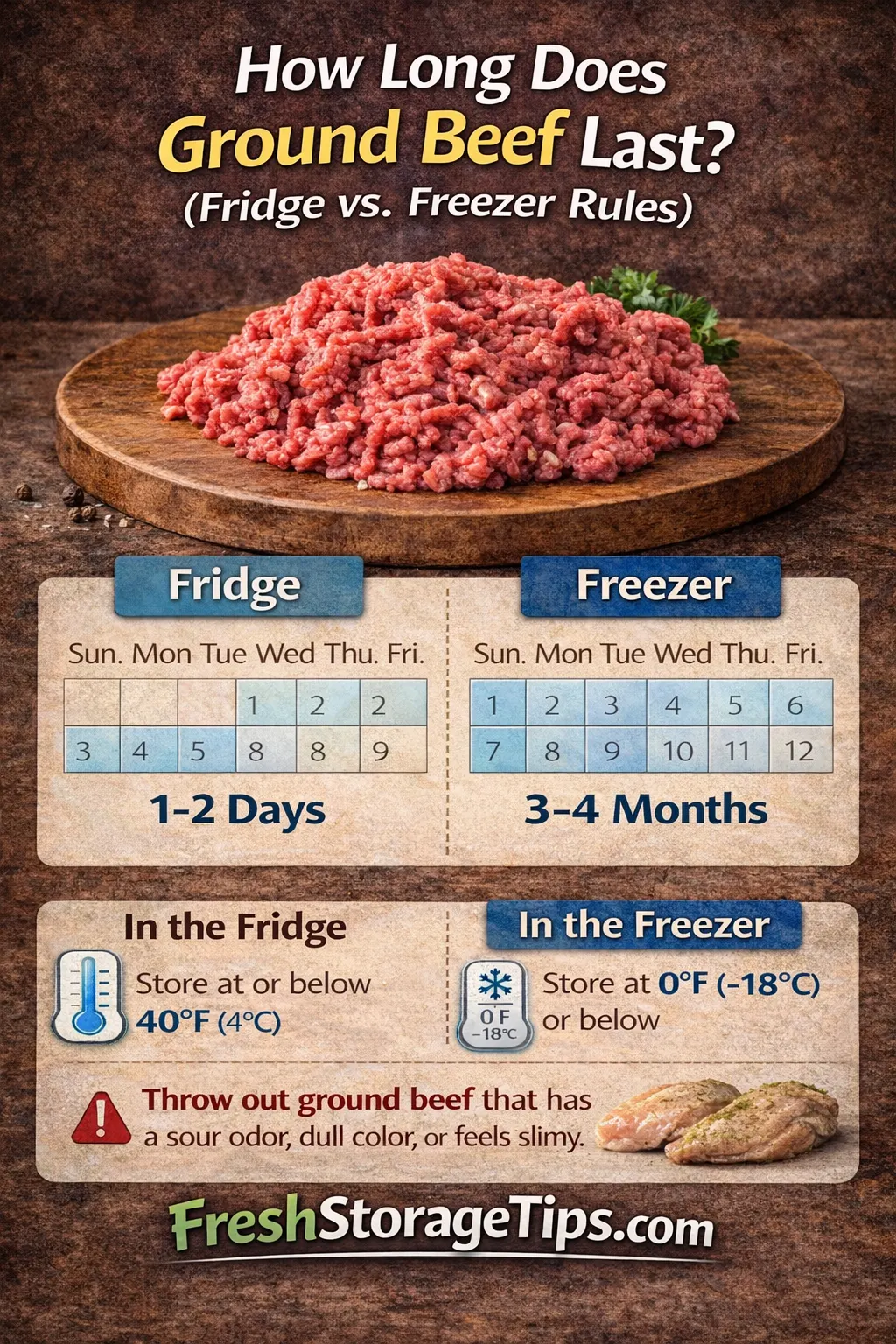
The two numbers that matter most are the two extremes: 1–2 days for raw beef in the fridge, and 3–4 months for raw beef in the freezer when stored correctly. Everything else — cooked fridge, cooked freezer — sits between those anchors.
The cooked beef numbers are worth noting separately. Browning a large batch of ground beef on Sunday and refrigerating it in sealed portions means you have safe, ready-to-use protein through Wednesday or Thursday — without the raw 1–2 day clock pressure. This is the basis of the meal-prep approach for ground beef: cook it in bulk, refrigerate in portions, and the fridge window becomes genuinely useful rather than anxiety-inducing.
If you regularly lose raw ground beef to the 1–2 day window, the solution is not to push the limit — it is to build the freeze step into your grocery routine. Bring it home, portion it flat immediately, freeze everything you will not cook today. Labels with date and weight make this nearly automatic.
Interactive storage chart
Filter by beef type or search for the storage situation you need. Click any column header to sort.
| Beef type | Location | Lasts | Key tip |
|---|---|---|---|
| Raw — fridge | Bottom shelf, 40‑°F or below | 1–2 days | Use or freeze on day of purchase. |
| Cooked — fridge | Airtight container, cooled first | 3–4 days | Cool completely before sealing. |
| Raw — freezer | 0‑°F, flat in labelled bag | 3–4 months | Flatten to save space and thaw faster. |
| Cooked — freezer | 0‑°F, labelled airtight bag | 2–3 months | Texture softens slightly — fine for sauces. |
| Raw — mixed with veg | Fridge | Max 24 hours | Vegetable moisture speeds spoilage. Cook same day. |
| Raw — counter (room temperature) | Out of fridge | Max 2 hours | 1 hour above 90‑°F. Discard after this window. |
How to spot spoiled ground beef (the three checks)
Use all three checks together — and always alongside the purchase date. Visual colour alone is the least reliable indicator.
Colour
Fresh ground beef is bright red on the outside (oxymyoglobin from oxygen exposure). The interior of a pack is often brown or grey — this is normal, caused by lack of oxygen, not spoilage. What is not normal: grey or green colouring on the outside surface, or any green tinge anywhere. A fully grey-brown exterior combined with the other signs below means discard immediately.
Smell
Fresh raw beef has an almost imperceptible metallic scent or no smell at all. A sour, vinegary, or ammonia-like smell is a clear spoilage indicator — but as noted above, absence of smell does not mean safety. The pathogens of greatest concern produce no detectable odour at dangerous concentrations. Use smell as a supporting check, not the deciding one.
Texture
Raw ground beef should feel slightly damp but not sticky or slimy. A tacky, sticky surface or any visible film indicates active bacterial spoilage. If it feels slimy at all, discard without tasting or cooking.
My test: fridge door vs bottom shelf back, same pack, 48 hours
I split one 500g pack of raw ground beef into two identical glass containers. One went near the fridge door on the middle shelf. The other went on the bottom shelf at the back — the coldest, most stable location.
At 24 hours: No visible difference. Both still largely bright red on the surface, no detectable smell from either container.
At 48 hours: Door container had begun to grey around the edges and had a faint sour note when opened. Bottom-shelf container was still largely red with no off smell.
Fridge temperature check: Door area measured 44‑°F during the test. Bottom shelf back measured 37‑°F. A 7-degree difference that roughly doubles the rate of bacterial multiplication according to USDA bacterial growth curves.
The lesson is simple: location inside the fridge matters as much as the fridge setting itself. Bottom shelf, back of the fridge, every single time.
How to freeze ground beef correctly
Freezing is the only way to extend ground beef beyond its 2-day fridge limit while keeping it safe. The method determines how practical it is when you need to use it.
The flat-portion method
- Portion into usable amounts — 250g, 500g, or whatever your typical recipe calls for. Freezing in recipe-sized amounts means you thaw only what you need.
- Place each portion in a heavy freezer bag. Squeeze out every bit of air — oxygen causes freezer burn that makes the beef dry and metallic-tasting.
- Flatten each bag to about 1cm thickness. Flat portions thaw in the fridge in 4–6 hours instead of overnight for a ball or block. This single step makes the difference between a useful freezer stash and one you never bother with.
- Label with date and weight. All frozen ground beef looks identical after a few weeks. The label is the only information you have.
- Freeze immediately — do not let it sit in the fridge first if you are already within the 1–2 day window.
- Use within 3–4 months in the freezer when stored correctly for best quality.
Thawing safely
The only safe thawing methods are in the fridge (overnight for a ball, 4–6 hours for a flat portion) or under cold running water in a sealed bag. Never thaw on the counter — the outside of the beef reaches room temperature and enters the bacterial danger zone long before the centre thaws. A flat-frozen portion under cold running water takes about 30–45 minutes.
“Buy it with a plan. Cook it today, or freeze it today. The 1–2 day window does not forgive a change of plans.”
Six rules for safe ground beef storage
The coldest and most temperature-stable location. Door and middle shelf positions run warmer and fluctuate with every opening. Bottom shelf at the back stays closest to 37–38‑°F consistently.
Raw ground beef has a 1–2 day fridge window. If you do not have a recipe planned for today or tomorrow, freeze it the moment you get home. This is the single most effective ground beef safety habit.
Flat frozen portions thaw in 4–6 hours in the fridge instead of overnight. Label each bag with date and weight — after a month in the freezer, all ground beef looks identical.
E. coli O157:H7 produces no detectable odour at dangerous concentrations. Use the purchase date as your primary decision tool. A pack can smell fine and still carry harmful bacterial levels after 2 days at fridge temperature.
Sealing hot ground beef traps steam, raises the container temperature, and creates condensation that accelerates spoilage. Spread it to cool for 20–30 minutes, then seal and refrigerate within 2 hours of cooking.
The outside surface reaches room temperature and the bacterial danger zone long before the centre thaws. Fridge thawing or cold running water in a sealed bag are the only safe methods. Flat portions make fridge thawing practical.
How ground beef compares to other proteins in your fridge
Ground beef has one of the shortest fridge windows of any common protein — shorter than whole beef cuts, shorter than most fish, and matched only by other ground meats and raw poultry. Understanding where it sits relative to other proteins makes meal planning significantly less stressful.
Protein fridge storage comparison — raw, stored at 40‑°F or below
A clear walkthrough of the USDA safety guidelines, how to read spoilage signs correctly, and why the smell test alone is not a reliable safety indicator for ground beef.
What I use for ground beef storage
Simple tools that make safe fridge and freezer storage effortless.
Removable Date Labels
Label every freezer bag of ground beef with the date and weight. After a month in the freezer all portions look identical — the label is the only information you have. Peel off cleanly with no residue.
View on AmazonHeavy-Duty Freezer Bags
Thicker than standard bags — essential for flat-frozen beef portions. Squeeze out all air before sealing to prevent freezer burn. Flat portions thaw in 4–6 hours in the fridge instead of overnight.
View on AmazonAirtight Glass Containers
For cooked ground beef in the fridge. Glass does not absorb meat odours, seals cleanly, and keeps temperature stable. Always cool beef completely before sealing — never seal hot meat in glass.
View on AmazonPrecision Pro Vacuum Sealer
For the longest freezer life, a vacuum sealer removes all air and prevents freezer burn entirely. Vacuum-sealed flat ground beef portions hold quality for the full 3–4 month window without degradation.
View on AmazonAs an Amazon Associate I earn from qualifying purchases — at no extra cost to you.
Raw ground beef lasts only 1 to 2 days in the fridge and 3 to 4 months in the freezer. Steak lasts 3 to 5 days in the fridge, significantly longer than ground beef, because grinding increases the surface area where bacteria can grow. Other raw meats like bacon are cured and last up to 7 days once opened, making them much more fridge-stable than fresh ground beef. Knowing the signs that meat has gone bad is just as important as knowing the shelf life because ground beef can smell off before the use-by date if stored incorrectly.
Questions people actually ask
1–2 days when stored correctly at 40‑°F (4‑°C) or below on the bottom shelf. The short window is caused by the grinding process creating exponentially more surface area for bacterial colonisation than whole cuts. Use or freeze on the day of purchase for maximum safety. See how chicken breast compares — it has the same 1–2 day fridge window and the same freeze-or-cook logic.
Raw ground beef lasts 3–4 months in the freezer when stored correctly for best quality. It remains safe to eat beyond that, but flavour and texture decline noticeably after 4 months. Cooked ground beef lasts 2–3 months in the freezer when stored correctly. Always label with date and weight — frozen ground beef is impossible to identify after a few weeks without a label.
Not necessarily. Brown or grey colouring inside a pack is normal — caused by lack of oxygen exposure (metmyoglobin). If the outside surface has turned brown or grey AND has an off smell or slimy texture, discard it. Brown in the centre with a normal exterior and no smell is not a spoilage indicator. Use the purchase date as your primary decision tool — not the colour alone.
Yes — if it was thawed in the fridge, not on the counter. Fridge-thawed beef that has not exceeded its safe window can be refrozen safely. Texture degrades with each freeze–thaw cycle — the beef becomes less juicy. Never refreeze beef thawed at room temperature, as bacteria may have multiplied to unsafe levels during the thawing period.
3–4 days in the fridge when stored correctly in a sealed airtight container. Cool completely before sealing — sealing hot meat traps steam and raises the container temperature, which accelerates spoilage. Cooked ground beef in the freezer lasts 2–3 months in the freezer when stored correctly. Cooking in bulk and refrigerating in portions is the most practical way to use the longer cooked window for meal prep. See also how deli meat compares — another cooked protein where the fridge window is the key variable.