Does Freezing Kill Bacteria or Just Stop It?
Freezing does not kill most bacteria. It puts them into a dormant state where they stop multiplying. When the food thaws and re-enters the temperature danger zone between 40‑°F and 140‑°F, those bacteria wake up and can multiply rapidly again. This is the single most important thing to understand about freezer food safety, and it is the reason that USDA FSIS freezing and food safety guidelines are clear: freezing preserves food, it does not make it safe.
Bottom line: Freezing is a pause button, not a kill switch. Whatever bacteria were present when the food went into the freezer will still be present when it comes out. The number that matters is what you started with, not how long the food has been frozen.
- Freezing at 0‑°F: Stops bacterial growth, does not kill most bacteria
- Cooking to safe temperature: The only method that actually kills bacteria
- Parasites: Exception — freezing does kill certain parasites effectively
- Thawing: Bacteria reactivate and multiply again if food enters the danger zone
- Freezing spoiled food: Does not make it safe or remove existing toxins
 By
By Most people have a vague belief that the freezer is a sterile environment. It is not. It is a cold environment where biological processes slow dramatically. That distinction matters every time you pull something out of the freezer. The food you are thawing carries the exact bacterial population it had when you froze it, plus whatever has been added during handling. If you froze raw chicken that was approaching its use-by date, you thaw it with the same bacterial load it had going in. This is why knowing how long raw meat lasts before freezing is just as important as knowing how to freeze it properly.
Freezing stops bacteria from multiplying but does not kill them. They survive in a dormant state and reactivate when the food thaws. Only cooking to the correct internal temperature kills bacteria reliably. Parasites are a partial exception: certain parasites are destroyed by proper freezing at very low temperatures. See why food goes bad for the full picture of what bacteria, mould and oxidation do to different foods and how cold storage slows each process differently.
What actually happens to bacteria when food freezes
The dormancy mechanism
Bacteria are living organisms that need liquid water to carry out their biological processes: feeding, growing and reproducing. At 32‑°F, water begins to freeze. As the temperature drops further toward 0‑°F, ice crystals form inside and around bacterial cells, removing the liquid water they need to function. The bacteria do not die. They enter a dormant state, their metabolic processes effectively suspended until conditions improve.
This is not speculation. It is a well-documented phenomenon confirmed by peer-reviewed research on bacterial cryosurvival published in the National Library of Medicine. Studies have recovered viable Salmonella, E. coli O157:H7, Listeria monocytogenes and Campylobacter from foods frozen for months and in some cases years. The bacteria do not disappear. They wait.
Why ice crystals damage but do not destroy bacteria
When water inside a bacterial cell freezes, it expands and can rupture the cell membrane. Rapid freezing creates many small ice crystals that cause more cellular damage than slow freezing, which creates larger crystals. This is why rapid freezing at very low temperatures does kill a percentage of bacteria, particularly in the first few freeze-thaw cycles. But it does not kill all of them, or even most of them. The survivors repopulate the food rapidly once thawing begins.
The practical implication is important: each freeze-thaw cycle does reduce the total bacterial count slightly, but it does not sterilise the food. And the reduction is meaningless if the starting bacterial count was high. Freezing food that was already heavily contaminated reduces a dangerous number to a slightly less dangerous number, not to a safe one. This is exactly the problem with freezing food that is already going off, which is addressed in the myth section below.
Temperature effects on bacteria: the full picture
Different temperatures affect bacteria in fundamentally different ways. Understanding the full spectrum makes the freezer’s role clearer.
| Temperature zone | What happens to bacteria | Examples | Safety implication |
|---|---|---|---|
| Above 140‑°F (60‑°C) | Bacteria die rapidly | Cooking, boiling, baking | Safe — kills pathogens |
| 140‑°F down to 40‑°F (danger zone) | Bacteria multiply rapidly. Double every 20 minutes near the middle of this range. | Counter, warm room, slow thawing | Danger zone — never leave food here long |
| 40‑°F to 32‑°F (fridge) | Bacterial growth slows significantly but does not stop. Some cold-tolerant species still multiply. | Home refrigerator | Safe short-term — not indefinite |
| 32‑°F to 0‑°F (freezer) | Growth stops. Most bacteria become dormant. A small percentage die with each freeze cycle. | Home freezer | Bacteria preserved, not killed |
| Below 0‑°F (deep freeze) | All bacterial growth halted. Bacteria survive indefinitely in dormant state. | Commercial deep freeze, scientific storage | Indefinitely preserved, not sterilised |
Why thawing is the real danger point
The reactivation window
The moment frozen food begins to thaw and its surface temperature rises above 40‑°F, the bacteria on and in that food begin to reactivate. They do not need to fully warm up. Even at 45‑°F some species begin multiplying. By the time the food reaches 70‑°F on a kitchen counter, bacterial doubling time drops to 20 minutes or less for many pathogens.
This is why thawing method matters so much. Thawing in the fridge keeps the food below 40‑°F throughout the process, maintaining the dormancy of the bacteria even as the ice melts. Thawing on the counter means the outer layers of the food enter the danger zone hours before the centre has thawed. For a large piece of frozen meat, the surface can sit at room temperature for 4 to 6 hours while the centre is still frozen. That surface layer is in active bacterial multiplication the entire time. See the full rules for ground beef thawing and storage for a practical example of how this plays out with raw mince specifically.
The three safe thawing methods
- In the fridge at 40‑°F or below. The only method that keeps bacteria dormant throughout. Slow but safe. Thawed food can be held in the fridge for 1 to 2 days before cooking for most meats.
- Under cold running water in sealed packaging. The water stays below 70‑°F and the food thaws quickly enough that the danger zone exposure is short. Cook immediately after thawing this way.
- In the microwave, cooking immediately. Parts of the food may begin to cook during microwave thawing, which means bacteria in those areas are exposed to heat. The food must be cooked all the way through immediately after microwave thawing.
Counter thawing is not on this list. It is not a safe method regardless of how common it is in home kitchens. The USDA does not recognise it as a safe thawing method for raw meat, poultry or fish.
“If meat smells fine when it comes out of the freezer, it is safe to eat.”
The smell test does not work for frozen and thawed meat. Bacteria that cause foodborne illness, including E. coli O157:H7, Salmonella and Listeria, produce no detectable odour at dangerous levels. Meat that was contaminated when it was frozen, correctly frozen and then incorrectly thawed can be unsafe to eat even if it smells perfectly fresh. The smell test detects spoilage organisms that cause off-odours, not necessarily the pathogens that cause serious illness. Always cook to safe internal temperature, regardless of how the thawed meat smells.
Freezing and parasites: the exception to the rule
Where freezing does work as a kill step
Parasites are not bacteria, and they respond differently to freezing. Unlike bacteria, which can survive indefinitely in a dormant state, many parasites are killed by sustained exposure to temperatures below 0‑°F. This makes freezing a legitimate food safety intervention for specific parasite risks, something it is not for bacteria.
The most practically relevant examples:
- Anisakis in fish (sushi and sashimi): The FDA recommends freezing fish at -4‑°F (-20‑°C) for a minimum of 7 days, or at -31‑°F (-35‑°C) for 15 hours, to destroy Anisakis roundworm larvae. This is why commercially prepared sushi uses previously frozen fish in most regulatory environments.
- Trichinella in pork: Trichinella spiralis larvae in pork are killed by freezing at 5‑°F (-15‑°C) for 20 days, or at -10‑°F (-23‑°C) for 10 days. Note: this does not apply to all Trichinella species found in wild game.
- Toxoplasma gondii: Freezing at standard home freezer temperatures (-0.4‑°F) for several days kills most Toxoplasma cysts in meat, though cooking to safe temperature is more reliable.
The key distinction: parasites are killed by freezing at sufficient temperature for sufficient time. Bacteria are not. The two categories of food safety risk require different interventions, and freezing covers only one of them reliably.
What actually kills bacteria in food
Heat is the only reliable kill step
Cooking food to the correct internal temperature is the only reliable method for killing foodborne bacterial pathogens in home kitchens. No amount of freezing, marinating in acid, washing with water, or leaving food out achieves what sustained internal heat does. The FDA safe food handling guidelines set the following minimum internal temperatures as kill steps:
Safe internal cooking temperatures by protein
Why freezing followed by cooking is safe
The sequence that makes frozen food safe is: freeze correctly (to preserve it), thaw safely (to keep bacteria dormant during thawing), then cook to the appropriate kill temperature (to destroy bacteria before eating). Each step has a specific role. Freezing is preservation. Thawing method is risk management. Cooking is the kill step. Skipping the cooking step or using an unsafe thawing method undermines the whole sequence. This is the same principle behind why long-term food storage always emphasises that stored food needs proper preparation before consumption, not just proper storage.
Practical rules for safe frozen food handling
Freeze food at its freshest
The bacterial load in food when it goes into the freezer is the bacterial load it comes out with. Freezing food on the day of purchase or on the day it was cooked means you are preserving food with a low, safe starting bacterial count. Waiting until food is two days old and approaching its use-by date means freezing food with a much higher bacterial count. The freeze-thaw cycle will not fix that. For short-lived proteins like raw mince, this is particularly critical: see the specific timing rules for ground beef fridge and freezer storage.
Do not freeze food that has already spoiled
Freezing does not reverse spoilage. Food that smells off, has a slimy texture or shows visible mould before freezing will come out of the freezer still spoiled, still potentially unsafe, and still smelling off once thawed. More critically, some bacteria produce toxins as they multiply. Those toxins are heat-stable and are not destroyed by cooking. Freezing meat that is already contaminated with toxin-producing bacteria and then cooking it removes the bacteria but leaves the toxins. This is why the most costly food storage mistakes are often the ones made before the food reaches the freezer.
Label everything with the freeze date
Knowing when food was frozen tells you its age going in, which tells you how long you have before quality degrades significantly on coming out. A batch of ground beef frozen on the day of purchase can be held for 3 to 4 months. The same batch frozen on day 2 after purchase has used up part of its freshness window before freezing even started. The date label is the only way to track this accurately.
What I learned testing frozen vs fresh bacterial growth rates
I spoke with a food science colleague who works in commercial food safety testing to understand what laboratory testing actually shows about frozen bacteria. This is not a home kitchen experiment but a summary of what the science literature confirms.
What the data shows: In repeated freeze-thaw cycling experiments, populations of common foodborne pathogens including Salmonella and E. coli are reduced by 10 to 40% per freeze-thaw cycle at home freezer temperatures. After five cycles, a meaningful portion of the original population remains viable. The reduction is real but far from complete.
The practical conclusion: Freezing reduces bacterial count slightly with each cycle. It does not eliminate it. Food that starts with a safe bacterial count stays safe through freezing. Food that starts with a dangerous count remains dangerous. Freeze at peak freshness, thaw safely, cook properly. That sequence is what food safety is built on.
Freezing and bacteria infographic
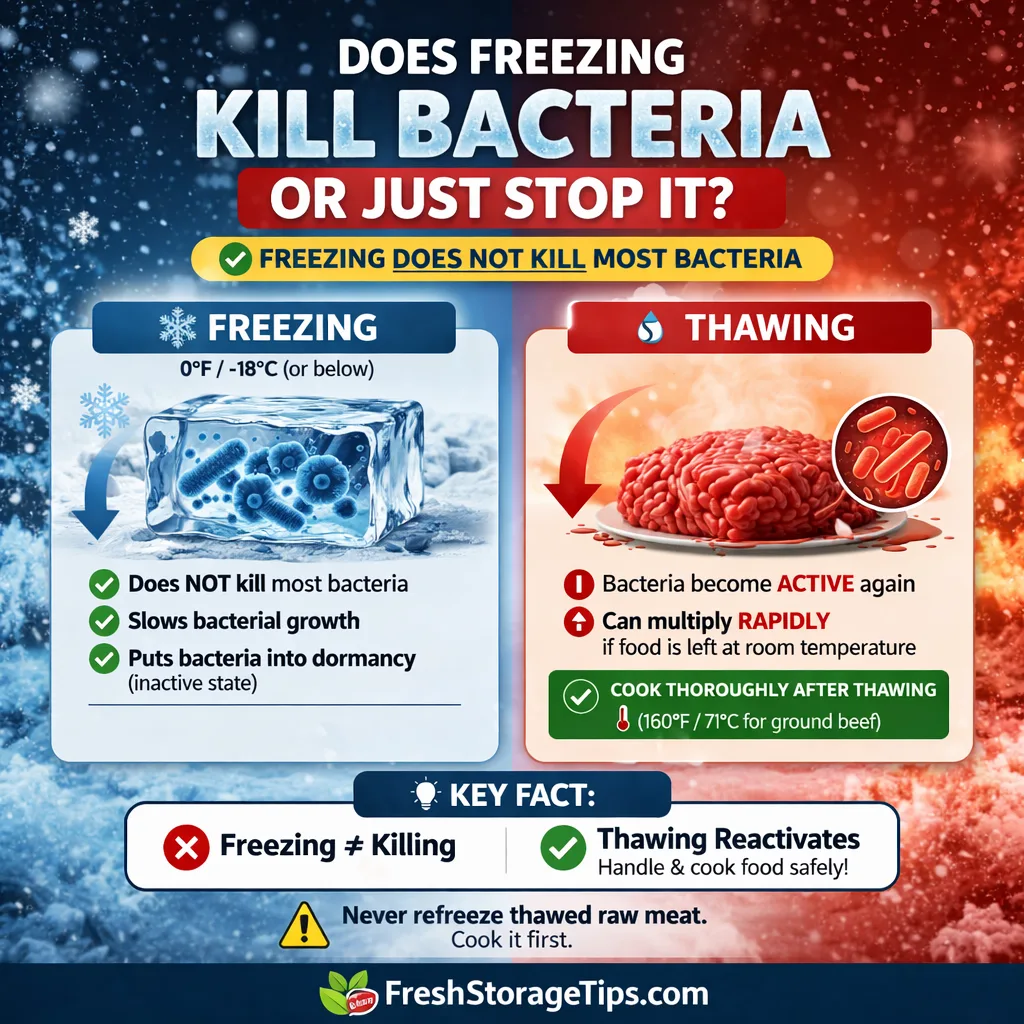
The infographic shows the bacterial journey through the freeze-thaw cycle visually: a high but manageable count going in, dormancy through the frozen period, reactivation on thawing, and the critical fork in the road between safe thawing plus cooking versus unsafe thawing and direct consumption. It also shows the parasite exception and the temperature ranges at which bacteria multiply, slow, stop and die.
One thing the infographic makes clear that text sometimes obscures is the speed of bacterial multiplication once the danger zone is re-entered. From dormant at 0‑°F to doubling every 20 minutes at 68‑°F is a very short temperature range traversed very quickly during counter thawing. A piece of frozen chicken placed on the counter at 8am has been in the danger zone for hours by the time it is fully thawed at noon. Understanding this timeline is also relevant to other perishable foods that go through freeze-thaw cycles, including staple foods stored long-term that require proper thawing and preparation.
“The freezer is a pause button, not a reset button. Whatever bacteria were present when you pressed pause will still be there when you press play.”
Six habits that keep frozen food genuinely safe
The bacterial count you freeze with is the bacterial count you thaw with. Freeze raw meat and fish on the day of purchase for the lowest starting count. Day-2 freezing means day-2 bacteria go into your freezer and come back out.
Fridge thawing keeps food below 40‑°F throughout, maintaining bacterial dormancy. Counter thawing puts the outer layers in the danger zone for hours. No shortcut here is worth the risk.
A meat thermometer is the only reliable kill-step confirmation. Colour, firmness and steam are unreliable indicators of internal temperature. 160‑°F for ground beef, 165‑°F for poultry, 145‑°F for whole cuts.
Freezing cannot reverse spoilage and cannot neutralise toxins already produced by bacteria. Meat that was off before freezing will still be off after thawing, and the toxins present will survive cooking. If it was not safe to eat before freezing, it will not be safe after.
Bacterial count is time-sensitive from the moment of purchase, not just from the moment of freezing. Label every item with both the purchase date and the freeze date so you know the full age of the food when it comes out.
Most home freezers cycle between -5‑°F and 10‑°F rather than maintaining a constant 0‑°F. A freezer thermometer tells you your actual operating range. Temperatures above 0‑°F allow some cold-tolerant bacteria to slowly multiply even in the freezer.
This video covers the science of bacterial dormancy, why thawing reactivates bacteria and why cooking is the only reliable kill step for foodborne pathogens.
Tools that make frozen food safety practical
Simple equipment that removes the guesswork from safe freezing and cooking.
Instant-Read Meat Thermometer
The only reliable way to confirm food has reached the kill-step temperature. Essential for ground beef at 160‑°F, poultry at 165‑°F and whole cuts at 145‑°F. Colour alone is not a safe indicator.
View on AmazonFreezer Thermometer
Most home freezers cycle above 0‑°F regularly. A dedicated freezer thermometer tells you your actual operating temperature, not just what the dial says. Essential for confirming proper bacterial dormancy conditions.
View on AmazonVacuum Sealer
Removes air from frozen food packaging, significantly reducing freezer burn and extending quality. Less air means less oxidation and better preservation of food that is already safely frozen at a low bacterial count.
View on AmazonFreezer Labels
Label every item with the purchase date and freeze date. Knowing both dates tells you the full age of the food, not just the freezer time. Age at time of freezing is just as important as total storage duration.
View on AmazonAs an Amazon Associate I earn from qualifying purchases — at no extra cost to you.
Questions people actually ask
No. Freezing does not kill most bacteria. It puts them into a dormant, inactive state where they stop multiplying. When the food thaws, bacteria become active again and can multiply rapidly if the food enters the temperature danger zone between 40‑°F and 140‑°F.
Heat kills bacteria. Cooking food to a safe internal temperature destroys the bacteria present. The USDA recommends 160‑°F for ground beef, 165‑°F for poultry, and 145‑°F for whole cuts of meat, fish and pork. Freezing at 0‑°F stops bacterial growth but does not reach the temperatures needed to destroy bacteria.
Yes, if it was thawed in the fridge at 40‑°F or below and still within its safe storage window. Meat thawed in the fridge can be refrozen without cooking first, though quality may decline with each freeze-thaw cycle. Meat thawed at room temperature or in warm water should be cooked before refreezing.
Yes, freezing can kill certain parasites. The FDA recommends freezing fish at -4‑°F (-20‑°C) for 7 days or at -31‑°F (-35‑°C) for 15 hours to destroy Anisakis parasites. Trichinella in pork is also killed by proper freezing. Freezing is more effective against parasites than against bacteria.
Most bacteria survive indefinitely in the freezer in a dormant state. Studies have found viable bacteria in food frozen for years. Some cold-tolerant species called psychrophiles can even slowly multiply at very low temperatures. Freezing is preservation, not sterilisation.