Home » Archives for Marleen Van Der Zijl » Page 6
advice How long does ground beef last
Meat Storage
fresh raw ground beef in a glass bowl on kitchen counter ready for fridge storage
Bottom shelf of the fridge, away from the door — the coldest and most stable spot for raw ground beef.

How Long Does Ground Beef Last? (Only 1–2 Days in the Fridge)

Raw ground beef lasts 1–2 days in the fridge. Freeze it within that window and it keeps for 3–4 months in the freezer when stored correctly. Cooked ground beef lasts 3–4 days in the fridge and 2–3 months in the freezer when stored correctly. The short fridge window exists because grinding increases surface area dramatically — giving bacteria far more contact with the meat than a whole steak provides.

I bought ground beef on a Sunday once and forgot about it until Wednesday. That four-day gap is exactly one to two days past the safe limit, and the smell confirmed it. Unlike bacon, which has curing agents that extend its shelf life considerably, ground beef has no such protection — it is one of the most perishable proteins in the fridge. The rules here are stricter than almost anything else you store.

The single most useful habit I developed was buying ground beef with a plan already in place: cook it tonight, or freeze it today. There is no comfortable middle ground. The same short window applies to chicken breast, where the 1–2 day fridge limit is identical and the spoilage signs equally important to recognise. This article covers the exact timelines, why ground beef spoils so fast, and how to read the signs before they become a problem.

The short version

Raw ground beef: 1–2 days in the fridge when stored correctly. Cooked: 3–4 days in the fridge when stored correctly. Freezer (raw): 3–4 months in the freezer when stored correctly. Freezer (cooked): 2–3 months in the freezer when stored correctly. Store on the bottom shelf at 40‑°F or below. Freeze in flat portions for faster thawing. Never leave raw ground beef at room temperature (counter) for more than 2 hours — bacteria double every 20 minutes above 40‑°F. See also how to store deli meat for another protein where the fridge window is the critical variable.

Why ground beef spoils faster than other cuts (surface area is the real cause)

A whole steak has a relatively small surface area exposed to air and bacteria. Ground beef has been run through a grinder that breaks it into thousands of tiny particles — each one a new surface exposed to oxygen and microorganisms. The same weight of meat has exponentially more contact area with the environment after grinding than before.

This is why the USDA gives ground beef a 1–2 day fridge limit while a whole steak gets 3–5 days. It is not that the beef itself is different — it is that the processing creates conditions where bacteria can multiply much faster. Pathogens like E. coli O157:H7 and Salmonella that may sit on the outer surface of a whole cut get distributed throughout the grind, making thorough cooking to 160‑°F (71‑°C) essential for every portion.

Food safety science

The USDA FSIS ground beef food safety guidelines set a 1–2 day refrigerator limit for raw ground beef stored at 40‑°F (4‑°C) or below. Above 40‑°F, bacteria double approximately every 20 minutes — meaning a pack left on a warm counter in a 70‑°F kitchen for 2 hours can have significantly elevated bacterial loads before it has even discoloured.

The CDC beef food safety page confirms that E. coli O157:H7 is the primary concern with ground beef, and that it is destroyed by cooking to an internal temperature of 160‑°F throughout — not just on the surface. The USDA further notes that ground beef can be frozen indefinitely from a safety standpoint, but quality declines noticeably after 3–4 months.

Temperature is the single most important variable. A fridge running at 38‑°F extends ground beef life to the full 2-day window. A fridge running at 45‑°F — common near the door or in an overfull fridge — can halve that. This is why the bottom shelf, away from the door, at the back of the fridge is the correct location: it is the coldest and most temperature-stable spot in the appliance.

Fridge vs freezer vs counter — the honest timelines

Longest storage

Freezer

0‑°F — flat portions, labelled

Raw: 3–4 months in the freezer when stored correctly. Cooked: 2–3 months when stored correctly. Safe beyond that — quality declines after 4 months. Thaw in fridge overnight, never on the counter.

Very short window

Fridge (raw)

40‑°F or below — bottom shelf

1–2 days when stored correctly. Use or freeze on the day of purchase for maximum safety. Cooked beef gets 3–4 days — cooking resets the safety clock.

Never do this

Counter (room temperature)

Above 40‑°F

Maximum 2 hours at room temperature. Above 90‑°F that drops to 1 hour. Never thaw on the counter — outside reaches the danger zone long before the centre thaws.

Myth worth addressing

“If it still smells fine, it is safe to eat.”

This is one of the most dangerous food safety myths. E. coli O157:H7 — the primary pathogen of concern in ground beef — produces no detectable smell at dangerous concentrations. Spoilage bacteria (which do cause the sour, off smell) are largely separate from pathogenic bacteria. A pack of ground beef can smell perfectly normal and still carry harmful bacterial loads. Use the purchase date as your primary decision tool, not your nose. Smell is a useful secondary check, not a primary safety indicator.

Shelf life at a glance

TypeLocationHow longKey tip
Raw ground beef Fridge, bottom shelf, 40‑°F or below 1–2 days Use or freeze on day of purchase for maximum safety.
Raw ground beef Freezer, 0‑°F, flat in labelled bag 3–4 months Safe beyond 4 months but quality declines. Always label with date.
Cooked ground beef Fridge, airtight container, cooled first 3–4 days Cool completely before sealing — never seal hot meat.
Cooked ground beef Freezer, labelled airtight bag 2–3 months Texture softens slightly after thawing — fine for sauces and soups.
Raw, mixed with vegetables Fridge Maximum 24 hours Vegetable moisture accelerates spoilage. Cook the same day.
Raw, counter (room temperature) Out of fridge Maximum 2 hours 1 hour if kitchen is above 90‑°F. Discard after this window.

Can you eat ground beef after 3 days?

No — raw ground beef should not be eaten after 3 days in the fridge. The safe limit is 1–2 days when stored at 40‑°F (4‑°C) or below. After that, the risk of harmful bacteria increases significantly — even if the meat looks and smells normal. The USDA is explicit: raw ground beef past 2 days should be discarded or was safe to freeze on day 1 or 2, but not later. Cooking it does not make it safe — some bacterial toxins survive heat.

Cooked ground beef is different: 3 days in the fridge is still within the safe 3–4 day window for cooked meat. The rule changes because cooking destroys the initial bacterial load and resets the clock. But raw beef at 3 days is past its limit regardless of appearance or smell.

Storage infographic — timelines at a glance

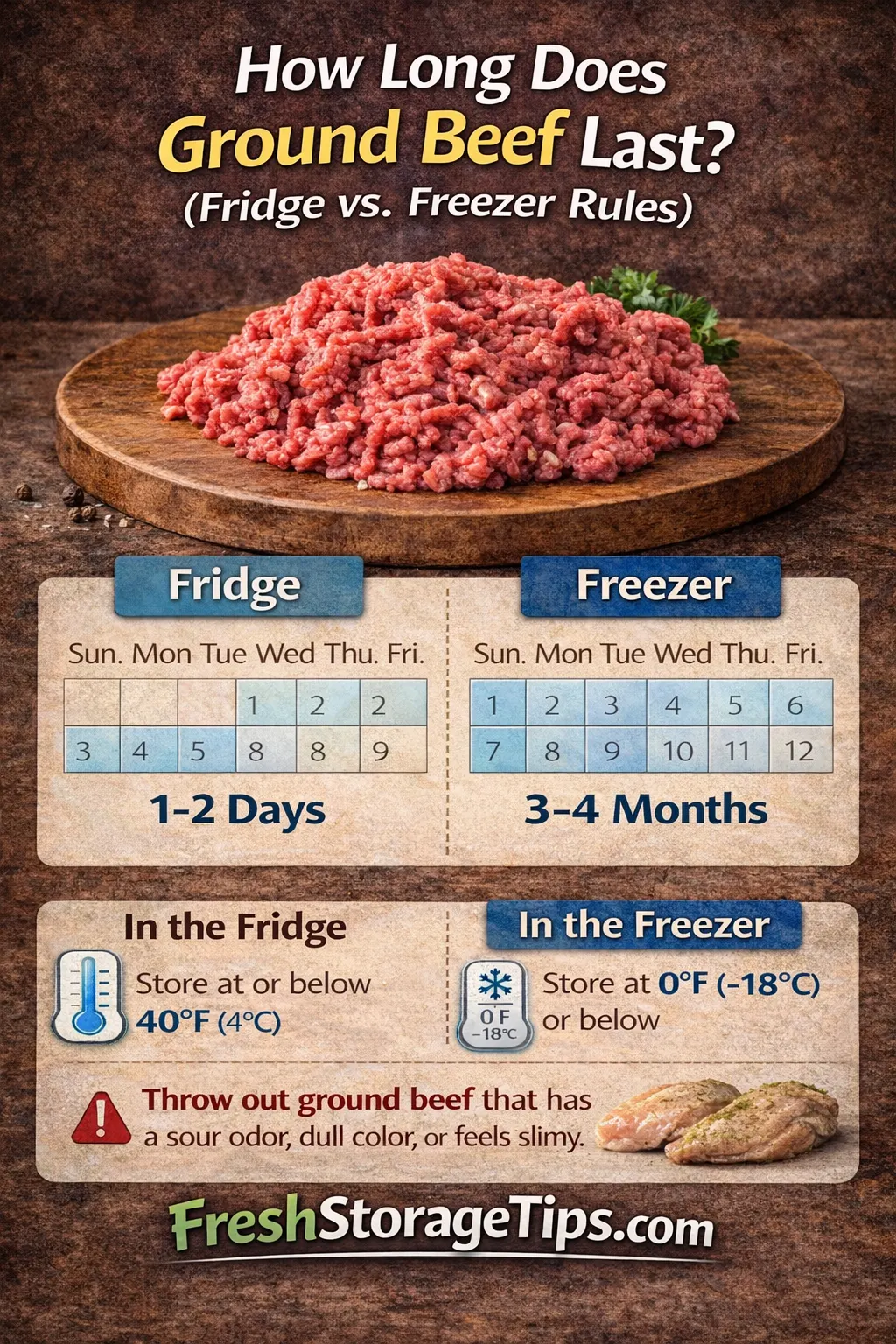
Infographic: ground beef fridge 1-2 days, freezer 3-4 months, cooked fridge 3-4 days
The key timelines at a glance — print this and put it on the fridge.

The two numbers that matter most are the two extremes: 1–2 days for raw beef in the fridge, and 3–4 months for raw beef in the freezer when stored correctly. Everything else — cooked fridge, cooked freezer — sits between those anchors.

The cooked beef numbers are worth noting separately. Browning a large batch of ground beef on Sunday and refrigerating it in sealed portions means you have safe, ready-to-use protein through Wednesday or Thursday — without the raw 1–2 day clock pressure. This is the basis of the meal-prep approach for ground beef: cook it in bulk, refrigerate in portions, and the fridge window becomes genuinely useful rather than anxiety-inducing.

If you regularly lose raw ground beef to the 1–2 day window, the solution is not to push the limit — it is to build the freeze step into your grocery routine. Bring it home, portion it flat immediately, freeze everything you will not cook today. Labels with date and weight make this nearly automatic.

Interactive storage chart

Filter by beef type or search for the storage situation you need. Click any column header to sort.

Beef type Location Lasts Key tip
Raw — fridge Bottom shelf, 40‑°F or below 1–2 days Use or freeze on day of purchase.
Cooked — fridge Airtight container, cooled first 3–4 days Cool completely before sealing.
Raw — freezer 0‑°F, flat in labelled bag 3–4 months Flatten to save space and thaw faster.
Cooked — freezer 0‑°F, labelled airtight bag 2–3 months Texture softens slightly — fine for sauces.
Raw — mixed with veg Fridge Max 24 hours Vegetable moisture speeds spoilage. Cook same day.
Raw — counter (room temperature) Out of fridge Max 2 hours 1 hour above 90‑°F. Discard after this window.

How to spot spoiled ground beef (the three checks)

Use all three checks together — and always alongside the purchase date. Visual colour alone is the least reliable indicator.

Colour

Fresh ground beef is bright red on the outside (oxymyoglobin from oxygen exposure). The interior of a pack is often brown or grey — this is normal, caused by lack of oxygen, not spoilage. What is not normal: grey or green colouring on the outside surface, or any green tinge anywhere. A fully grey-brown exterior combined with the other signs below means discard immediately.

Smell

Fresh raw beef has an almost imperceptible metallic scent or no smell at all. A sour, vinegary, or ammonia-like smell is a clear spoilage indicator — but as noted above, absence of smell does not mean safety. The pathogens of greatest concern produce no detectable odour at dangerous concentrations. Use smell as a supporting check, not the deciding one.

Texture

Raw ground beef should feel slightly damp but not sticky or slimy. A tacky, sticky surface or any visible film indicates active bacterial spoilage. If it feels slimy at all, discard without tasting or cooking.

My test: fridge door vs bottom shelf back, same pack, 48 hours

I split one 500g pack of raw ground beef into two identical glass containers. One went near the fridge door on the middle shelf. The other went on the bottom shelf at the back — the coldest, most stable location.

At 24 hours: No visible difference. Both still largely bright red on the surface, no detectable smell from either container.

At 48 hours: Door container had begun to grey around the edges and had a faint sour note when opened. Bottom-shelf container was still largely red with no off smell.

Fridge temperature check: Door area measured 44‑°F during the test. Bottom shelf back measured 37‑°F. A 7-degree difference that roughly doubles the rate of bacterial multiplication according to USDA bacterial growth curves.

The lesson is simple: location inside the fridge matters as much as the fridge setting itself. Bottom shelf, back of the fridge, every single time.

How to freeze ground beef correctly

Freezing is the only way to extend ground beef beyond its 2-day fridge limit while keeping it safe. The method determines how practical it is when you need to use it.

The flat-portion method

  1. Portion into usable amounts — 250g, 500g, or whatever your typical recipe calls for. Freezing in recipe-sized amounts means you thaw only what you need.
  2. Place each portion in a heavy freezer bag. Squeeze out every bit of air — oxygen causes freezer burn that makes the beef dry and metallic-tasting.
  3. Flatten each bag to about 1cm thickness. Flat portions thaw in the fridge in 4–6 hours instead of overnight for a ball or block. This single step makes the difference between a useful freezer stash and one you never bother with.
  4. Label with date and weight. All frozen ground beef looks identical after a few weeks. The label is the only information you have.
  5. Freeze immediately — do not let it sit in the fridge first if you are already within the 1–2 day window.
  6. Use within 3–4 months in the freezer when stored correctly for best quality.

Thawing safely

The only safe thawing methods are in the fridge (overnight for a ball, 4–6 hours for a flat portion) or under cold running water in a sealed bag. Never thaw on the counter — the outside of the beef reaches room temperature and enters the bacterial danger zone long before the centre thaws. A flat-frozen portion under cold running water takes about 30–45 minutes.

“Buy it with a plan. Cook it today, or freeze it today. The 1–2 day window does not forgive a change of plans.”

Storage tips

Six rules for safe ground beef storage

1
Bottom shelf, back of fridge — always

The coldest and most temperature-stable location. Door and middle shelf positions run warmer and fluctuate with every opening. Bottom shelf at the back stays closest to 37–38‑°F consistently.

2
Cook it or freeze it on the day you buy it

Raw ground beef has a 1–2 day fridge window. If you do not have a recipe planned for today or tomorrow, freeze it the moment you get home. This is the single most effective ground beef safety habit.

3
Freeze flat in labelled portions

Flat frozen portions thaw in 4–6 hours in the fridge instead of overnight. Label each bag with date and weight — after a month in the freezer, all ground beef looks identical.

4
Never trust smell alone

E. coli O157:H7 produces no detectable odour at dangerous concentrations. Use the purchase date as your primary decision tool. A pack can smell fine and still carry harmful bacterial levels after 2 days at fridge temperature.

5
Cool cooked beef before sealing

Sealing hot ground beef traps steam, raises the container temperature, and creates condensation that accelerates spoilage. Spread it to cool for 20–30 minutes, then seal and refrigerate within 2 hours of cooking.

6
Never thaw on the counter

The outside surface reaches room temperature and the bacterial danger zone long before the centre thaws. Fridge thawing or cold running water in a sealed bag are the only safe methods. Flat portions make fridge thawing practical.

How ground beef compares to other proteins in your fridge

Ground beef has one of the shortest fridge windows of any common protein — shorter than whole beef cuts, shorter than most fish, and matched only by other ground meats and raw poultry. Understanding where it sits relative to other proteins makes meal planning significantly less stressful.

Protein fridge storage comparison — raw, stored at 40‑°F or below

Ground beef (raw)Fridge: 1–2 days when stored correctly. Freeze immediately if not cooking today or tomorrow.
Chicken breast (raw)Fridge: 1–2 days when stored correctly. Same short window, same rules as ground beef.
Bacon (opened)Fridge: up to 7 days when stored correctly. Curing extends shelf life significantly.
Deli meat (opened)Fridge: 3–5 days when stored correctly. Sealed airtight after opening.
Whole steak (raw)Unlike ground beef, steak lasts longer in the fridge due to lower surface exposure — 3–5 days when stored correctly.
Cooked ground beefFridge: 3–4 days when stored correctly. Cooking resets the safety clock entirely.
YouTube
Watch: Ground beef storage and safety explained
Fridge vs freezer timelines, spoilage signs, and safe thawing

A clear walkthrough of the USDA safety guidelines, how to read spoilage signs correctly, and why the smell test alone is not a reliable safety indicator for ground beef.


amazon

What I use for ground beef storage

Simple tools that make safe fridge and freezer storage effortless.

🏷️

Removable Date Labels

Label every freezer bag of ground beef with the date and weight. After a month in the freezer all portions look identical — the label is the only information you have. Peel off cleanly with no residue.

View on Amazon
🧊

Heavy-Duty Freezer Bags

Thicker than standard bags — essential for flat-frozen beef portions. Squeeze out all air before sealing to prevent freezer burn. Flat portions thaw in 4–6 hours in the fridge instead of overnight.

View on Amazon
🍴

Airtight Glass Containers

For cooked ground beef in the fridge. Glass does not absorb meat odours, seals cleanly, and keeps temperature stable. Always cool beef completely before sealing — never seal hot meat in glass.

View on Amazon
🔧

Precision Pro Vacuum Sealer

For the longest freezer life, a vacuum sealer removes all air and prevents freezer burn entirely. Vacuum-sealed flat ground beef portions hold quality for the full 3–4 month window without degradation.

View on Amazon

As an Amazon Associate I earn from qualifying purchases — at no extra cost to you.

Raw ground beef lasts only 1 to 2 days in the fridge and 3 to 4 months in the freezer. Steak lasts 3 to 5 days in the fridge, significantly longer than ground beef, because grinding increases the surface area where bacteria can grow. Other raw meats like bacon are cured and last up to 7 days once opened, making them much more fridge-stable than fresh ground beef. Knowing the signs that meat has gone bad is just as important as knowing the shelf life because ground beef can smell off before the use-by date if stored incorrectly.

Questions people actually ask

How long does raw ground beef last in the fridge?

1–2 days when stored correctly at 40‑°F (4‑°C) or below on the bottom shelf. The short window is caused by the grinding process creating exponentially more surface area for bacterial colonisation than whole cuts. Use or freeze on the day of purchase for maximum safety. See how chicken breast compares — it has the same 1–2 day fridge window and the same freeze-or-cook logic.

How long does ground beef last in the freezer?

Raw ground beef lasts 3–4 months in the freezer when stored correctly for best quality. It remains safe to eat beyond that, but flavour and texture decline noticeably after 4 months. Cooked ground beef lasts 2–3 months in the freezer when stored correctly. Always label with date and weight — frozen ground beef is impossible to identify after a few weeks without a label.

Is brown ground beef spoiled?

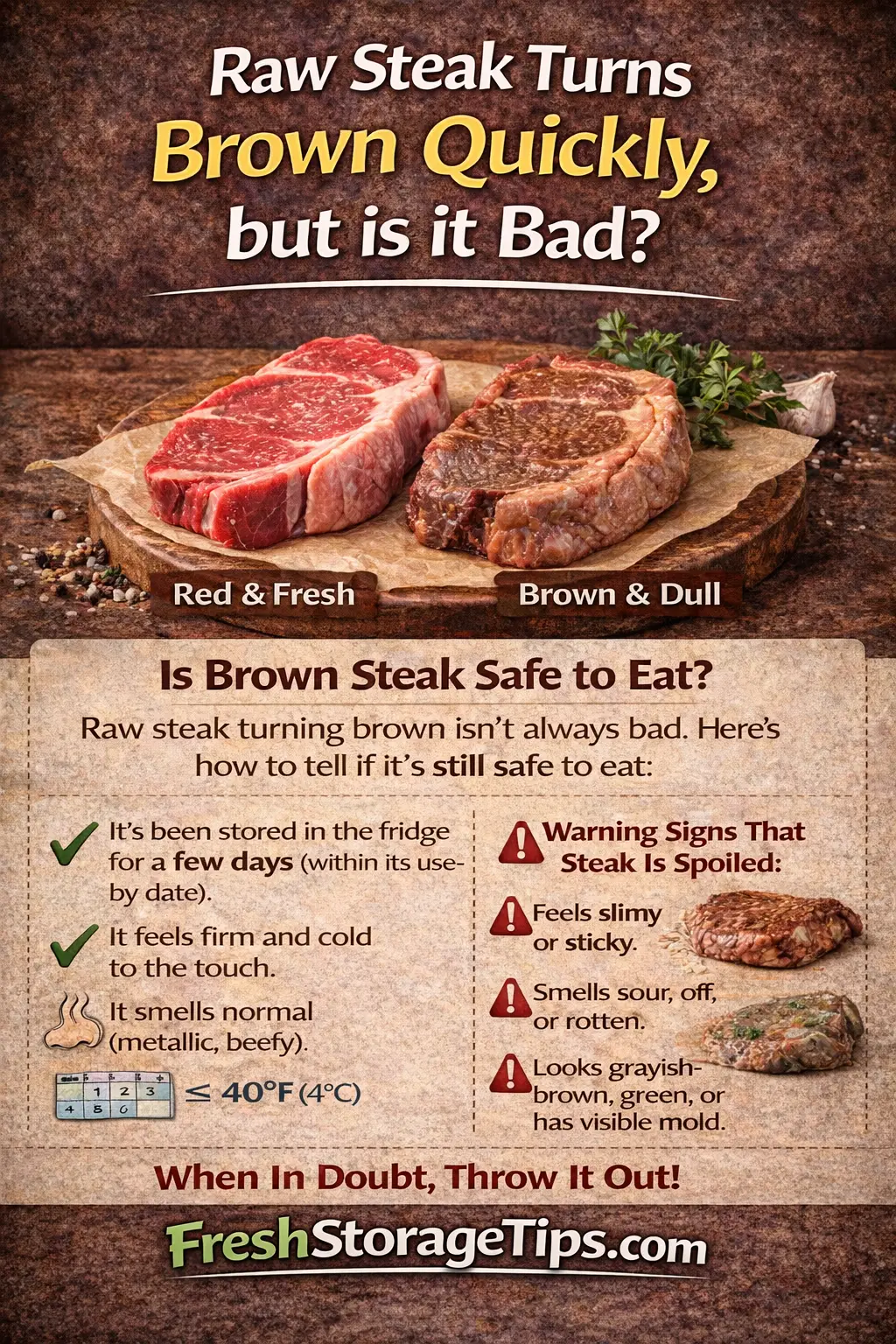
Not necessarily. Brown or grey colouring inside a pack is normal — caused by lack of oxygen exposure (metmyoglobin). If the outside surface has turned brown or grey AND has an off smell or slimy texture, discard it. Brown in the centre with a normal exterior and no smell is not a spoilage indicator. Use the purchase date as your primary decision tool — not the colour alone.

Can you refreeze ground beef after thawing?

Yes — if it was thawed in the fridge, not on the counter. Fridge-thawed beef that has not exceeded its safe window can be refrozen safely. Texture degrades with each freeze–thaw cycle — the beef becomes less juicy. Never refreeze beef thawed at room temperature, as bacteria may have multiplied to unsafe levels during the thawing period.

How long does cooked ground beef last?

3–4 days in the fridge when stored correctly in a sealed airtight container. Cool completely before sealing — sealing hot meat traps steam and raises the container temperature, which accelerates spoilage. Cooked ground beef in the freezer lasts 2–3 months in the freezer when stored correctly. Cooking in bulk and refrigerating in portions is the most practical way to use the longer cooked window for meal prep. See also how deli meat compares — another cooked protein where the fridge window is the key variable.

Marleen van der Zijl, founder of FreshStorageTips.com
About the author

Marleen is a HACCP-certified food safety practitioner and founder of FreshStorageTips.com. She tests storage methods in her own kitchen and writes from real results — not from repeating what other food sites say.

4 comments
0 FacebookTwitterPinterestEmail
tips from marleen how long does chicken breast last
Meat Storage
fresh raw chicken breast on a cutting board showing colour check for spoilage signs
Pale pink and slightly damp — fresh. Grey, yellow, or slimy — discard immediately.

How to Tell If Chicken Breast Is Bad (3 Signs You Should Never Ignore)

Chicken breast has gone bad if it smells sour or like ammonia, looks grey or yellow on the surface, or feels slimy to the touch. Any one of these three signs means discard — do not rinse it and cook it anyway. Raw chicken lasts only 1–2 days in the fridge, so the purchase date is your most important reference, not just your senses.

  • Smell: Sour, ammonia-like, or persistent eggy smell — discard
  • Colour: Grey, yellow, or green on the surface — discard
  • Texture: Slimy, sticky, or tacky to the touch — discard
  • Date: Raw chicken past 2 days in the fridge — discard regardless of the above

I have thrown away chicken more than once after staring at it too long trying to decide. The problem is that the most dangerous spoilage — Salmonella and Campylobacter contamination — produces no reliable visual or smell cue at unsafe levels. Unlike ground beef, where the 1–2 day clock is the same but the surface area problem is different, chicken has its own set of spoilage signals that are worth understanding precisely.

The three physical checks below are the most reliable tools you have — but the date on the package is more reliable than all of them combined. Chicken that is on day 3 in the fridge is past its safe limit even if it passes all three checks. See also how to store bacon — a cured meat where the fridge window is dramatically longer because of the salt and nitrates involved, making chicken’s short window easier to understand by contrast.

The short version

Three signs chicken has gone bad: sour or ammonia smell, grey or yellow surface colour, slimy or sticky texture. Raw chicken lasts 1–2 days in the fridge when stored correctly at 40‑°F or below. Cooked chicken lasts 3–4 days in the fridge when stored correctly. Frozen raw chicken: 9–12 months in the freezer when stored correctly. Never trust smell alone — the pathogens of greatest concern produce no detectable odour. Use the date first, senses second. See also how long ground beef lasts for a protein with the same 1–2 day fridge window and identical freeze-or-cook logic.

The 3 signs chicken breast has gone bad

Use all three checks together — and always alongside the purchase date. No single check is reliable on its own.

Sign 1: Smell

Fresh raw chicken has almost no smell — a very faint, neutral scent at most. A sour, ammonia-like, or persistently eggy smell that does not fade within a minute of opening the pack means spoilage. Discard immediately.

One important exception: a mild sulphur or eggy smell from a vacuum-sealed pack that disappears within 60 seconds of opening is normal. Harmless lactic acid bacteria produce this gas in sealed packaging. If the smell fades quickly and the colour and texture check out, the chicken is fine. If the smell persists — discard.

Sign 2: Colour

raw chicken breast colour comparison showing fresh pale pink versus grey spoiled
Pale pink = fresh. Any grey or yellow on the surface = discard.

Fresh chicken breast is pale pink with white fat. As it ages, it may turn slightly darker pink — this alone is not a spoilage indicator. What is a spoilage indicator: grey, yellow, or green colouring on the surface of the meat. Any of these, especially in combination with an off smell, means discard.

Some browning at the edges of very fresh chicken is caused by oxidation and is not necessarily dangerous — but it is a signal that the clock is running out. Brown-edged chicken that still smells fine and is within the 1–2 day window can be cooked safely. Brown-edged chicken at day 3 should be discarded regardless.

Sign 3: Texture

Raw chicken should feel slightly damp but never slimy, sticky, or tacky. If you touch the surface and it feels like it has a film or coating, or it pulls slightly against your fingers in a way that feels tacky — discard it. Do not rinse it and cook it. Rinsing raw chicken spreads bacteria around the sink, counter, and any nearby surfaces. Cooking slimy chicken does not make it safe — the sliminess indicates active bacterial spoilage that heat cannot reverse.

Why is my chicken slimy? (and is it still safe?)

Slimy chicken is not safe to eat. The sliminess is caused by bacterial biofilm — a layer of microbial activity on the surface of the meat. It is one of the clearest physical signs of spoilage you can find and it means the bacterial population has progressed well beyond early-stage growth.

There is one exception worth knowing: chicken that has been stored in a vacuum-sealed pack can feel slightly slippery when first removed — this is from the lactic acid bacteria in the sealed environment, not spoilage. The difference is easy to identify: rinse under cold water and pat dry. If the sliminess returns within a few minutes, it is spoilage. If the surface feels normal after drying and there is no off smell, the chicken is fine.

Never try to wash slimy chicken and cook it anyway. The USDA explicitly advises against washing raw poultry because it splashes bacteria across the sink, countertops, and any food nearby — and it does not remove the surface film that indicates spoilage. The texture tells you the bacterial load has already reached a level where cooking cannot guarantee safety.

Food safety science

The USDA FSIS chicken food safety guidelines set a 1–2 day refrigerator limit for raw chicken at 40‑°F (4‑°C) or below. The primary pathogens of concern — Salmonella and Campylobacter — produce no detectable smell at dangerous concentrations. This is why USDA guidance explicitly states that smell is an unreliable safety indicator for poultry.

The CDC Salmonella and chicken page notes that Salmonella causes approximately 1.35 million infections in the US each year, with poultry as a primary source. Cooking chicken to an internal temperature of 165‑°F (74‑°C) throughout destroys these pathogens — but only in chicken that has not already produced heat-resistant toxins through extended spoilage.

Myth worth addressing

“If you cook it thoroughly, it does not matter if it has gone off a bit.”

This is wrong and potentially dangerous. Cooking to 165‑°F kills live bacteria — but some spoilage bacteria produce toxins during the decay process that are heat-stable and survive cooking. Staphylococcal enterotoxins, for example, are not destroyed by normal cooking temperatures. If chicken has been sitting at an unsafe temperature or past its safe window long enough for significant bacterial growth, cooking it does not guarantee safety. The USDA position is clear: if in doubt, throw it out. No meal is worth a foodborne illness.

Can you eat chicken breast after 3 days?

Raw chicken: no. The safe limit for raw chicken breast in the fridge is 1–2 days when stored correctly at 40‑°F (4‑°C) or below. At 3 days, raw chicken should be discarded even if it passes the smell, colour, and texture checks. The pathogens of greatest concern produce no detectable sensory changes at dangerous concentrations — the date is a more reliable safety indicator than your senses.

Cooked chicken: yes, if stored correctly. Cooked chicken breast lasts 3–4 days in the fridge when stored correctly in a sealed airtight container. Three days is still within the safe window for cooked poultry. Day 5 is not — discard it at that point regardless of appearance or smell.

Why chicken breast spoils so fast (bacteria is the real cause)

Chicken breast is high in protein and moisture — exactly the conditions that Salmonella, Campylobacter, and Staphylococcus aureus need to multiply. Unlike cured meats such as bacon or deli meat, raw chicken has no preservatives, no salt curing, and no acidification — nothing to slow bacterial growth beyond temperature alone.

Above 40‑°F, bacteria double approximately every 20 minutes. A chicken breast left on a kitchen counter at 70‑°F for 2 hours can reach bacterial counts that make it genuinely risky — without any visible change in appearance. This is why the 2-hour rule (never leave raw chicken at room temperature for more than 2 hours, 1 hour above 90‑°F) is not a suggestion but a hard safety limit.

The fridge does not stop bacterial growth — it slows it dramatically. At 38‑°F, bacteria multiply slowly enough that chicken is safe for 1–2 days. At 45‑°F (common near the fridge door), that window shrinks. This is why location in the fridge — bottom shelf, back, away from the door — matters as much as the thermostat setting.

Shelf life at a glance

TypeLocationHow longKey tip
Raw breast — fridge Bottom shelf, 40‑°F or below 1–2 days Cook or freeze on day of purchase for maximum safety.
Cooked breast — fridge Airtight container, cooled first 3–4 days Cool completely before sealing. Never seal hot chicken.
Raw breast — freezer 0‑°F, airtight bag, labelled 9–12 months Wrap in foil then bag to prevent freezer burn. Label with date.
Cooked breast — freezer 0‑°F, airtight bag, labelled 2–4 months Shred before freezing for faster thawing and easier use.
Ground chicken — fridge Bottom shelf, 40‑°F or below Maximum 1 day Higher surface area = faster spoilage than whole breast.
Raw breast — counter (room temperature) Out of fridge Maximum 2 hours 1 hour if kitchen is above 90‑°F. Discard after this window.

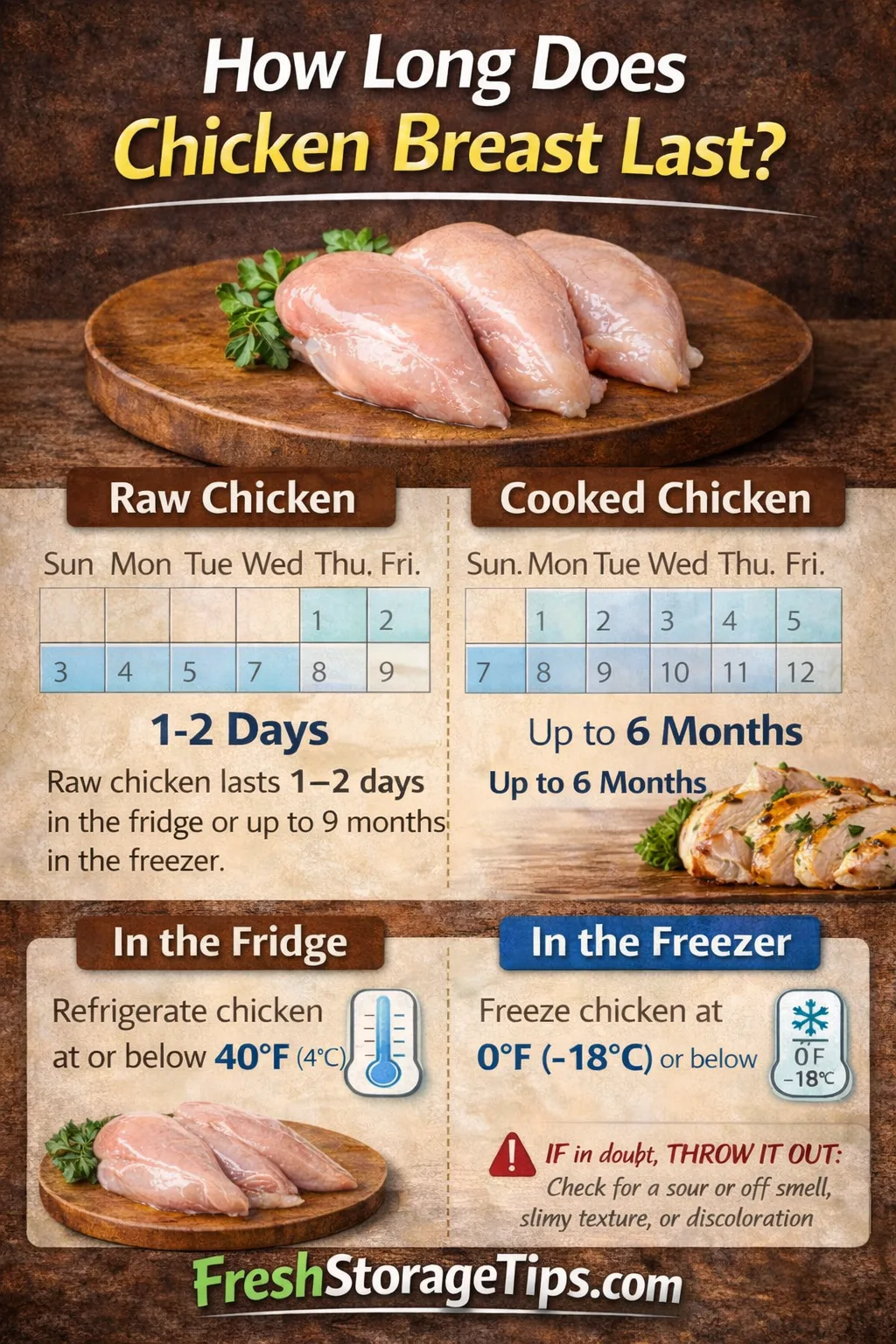
Storage infographic — timelines at a glance

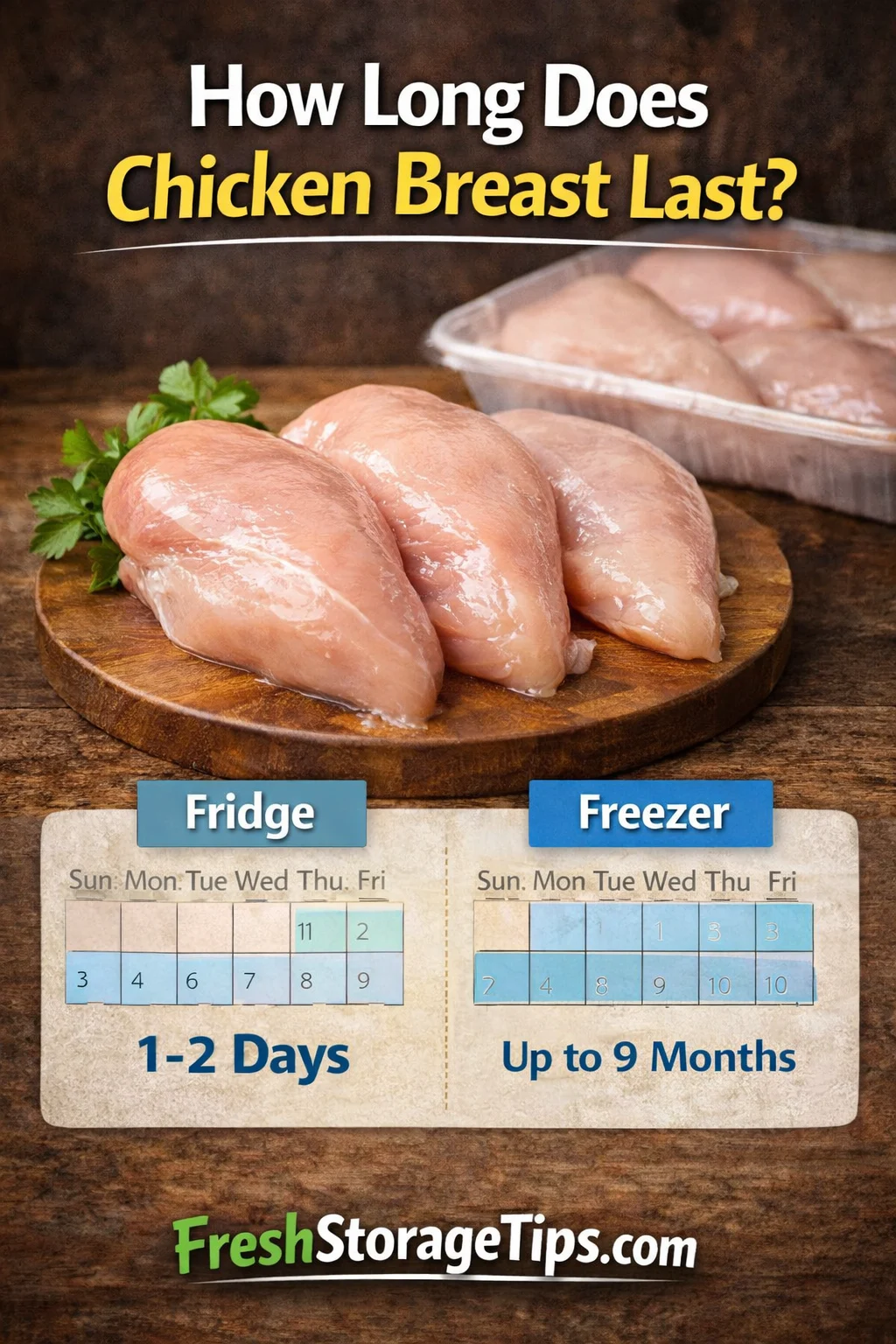
Infographic: raw chicken fridge 1-2 days, cooked fridge 3-4 days, frozen 9-12 months
Print this and keep it near the fridge — the key chicken storage timelines at a glance.

The most important number on this infographic is the one most people underestimate: 1–2 days for raw chicken in the fridge. Most people assume chicken lasts 3–4 days raw — that is the cooked window, not the raw one. Confusing the two is one of the most common causes of poultry-related food poisoning.

The freezer window — 9–12 months for raw breast when stored correctly — is significantly longer than ground beef or even steak. Whole muscle chicken breast is dense enough that freezer burn takes longer to develop, and the lack of grinding means less surface area exposed to air. Wrap in foil before bagging for the best freezer results.

The cooked window of 3–4 days is the most practically useful number for meal prep. Cook a batch of chicken breast on Sunday and you have safe protein for salads, wraps, and stir-fries through Wednesday — without needing to think about the raw 1–2 day clock at all.

Interactive storage chart

Filter by chicken state or search for the storage situation you need. Click any column header to sort.

Chicken type Location Lasts Key tip
Raw breast — fridge Bottom shelf, 40‑°F or below 1–2 days Cook or freeze on day of purchase.
Cooked breast — fridge Airtight container, cooled first 3–4 days Cool completely before sealing.
Raw breast — freezer 0‑°F, foil + airtight bag 9–12 months Wrap in foil before bagging to prevent freezer burn.
Cooked breast — freezer 0‑°F, labelled airtight bag 2–4 months Shred before freezing for easier use.
Ground chicken — fridge Bottom shelf, 40‑°F or below Max 1 day Higher surface area = faster spoilage. Cook same day.
Raw — counter (room temperature) Out of fridge Max 2 hours 1 hour above 90‑°F. Never thaw on the counter.

How to freeze chicken breast correctly

Chicken breast freezes extremely well — better than ground beef or most other proteins — because the dense whole muscle is less prone to freezer burn than ground or processed meat. The key is eliminating air contact.

Raw chicken breast

  1. Do not wash — washing raw chicken splashes bacteria across the sink and surrounding surfaces without making the chicken safer.
  2. Wrap each breast individually in foil — this creates a moisture barrier that significantly reduces freezer burn compared to going straight into a bag.
  3. Place foil-wrapped breasts in a heavy freezer bag. Squeeze out all air and seal.
  4. Label with date and weight. Use within 9–12 months in the freezer when stored correctly for best quality.

Cooked chicken breast

  1. Cool completely first — never seal hot cooked chicken. Spread it out for 20–30 minutes, then seal and refrigerate or freeze within 2 hours of cooking.
  2. Shred before freezing if you plan to use it in salads, soups, or wraps. Shredded chicken freezes in flat portions and thaws faster than whole breasts.
  3. Freeze in recipe-sized portions in labelled freezer bags. Use within 2–4 months in the freezer when stored correctly.

Safe thawing — never on the counter

Thaw in the fridge overnight, or under cold running water in a sealed bag (30–60 minutes). Never on the counter — the outside of the chicken reaches the bacterial danger zone long before the centre thaws. Unlike ground beef, chicken breast is thick enough that counter thawing creates a significant temperature differential between the outer surface and the centre.

My test: fridge door vs bottom shelf back, same pack, 48 hours

I split one pack of raw chicken breast into two identical glass containers. One went near the fridge door on the middle shelf. The other went on the bottom shelf at the back — the coldest spot.

At 24 hours: No difference. Both pale pink, no smell from either.

At 48 hours: Door container had a very faint sour note on opening — not strong, but detectable. Slight grey tinge at the edges. Bottom-shelf container: still pale pink, no smell, surface damp but not slimy.

Temperature check: Door area: 44‑°F. Bottom shelf back: 37‑°F. A 7-degree difference — enough to meaningfully alter bacterial multiplication rates.

The door container chicken went into the bin. The bottom-shelf chicken was cooked that evening — perfectly fine. The difference was purely location, not time.

“The date is more reliable than the smell. The smell is more reliable than the colour. Use all three — but trust them in that order.”

Storage tips

Six rules for safe chicken breast storage

1
Bottom shelf, back of fridge — always

The coldest and most stable spot in the fridge. Door and middle shelves run warmer and fluctuate with every opening. Raw chicken on the bottom shelf also prevents juices dripping onto other food.

2
Cook or freeze on the day you buy it

Raw chicken has a 1–2 day fridge window. If you do not plan to cook it today or tomorrow, freeze it immediately. The smell-and-colour check is not a substitute for acting within the safe window.

3
Never trust smell alone

Salmonella and Campylobacter — the primary pathogens in chicken — produce no detectable smell at dangerous concentrations. A chicken breast can smell fine and still carry unsafe bacterial levels. Date first, senses second.

4
Never rinse raw chicken

Rinsing spreads bacteria across the sink and surrounding surfaces without making the chicken safer. The USDA and CDC both explicitly advise against washing raw poultry. Cooking to 165‑°F throughout is the only reliable pathogen kill step.

5
Cool cooked chicken before sealing

Sealing hot cooked chicken traps steam, raises the container temperature, and creates condensation that accelerates spoilage. Spread it to cool for 20–30 minutes, then seal and refrigerate within 2 hours of cooking.

6
Never thaw on the counter

The outside surface reaches the bacterial danger zone long before the centre thaws. Fridge overnight or cold running water in a sealed bag are the only safe methods. Never thaw chicken in warm water — it dramatically accelerates bacterial growth at the surface.

How chicken breast compares to other proteins in your fridge

Raw chicken breast shares the shortest fridge window of any common protein with ground beef — both are 1–2 days, both for the same reason: high moisture, high protein, no preservation. The contrast with cured meats is dramatic and worth understanding.

Protein fridge storage comparison — raw, stored at 40‑°F or below

Chicken breast (raw)Fridge: 1–2 days when stored correctly. Cook or freeze on day of purchase.
Ground beef (raw)Fridge: 1–2 days when stored correctly. Same window, same freeze-or-cook logic.
Bacon (opened)Fridge: up to 7 days when stored correctly. Salt curing extends shelf life significantly.
Deli meat (opened)Fridge: 3–5 days when stored correctly. Sealed airtight after opening.
Whole steak (raw)Fridge: 3–5 days when stored correctly. Smaller surface area = slower bacterial growth.
Cooked chicken breastFridge: 3–4 days when stored correctly. Cooking resets the safety clock entirely.
YouTube
Watch: Safe poultry handling and spoilage signs
The 3 checks, thawing safely, and why you should never rinse chicken

A practical walkthrough of the USDA guidelines for poultry safety, including the three sensory checks and why the date on the package is more reliable than any of them alone.


amazon

What I use for chicken storage

Simple tools that make safe fridge and freezer storage of poultry effortless.

🏷️

Removable Date Labels

Label every container and freezer bag with the date. Raw chicken lasts only 1–2 days — the date label is the most important food safety tool in your fridge. Peel off cleanly with no residue.

View on Amazon
🍴

Airtight Glass Containers

For cooked chicken in the fridge. Glass does not absorb meat odours, seals cleanly, and keeps temperature stable. Always cool completely before sealing — never seal hot chicken.

View on Amazon
🧊

Heavy-Duty Freezer Bags

For freezing raw or cooked chicken breast. Squeeze out all air before sealing. Use with foil wrapping for raw breasts for maximum freezer-burn protection over the 9–12 month window.

View on Amazon
🔧

Precision Pro Vacuum Sealer

Removes all air for maximum freezer life. Vacuum-sealed chicken breast holds quality for the full 9–12 month window without freezer burn — far better than even double-bagged storage.

View on Amazon

As an Amazon Associate I earn from qualifying purchases — at no extra cost to you.

Raw chicken breast lasts only 1 to 2 days in the fridge, so knowing the signs it has gone off is essential for anyone who meal preps. Cooked chicken lasts 3 to 4 days in the fridge, but the same smell and texture checks apply before reheating. For other raw meats, ground beef also only lasts 1 to 2 days in the fridge and spoils in a very similar way to raw chicken. Other protein foods like hard-boiled eggs last up to 7 days in the fridge and have their own tell-tale signs of spoilage worth knowing.

Questions people actually ask

How can you tell if chicken breast has gone bad?

Check three things: smell (sour, ammonia, or persistent eggy smell = discard), colour (grey, yellow, or green on the surface = discard), and texture (slimy or sticky = discard). Fresh chicken is pale pink, nearly odourless, and slightly damp but not tacky. Use the purchase date as your primary tool — raw chicken lasts only 1–2 days in the fridge when stored correctly. See how ground beef spoilage signs compare — the same three checks apply with the same date-first logic.

Can I eat chicken that has been in the fridge for 3 days?

Raw chicken: no. The safe limit for raw chicken breast is 1–2 days in the fridge when stored correctly at 40‑°F or below. At 3 days, raw chicken should be discarded even if it passes all three sensory checks. Cooked chicken: yes — 3 days is still within the safe 3–4 day window for cooked poultry stored correctly in a sealed airtight container. Day 5 is not safe regardless of how it looks or smells.

Is it safe to eat chicken that smells a little?

A faint eggy or sulphur smell from vacuum-packed chicken is normal — caused by harmless lactic acid bacteria in the sealed environment. It should disappear within 60 seconds of opening. If the smell persists, or is sour, ammonia-like, or distinctly rotten, discard the chicken. Note: absence of smell does not guarantee safety. Salmonella and Campylobacter produce no detectable odour at dangerous concentrations. The date is more reliable than the smell.

Can you cook chicken that has gone grey?

No. Grey or yellow colouring on the surface of raw chicken, especially combined with an off smell or slimy texture, indicates active spoilage. Cooking does not make spoiled chicken safe — some bacterial toxins produced during spoilage are heat-stable and survive cooking to 165‑°F. When in doubt, discard. No meal is worth a foodborne illness.

How long does raw chicken breast last in the fridge?

1–2 days when stored correctly at 40‑°F (4‑°C) or below on the bottom shelf. Freeze it if you will not cook it within that window. The USDA is explicit: do not push raw chicken to day 3 even if it appears and smells normal. Cook or freeze on the day of purchase for maximum safety margin.

Marleen van der Zijl, founder of FreshStorageTips.com
About the author

Marleen is a HACCP-certified food safety practitioner and founder of FreshStorageTips.com. She tests storage methods in her own kitchen and writes from real results — not from repeating what other food sites say.

13 comments
0 FacebookTwitterPinterestEmail
Fresh Storage Tips
Privacy Overview

This website uses cookies so that we can provide you with the best user experience possible. Cookie information is stored in your browser and performs functions such as recognising you when you return to our website and helping our team to understand which sections of the website you find most interesting and useful.