
Chicken breast has gone bad if it smells sour or like ammonia, looks grey or yellow on the surface, or feels slimy to the touch. Any one of these three signs means discard: do not rinse it and cook it anyway. Raw chicken lasts only 1–2 days in the fridge, so the purchase date is your most important reference, not just your senses.
- Smell: Sour, ammonia-like, or persistent eggy smell: discard
- Colour: Grey, yellow, or green on the surface: discard
- Texture: Slimy, sticky, or tacky to the touch: discard
- Date: Raw chicken past 2 days in the fridge: discard regardless of the above
I have thrown away chicken more than once after staring at it too long trying to decide. The problem is that the most dangerous spoilage, Salmonella and Campylobacter contamination, produces no reliable visual or smell cue at unsafe levels. Unlike ground beef, where the 1–2 day clock is the same but the surface area problem is different, chicken has its own set of spoilage signals that are worth understanding precisely.
The three physical checks below are the most reliable tools you have, but the date on the package is more reliable than all of them combined. Chicken that is on day 3 in the fridge is past its safe limit even if it passes all three checks. See also how to store bacon: a cured meat where the fridge window is dramatically longer because of the salt and nitrates involved, making chicken’s short window easier to understand by contrast.
Three signs chicken has gone bad: sour or ammonia smell, grey or yellow surface colour, slimy or sticky texture. Raw chicken lasts 1–2 days in the fridge when stored correctly at 40‑°F or below. Cooked chicken lasts 3–4 days in the fridge when stored correctly. Frozen raw chicken: 9–12 months in the freezer when stored correctly. Never trust smell alone: the pathogens of greatest concern produce no detectable odour. Use the date first, senses second. See also how long ground beef lasts for a protein with the same 1–2 day fridge window and identical freeze-or-cook logic.
The 3 signs chicken breast has gone bad
Use all three checks together, and always alongside the purchase date. No single check is reliable on its own.
Sign 1: Smell
Fresh raw chicken has almost no smell: a very faint, neutral scent at most. A sour, ammonia-like, or persistently eggy smell that does not fade within a minute of opening the pack means spoilage. Discard immediately.
One important exception: a mild sulphur or eggy smell from a vacuum-sealed pack that disappears within 60 seconds of opening is normal. Harmless lactic acid bacteria produce this gas in sealed packaging. If the smell fades quickly and the colour and texture check out, the chicken is fine. If the smell persists: discard.
Sign 2: Colour
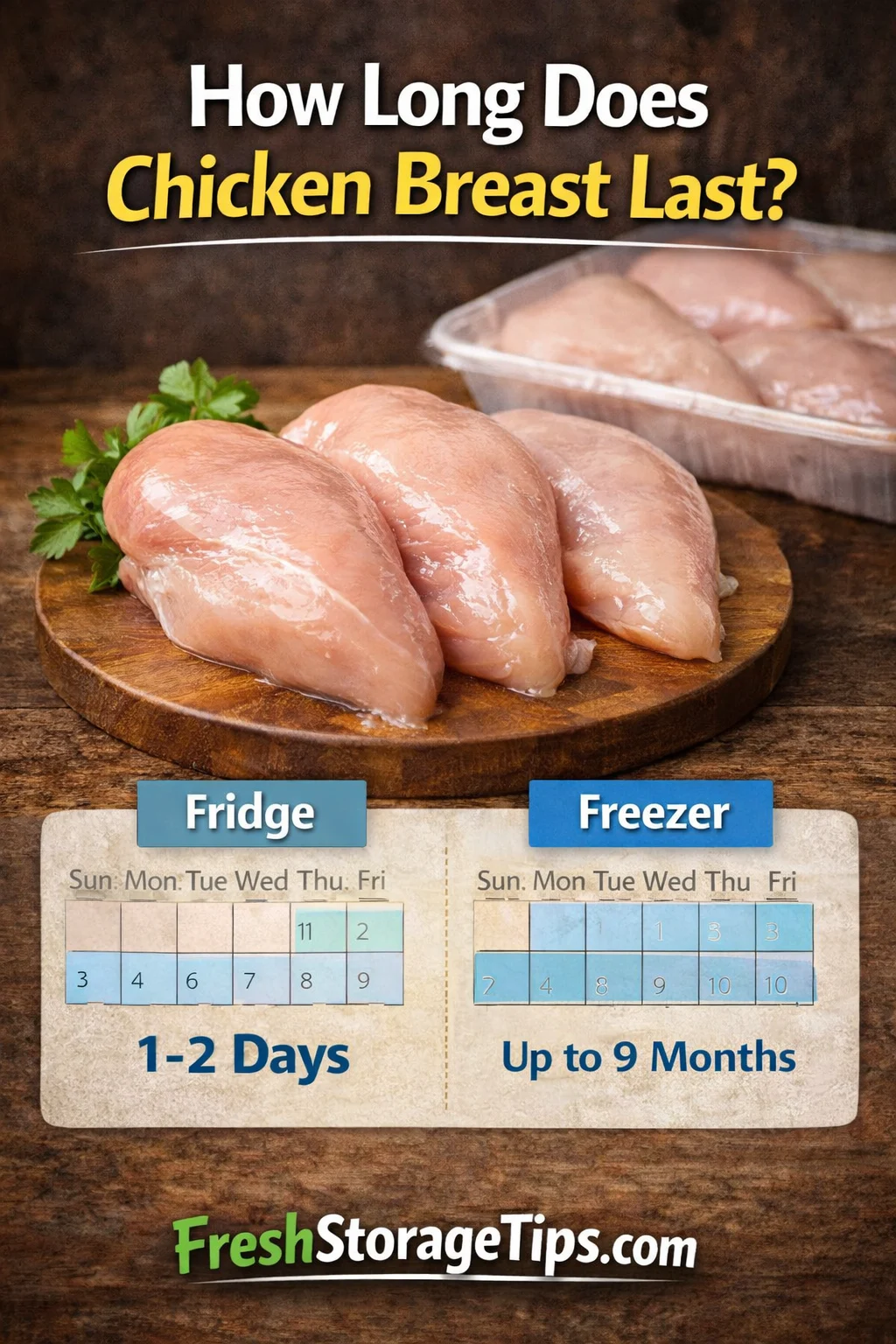
Fresh chicken breast is pale pink with white fat. As it ages, it may turn slightly darker pink: this alone is not a spoilage indicator. What is a spoilage indicator: grey, yellow, or green colouring on the surface of the meat. Any of these, especially in combination with an off smell, means discard.
Some browning at the edges of very fresh chicken is caused by oxidation and is not necessarily dangerous, but it is a signal that the clock is running out. Brown-edged chicken that still smells fine and is within the 1–2 day window can be cooked safely. Brown-edged chicken at day 3 should be discarded regardless.
Sign 3: Texture
Raw chicken should feel slightly damp but never slimy, sticky, or tacky. If you touch the surface and it feels like it has a film or coating, or it pulls slightly against your fingers in a way that feels tacky: discard it. Do not rinse it and cook it. Rinsing raw chicken spreads bacteria around the sink, counter, and any nearby surfaces. Cooking slimy chicken does not make it safe: the sliminess indicates active bacterial spoilage that heat cannot reverse.
Why is my chicken slimy? (and is it still safe?)
Slimy chicken is not safe to eat. The sliminess is caused by bacterial biofilm: a layer of microbial activity on the surface of the meat. It is one of the clearest physical signs of spoilage you can find and it means the bacterial population has progressed well beyond early-stage growth.
There is one exception worth knowing: chicken that has been stored in a vacuum-sealed pack can feel slightly slippery when first removed: this is from the lactic acid bacteria in the sealed environment, not spoilage. The difference is easy to identify: rinse under cold water and pat dry. If the sliminess returns within a few minutes, it is spoilage. If the surface feels normal after drying and there is no off smell, the chicken is fine.
Never try to wash slimy chicken and cook it anyway. The USDA explicitly advises against washing raw poultry because it splashes bacteria across the sink, countertops, and any food nearby, and it does not remove the surface film that indicates spoilage. The texture tells you the bacterial load has already reached a level where cooking cannot guarantee safety.
“If you cook it thoroughly, it does not matter if it has gone off a bit.”
This is wrong and potentially dangerous. Cooking to 165‑°F kills live bacteria, but some spoilage bacteria produce toxins during the decay process that are heat-stable and survive cooking. Staphylococcal enterotoxins, for example, are not destroyed by normal cooking temperatures. If chicken has been sitting at an unsafe temperature or past its safe window long enough for significant bacterial growth, cooking it does not guarantee safety. The USDA position is clear: if in doubt, throw it out. No meal is worth a foodborne illness.
Can you eat chicken breast after 3 days?
Raw chicken: no. The safe limit for raw chicken breast in the fridge is 1–2 days when stored correctly at 40‑°F (4‑°C) or below. At 3 days, raw chicken should be discarded even if it passes the smell, colour, and texture checks. The pathogens of greatest concern produce no detectable sensory changes at dangerous concentrations: the date is a more reliable safety indicator than your senses.
Cooked chicken: yes, if stored correctly. Cooked chicken breast lasts 3–4 days in the fridge when stored correctly in a sealed airtight container. Three days is still within the safe window for cooked poultry. Day 5 is not: discard it at that point regardless of appearance or smell.
Why chicken breast spoils so fast (bacteria is the real cause)
Chicken breast is high in protein and moisture: exactly the conditions that Salmonella, Campylobacter, and Staphylococcus aureus need to multiply. Unlike cured meats such as bacon or deli meat, raw chicken has no preservatives, no salt curing, and no acidification: nothing to slow bacterial growth beyond temperature alone.
Above 40‑°F, bacteria double approximately every 20 minutes. A chicken breast left on a kitchen counter at 70‑°F for 2 hours can reach bacterial counts that make it genuinely risky, without any visible change in appearance. This is why the 2-hour rule (never leave raw chicken at room temperature for more than 2 hours, 1 hour above 90‑°F) is not a suggestion but a hard safety limit.
The fridge does not stop bacterial growth: it slows it dramatically. At 38‑°F, bacteria multiply slowly enough that chicken is safe for 1–2 days. At 45‑°F (common near the fridge door), that window shrinks. This is why location in the fridge, bottom shelf, back, away from the door, matters as much as the thermostat setting.
Shelf life at a glance
| Type | Location | How long | Key tip |
|---|---|---|---|
| Raw breast: fridge | Bottom shelf, 40‑°F or below | 1–2 days | Cook or freeze on day of purchase for maximum safety. |
| Cooked breast: fridge | Airtight container, cooled first | 3–4 days | Cool completely before sealing. Never seal hot chicken. |
| Raw breast: freezer | 0‑°F, airtight bag, labelled | 9–12 months | Wrap in foil then bag to prevent freezer burn. Label with date. |
| Cooked breast: freezer | 0‑°F, airtight bag, labelled | 2–4 months | Shred before freezing for faster thawing and easier use. |
| Ground chicken: fridge | Bottom shelf, 40‑°F or below | Maximum 1 day | Higher surface area = faster spoilage than whole breast. |
| Raw breast: counter (room temperature) | Out of fridge | Maximum 2 hours | 1 hour if kitchen is above 90‑°F. Discard after this window. |
Storage infographic: timelines at a glance
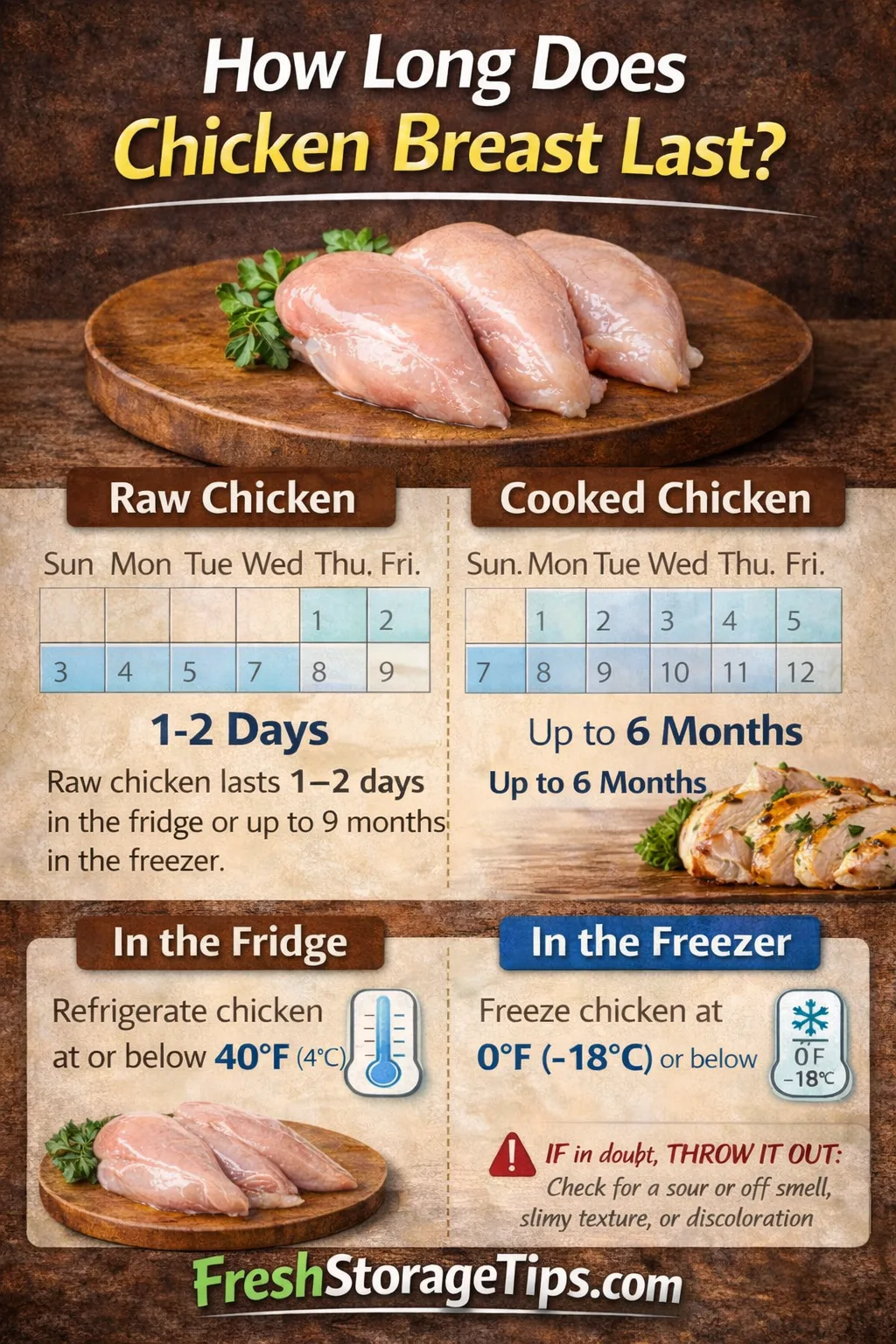
The most important number on this infographic is the one most people underestimate: 1–2 days for raw chicken in the fridge. Most people assume chicken lasts 3–4 days raw: that is the cooked window, not the raw one. Confusing the two is one of the most common causes of poultry-related food poisoning.
The freezer window, 9–12 months for raw breast when stored correctly, is significantly longer than ground beef or even steak. Whole muscle chicken breast is dense enough that freezer burn takes longer to develop, and the lack of grinding means less surface area exposed to air. Wrap in foil before bagging for the best freezer results.
The cooked window of 3–4 days is the most practically useful number for meal prep. Cook a batch of chicken breast on Sunday and you have safe protein for salads, wraps, and stir-fries through Wednesday, without needing to think about the raw 1–2 day clock at all.
Interactive storage chart
Filter by chicken state or search for the storage situation you need. Click any column header to sort.
| Chicken type | Location | Lasts | Key tip |
|---|---|---|---|
| Raw breast: fridge | Bottom shelf, 40‑°F or below | 1–2 days | Cook or freeze on day of purchase. |
| Cooked breast: fridge | Airtight container, cooled first | 3–4 days | Cool completely before sealing. |
| Raw breast: freezer | 0‑°F, foil + airtight bag | 9–12 months | Wrap in foil before bagging to prevent freezer burn. |
| Cooked breast: freezer | 0‑°F, labelled airtight bag | 2–4 months | Shred before freezing for easier use. |
| Ground chicken: fridge | Bottom shelf, 40‑°F or below | Max 1 day | Higher surface area = faster spoilage. Cook same day. |
| Raw, counter (room temperature) | Out of fridge | Max 2 hours | 1 hour above 90‑°F. Never thaw on the counter. |
How to freeze chicken breast correctly
Chicken breast freezes extremely well, better than ground beef or most other proteins, because the dense whole muscle is less prone to freezer burn than ground or processed meat. The key is eliminating air contact.
Raw chicken breast
- Do not wash: washing raw chicken splashes bacteria across the sink and surrounding surfaces without making the chicken safer.
- Wrap each breast individually in foil: this creates a moisture barrier that significantly reduces freezer burn compared to going straight into a bag.
- Place foil-wrapped breasts in a heavy freezer bag. Squeeze out all air and seal.
- Label with date and weight. Use within 9–12 months in the freezer when stored correctly for best quality.
Cooked chicken breast
- Cool completely first, never seal hot cooked chicken. Spread it out for 20–30 minutes, then seal and refrigerate or freeze within 2 hours of cooking.
- Shred before freezing if you plan to use it in salads, soups, or wraps. Shredded chicken freezes in flat portions and thaws faster than whole breasts.
- Freeze in recipe-sized portions in labelled freezer bags. Use within 2–4 months in the freezer when stored correctly.
Safe thawing: never on the counter
Thaw in the fridge overnight, or under cold running water in a sealed bag (30–60 minutes). Never on the counter: the outside of the chicken reaches the bacterial danger zone long before the centre thaws. Unlike ground beef, chicken breast is thick enough that counter thawing creates a significant temperature differential between the outer surface and the centre.
My test: fridge door vs bottom shelf back, same pack, 48 hours
I split one pack of raw chicken breast into two identical glass containers. One went near the fridge door on the middle shelf. The other went on the bottom shelf at the back: the coldest spot.
At 24 hours: No difference. Both pale pink, no smell from either.
At 48 hours: Door container had a very faint sour note on opening, not strong, but detectable. Slight grey tinge at the edges. Bottom-shelf container: still pale pink, no smell, surface damp but not slimy.
Temperature check: Door area: 44‑°F. Bottom shelf back: 37‑°F. A 7-degree difference: enough to meaningfully alter bacterial multiplication rates.
The door container chicken went into the bin. The bottom-shelf chicken was cooked that evening: perfectly fine. The difference was purely location, not time.
“The date is more reliable than the smell. The smell is more reliable than the colour. Use all three, but trust them in that order.”
Six rules for safe chicken breast storage
The coldest and most stable spot in the fridge. Door and middle shelves run warmer and fluctuate with every opening. Raw chicken on the bottom shelf also prevents juices dripping onto other food.
Raw chicken has a 1–2 day fridge window. If you do not plan to cook it today or tomorrow, freeze it immediately. The smell-and-colour check is not a substitute for acting within the safe window.
Salmonella and Campylobacter, the primary pathogens in chicken, produce no detectable smell at dangerous concentrations. A chicken breast can smell fine and still carry unsafe bacterial levels. Date first, senses second.
Rinsing spreads bacteria across the sink and surrounding surfaces without making the chicken safer. The USDA and CDC both explicitly advise against washing raw poultry. Cooking to 165‑°F throughout is the only reliable pathogen kill step.
Sealing hot cooked chicken traps steam, raises the container temperature, and creates condensation that accelerates spoilage. Spread it to cool for 20–30 minutes, then seal and refrigerate within 2 hours of cooking.
The outside surface reaches the bacterial danger zone long before the centre thaws. Fridge overnight or cold running water in a sealed bag are the only safe methods. Never thaw chicken in warm water: it dramatically accelerates bacterial growth at the surface.
How chicken breast compares to other proteins in your fridge
Raw chicken breast shares the shortest fridge window of any common protein with ground beef: both are 1–2 days, both for the same reason: high moisture, high protein, no preservation. The contrast with cured meats is dramatic and worth understanding.
Protein fridge storage comparison: raw, stored at 40‑°F or below
A practical walkthrough of the USDA guidelines for poultry safety, including the three sensory checks and why the date on the package is more reliable than any of them alone.
What I use for chicken storage
Simple tools that make safe fridge and freezer storage of poultry effortless.
Removable Date Labels
Label every container and freezer bag with the date. Raw chicken lasts only 1–2 days: the date label is the most important food safety tool in your fridge. Peel off cleanly with no residue.
View on AmazonAirtight Glass Containers
For cooked chicken in the fridge. Glass does not absorb meat odours, seals cleanly, and keeps temperature stable. Always cool completely before sealing, never seal hot chicken.
View on AmazonHeavy-Duty Freezer Bags
For freezing raw or cooked chicken breast. Squeeze out all air before sealing. Use with foil wrapping for raw breasts for maximum freezer-burn protection over the 9–12 month window.
View on AmazonVacuum Sealer
Removes all air for maximum freezer life. Vacuum-sealed chicken breast holds quality for the full 9–12 month window without freezer burn: far better than even double-bagged storage.
View on AmazonAs an Amazon Associate I earn from qualifying purchases, at no extra cost to you.
Raw chicken breast lasts only 1 to 2 days in the fridge, so knowing the signs it has gone off is essential for anyone who meal preps. Cooked chicken lasts 3 to 4 days in the fridge, but the same smell and texture checks apply before reheating. For other raw meats, ground beef also only lasts 1 to 2 days in the fridge and spoils in a very similar way to raw chicken. Other protein foods like hard-boiled eggs last up to 7 days in the fridge and have their own tell-tale signs of spoilage worth knowing.
Questions people actually ask
Check three things: smell (sour, ammonia, or persistent eggy smell = discard), colour (grey, yellow, or green on the surface = discard), and texture (slimy or sticky = discard). Fresh chicken is pale pink, nearly odourless, and slightly damp but not tacky. Use the purchase date as your primary tool: raw chicken lasts only 1–2 days in the fridge when stored correctly. See how ground beef spoilage signs compare: the same three checks apply with the same date-first logic.
Raw chicken: no. The safe limit for raw chicken breast is 1–2 days in the fridge when stored correctly at 40‑°F or below. At 3 days, raw chicken should be discarded even if it passes all three sensory checks. Cooked chicken: yes, 3 days is still within the safe 3–4 day window for cooked poultry stored correctly in a sealed airtight container. Day 5 is not safe regardless of how it looks or smells.
A faint eggy or sulphur smell from vacuum-packed chicken is normal: caused by harmless lactic acid bacteria in the sealed environment. It should disappear within 60 seconds of opening. If the smell persists, or is sour, ammonia-like, or distinctly rotten, discard the chicken. Note: absence of smell does not guarantee safety. Salmonella and Campylobacter produce no detectable odour at dangerous concentrations. The date is more reliable than the smell.
No. Grey or yellow colouring on the surface of raw chicken, especially combined with an off smell or slimy texture, indicates active spoilage. Cooking does not make spoiled chicken safe: some bacterial toxins produced during spoilage are heat-stable and survive cooking to 165‑°F. When in doubt, discard. No meal is worth a foodborne illness.
1–2 days when stored correctly at 40‑°F (4‑°C) or below on the bottom shelf. Freeze it if you will not cook it within that window. The USDA is explicit: do not push raw chicken to day 3 even if it appears and smells normal. Cook or freeze on the day of purchase for maximum safety margin.

Marleen is a HACCP-certified food safety practitioner and founder of FreshStorageTips.com. She tests storage methods in her own kitchen and writes from real results, not from repeating what other food sites say.