
Does Margarine Need Refrigeration? (The 2-Hour Rule)
Yes, margarine needs to be refrigerated. At room temperature it is generally safe for short periods (up to around 2 hours) — quality declines quickly beyond that as the vegetable oils begin oxidising. Opened margarine lasts 1–2 months in the fridge when stored correctly. Unopened: up to 1 month past the printed date.
Bottom line: Margarine should be refrigerated. Leaving it out for a short while is usually fine — but overnight? Throw it away.
- Room temperature (counter): Safe up to 2 hours when stored correctly — 1 hour above 90‑°F
- Fridge (opened): 1–2 months when stored correctly at 40‑°F or below
- Fridge (unopened): 1 month past best-by date when stored correctly
- Freezer: Up to 6 months in the freezer when stored correctly
- Left out overnight: Discard — far exceeds the safe window
I used to leave my margarine on the counter all day without thinking twice about it. It spread easier at room temperature, it looked fine, and the idea that it could go bad felt overstated. Then I started paying attention to the oil pooling on the surface after a warm afternoon and the slightly sour taste that developed by evening. That is oxidation — the same process that makes butter go rancid when left out, just happening faster in margarine because vegetable oils are more reactive to heat and light than dairy fat.
The 2-hour rule is not margarine-specific — it is the standard USDA food safety guideline for perishable foods at room temperature. What makes margarine worth understanding specifically is how much its shelf life varies depending on brand, formulation, and whether it has been opened. A tub of spread-style margarine and a stick of baking margarine behave quite differently. See also how to store brie — another dairy product where temperature management determines whether you get a week of freshness or two days.
Yes, margarine needs refrigeration. Room temperature (counter): generally safe for short periods (up to around 2 hours) — quality declines quickly, and 1 hour is the limit if your kitchen is above 90‑°F. Opened fridge: 1–2 months when stored correctly. Unopened fridge: up to 1 month past the printed date. Freezer: up to 6 months in the freezer when stored correctly. Left out overnight: discard. The oils in margarine oxidise and develop rancid off-flavours well within the timeframes most people assume are safe. See also how to store margarine correctly for the full method guide, and does margarine go bad for the full spoilage signs and shelf life breakdown.
Why margarine needs the fridge (oxidation is the real cause)
Margarine is an emulsion of water and vegetable oils — typically soybean, canola, palm, or sunflower oil — stabilised with emulsifiers, salt, and preservatives. Unlike dairy butter, which is primarily animal fat with relatively stable saturated fatty acids, margarine contains a significant proportion of unsaturated and polyunsaturated fatty acids. These are more chemically reactive, particularly with oxygen and heat.
Oxidation of unsaturated fatty acids produces aldehydes, ketones, and free radicals — the compounds responsible for the rancid, metallic, or sour smell and taste of old margarine. At refrigerator temperature (40‑°F / 4‑°C), this process is dramatically slowed. At room temperature, especially above 70‑°F, it accelerates. In a warm kitchen in summer, a tub of margarine left uncovered all day can develop detectable off-flavours within hours.
Most commercial margarines contain antioxidants (typically TBHQ, BHA, or tocopherols) that slow this process. These additives extend shelf life significantly compared to unpreserved fat products — but they do not eliminate the need for refrigeration. They are a buffer, not a replacement for cold storage. A simple fridge thermometer ensures your margarine stays consistently below 40‑°F — many fridges run warmer than their dials suggest, especially near the door.
The 2-hour rule explained (and when it drops to 1 hour)
Up to 2 hours
Spreading margarine at room temperature is fine if it goes back in the fridge promptly. Leave it out during a meal, put it away after. This is normal kitchen use.
1 hour maximum
In summer heat or a warm kitchen, oxidation and any microbial activity accelerate. The USDA halves the safe window to 1 hour above 90‑°F. Return to fridge sooner.
Beyond 2 hours
Beyond 2 hours at room temperature, the oils have begun oxidising meaningfully. The product may look and smell fine initially but rancidity is developing. Discard to be safe.
The 2-hour rule applies to the cumulative time margarine spends at room temperature — not a single continuous exposure. If you take it out for breakfast, put it back, then take it out again for lunch, those two periods add up. This is the part most people miss. A tub that has been taken in and out of the fridge multiple times during a warm day can easily accumulate 3–4 hours of room temperature exposure across the day.
“Margarine is basically an industrial product full of preservatives so it doesn’t need refrigeration.”
Partially true and mostly misleading. Yes, commercial margarines contain antioxidants that extend shelf life. But “extends shelf life” means longer in the fridge — it does not mean safe at room temperature indefinitely. The preservatives in margarine are calibrated for cold-chain storage. At room temperature, they slow oxidation but cannot prevent it. The FDA and USDA both classify margarine as a refrigerated product for this reason. The label on virtually every tub of margarine sold in the US says “keep refrigerated.” That is not a suggestion.
Left out overnight? Here is the honest answer
Margarine left out overnight should be discarded. A standard overnight period of 8–10 hours at room temperature is 4–5 times beyond the maximum safe window. The oils will have oxidised to a degree that produces measurable off-flavours, even if the margarine still looks perfectly normal in the tub.
This is the important nuance: rancidity and oxidation are not always visible or immediately obvious by smell with margarine. Fresh margarine has a very mild, neutral smell. Lightly oxidised margarine smells only slightly different — a faint metallic or sour note that is easy to miss unless you are paying close attention. By the time it smells clearly rancid, it has been degrading for some time. The date and the time-out-of-fridge clock are more reliable guides than the smell alone.
The one exception worth knowing: some stick margarines formulated specifically for baking contain a higher fat percentage and lower water content than tub spreads. These are slightly more shelf-stable and some are shelf-stable at room temperature by design — check the label. If it says “keep refrigerated,” the rule applies. If the label does not require refrigeration, it has been formulated differently.
Shelf life at a glance
| Situation | Method | How long | Notes |
|---|---|---|---|
| Unopened, fridge | Original sealed tub, 40‑°F or below | Up to 1 month past best-by date | Use best-by date as outer limit. Do not exceed even if sealed. |
| Opened, fridge | Original tub with lid, 40‑°F or below | 1–2 months when stored correctly | Keep lid on between uses. Keep away from strong-smelling foods. |
| Counter (room temperature) | Out of fridge, any temperature | Up to 2 hours when stored correctly | 1 hour maximum if kitchen is above 90‑°F. Cumulative time counts. |
| Counter overnight | Any room temperature | Discard | 8+ hours far exceeds safe window. Oxidation will have occurred. |
| Freezer | Original tub + foil wrap or freezer bag | Up to 6 months in the freezer when stored correctly | Texture may be slightly softer after thawing. Quality otherwise preserved. |
Margarine storage infographic
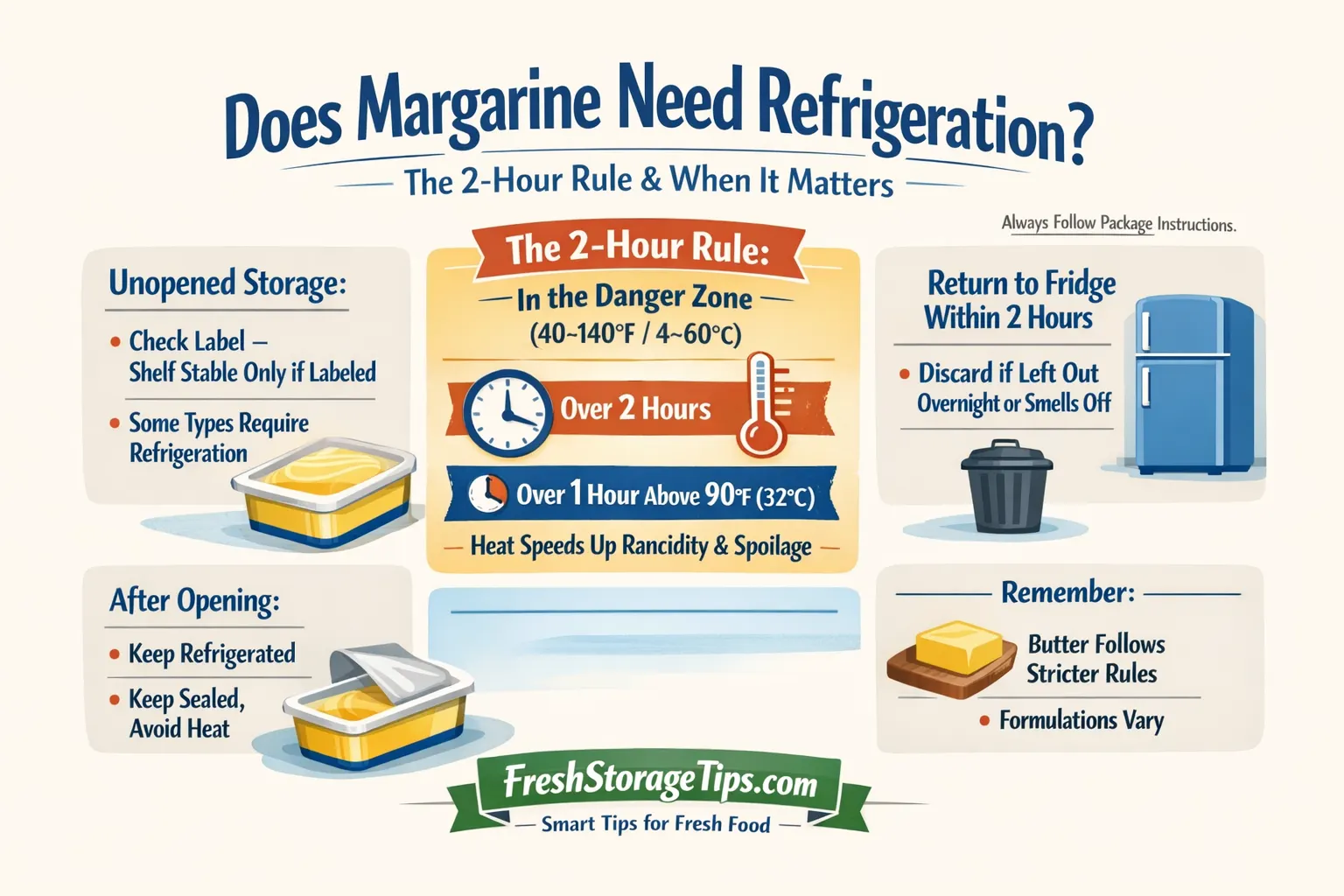
The infographic summarises the key numbers: 2 hours is the room-temperature limit, 1–2 months is the opened fridge window, and 6 months is the freezer maximum when stored correctly. The most commonly misunderstood figure is the 2-hour limit — most people assume margarine can sit on the counter all day because it looks and smells unchanged. The oxidation happening inside the oils is invisible until it is advanced.
One practical takeaway from the infographic that most storage guides skip: the opened vs unopened distinction matters significantly. A sealed tub of margarine at the back of the fridge is good up to 1 month past the printed best-by date. The same tub after the seal is broken has a 1–2 month window — because every time the lid comes off, the surface is exposed to oxygen and airborne microorganisms. The date you open the tub, not the best-before date, becomes your working reference from that point.
Margarine vs butter (the refrigeration rules are different)
This is the comparison that creates the most confusion. Butter is sometimes kept in a counter butter dish for days or weeks without obvious spoilage. Why can’t margarine be treated the same way?
The answer is chemistry. Dairy butter is predominantly saturated fat — around 80% fat by weight, with the remaining 20% being water, milk solids, and trace compounds. Saturated fats are chemically stable and resistant to oxidation. A well-salted butter in a covered dish at cool room temperature can genuinely last 1–2 weeks without significant quality loss — which is why butter crocks and counter dishes exist and are legitimate storage tools.
Margarine contains substantially higher proportions of unsaturated and polyunsaturated fatty acids. These react with oxygen much faster than saturated fats, particularly at room temperature. The water content in most tub margarines (typically 15–20%) also creates a medium for microbial growth in a way that high-fat butter does not. The result: margarine needs the fridge where butter can sometimes get away without it.
Fats and spreads — room temperature tolerance compared
Signs margarine has gone bad
Use these three checks before using margarine that has been stored longer than usual or has been out of the fridge:
Smell
Fresh margarine has a very mild, neutral, slightly buttery smell. Rancid margarine smells metallic, sour, paint-like, or like old cooking oil. If you detect any of these — discard. The smell of rancidity is caused by the same aldehyde and ketone compounds that make old vegetable oil unpleasant. Once detectable, the oxidation is already advanced.
Appearance
Fresh margarine is a uniform pale yellow. Signs of spoilage include: oil pooling or separating on the surface (emulsion breakdown), a darker yellow or orange tinge on the exposed surface, or visible mould (typically white, green, or black spots). Oil separation without off-smell can also indicate that the margarine has simply been left at too warm a temperature even briefly — the emulsion can destabilise without full rancidity, but the texture and quality will be compromised.
Taste
If smell and appearance seem fine but you are uncertain, a very small taste test will confirm: rancid margarine has a distinctly sharp, bitter, or metallic aftertaste that fresh margarine does not. Do not cook with margarine that tastes off — heating rancid oil concentrates the unpleasant compounds and the flavour will transfer directly to your food.
My test: fridge vs counter vs warm kitchen, same tub, 24 hours
I divided one opened tub of standard tub margarine into three portions in identical small containers. One went back in the fridge. One sat on the kitchen counter at approximately 68‑°F. One went in a slightly warm spot near the oven (approximately 80‑°F) to simulate a warm kitchen day.
Fridge portion at 24 hours: Identical to opening day. No detectable change in smell, colour, or texture. Normal.
Counter portion at 2 hours: Still fine. Slightly softer texture. No off-smell. Consistent with what the 2-hour rule predicts — still within safe window.
Counter portion at 8 hours: Very faint metallic note on smell when held close to the nose. Oil beginning to pool slightly on the surface. Not obviously rancid but detectably changed.
Counter portion at 24 hours: Clear sour-metallic smell. Surface oily. Texture grainy. Discarded.
Warm kitchen portion at 4 hours: Already showing signs similar to the counter portion at 8 hours. The extra warmth significantly accelerated oxidation.
The 2-hour rule is not conservative — it is genuinely where quality starts declining in normal kitchen conditions. The counter portion at 8 hours was technically still within “edible” range but already compromised. By 24 hours there was no question.
Six rules for keeping margarine fresh longer
Set margarine out for spreading, then put it straight back. Do not leave it on the table throughout a meal and forget about it. The cumulative time at room temperature counts across the whole day.
Every lid-off period exposes the surface to oxygen, light, and airborne contaminants. The lid is the most practical defence against oxidation between uses in the fridge and on the counter.
Fridge door temperature fluctuates 5–8‑°F with every opening. The back of the middle shelf is coldest and most consistent. For a product as sensitive to temperature as margarine, that difference adds up across months.
Margarine readily absorbs ambient odours through its exposed fat surface. Store away from onions, fish, cheese, and anything with a strong smell. The same porous oil structure that makes rancidity develop fast also absorbs refrigerator odours fast.
A knife that has touched bread, toast crumbs, or other food introduces organic matter into the tub. These contaminants accelerate spoilage. Always use a clean knife or spatula directly from the drawer.
Buying margarine in bulk? Freeze what you will not use within 2 months. Wrap the original tub in foil and place in a freezer bag to prevent odour absorption. Thaw overnight in the fridge. Quality is well-preserved for up to 6 months in the freezer when stored correctly.
This covers the butter refrigeration debate in detail — relevant here because understanding why butter can sometimes skip the fridge helps explain exactly why margarine cannot. The chemistry difference between dairy fat and vegetable oil emulsions is the key.
What I use for margarine and spread storage
Simple tools that make correct fridge and freezer storage of margarine effortless.
Removable Date Labels
Write the date you opened the tub directly on the label and stick it on. Opened margarine has a 1–2 month window — without the date, you are guessing. Peel off cleanly with no residue.
View on AmazonAirtight Glass Containers
For portioning margarine into smaller amounts for shorter-term use. Glass does not absorb fat odours, seals cleanly, and keeps the surface protected between uses better than many original tubs.
View on AmazonHeavy-Duty Freezer Bags
For freezing bulk margarine tubs. Wrap the original tub in foil first, then seal in a freezer bag to prevent odour absorption from other frozen items. Label with the freeze date.
View on AmazonFridge Thermometer
Confirm your fridge is actually running at 40‑°F or below. Many fridges — especially near the door or in warm kitchens — run warmer than the dial suggests. A thermometer removes the guesswork entirely.
View on AmazonAs an Amazon Associate I earn from qualifying purchases — at no extra cost to you.
Questions people actually ask
Yes. Margarine should be refrigerated at 40‑°F (4‑°C) or below. At room temperature it is generally safe for short periods (up to around 2 hours) — quality declines quickly, and 1 hour is the limit in kitchens above 90‑°F. Most tub labels say “keep refrigerated” explicitly. See how butter compares — dairy fat is more stable at room temperature than margarine’s vegetable oils. For full spoilage signs see does margarine go bad.
Margarine is generally safe for short periods at room temperature — up to around 2 hours is the commonly cited guideline based on USDA food safety principles. In a warm kitchen above 90‑°F, aim to return it to the fridge within 1 hour. Note that this is cumulative: if margarine is taken out for breakfast and again for lunch, both periods count toward the total. Overnight on the counter means discard.
No. Margarine left out overnight has been at room temperature for 8 or more hours — well beyond the safe window. While margarine does not carry the same pathogen risk as raw meat, the oils will have oxidised to a degree that produces off-flavours and rancidity. It may look and smell mostly normal, but discard it. Oxidation continues without dramatic visible signs until it is quite advanced.
1–2 months in the fridge when stored correctly at 40‑°F or below, kept in the original covered tub. Unopened margarine lasts up to 1 month past its printed best-by date in the fridge when stored correctly. Use the best-by date as your outer limit — once opened, use the date you opened it as your primary reference. Label the tub with the opening date so you do not have to guess. For the full guide see how long margarine lasts.
Yes — margarine freezes very well. Wrap the original tub in foil and place in a freezer bag to prevent freezer burn and odour absorption. Use within 6 months in the freezer when stored correctly. Thaw overnight in the fridge. Texture may be slightly softer after thawing but quality is well-preserved. Ideal for buying in bulk and freezing what you will not use within 2 months.

Marleen is a HACCP-certified food safety practitioner and founder of FreshStorageTips.com. She tests storage methods in her own kitchen and writes from real results — not from repeating what other food sites say.
1 comment
[…] you are looking at — and the shelf life numbers so you know when to start checking. See also does margarine need refrigeration for the storage rules that determine how quickly spoilage develops in the first […]