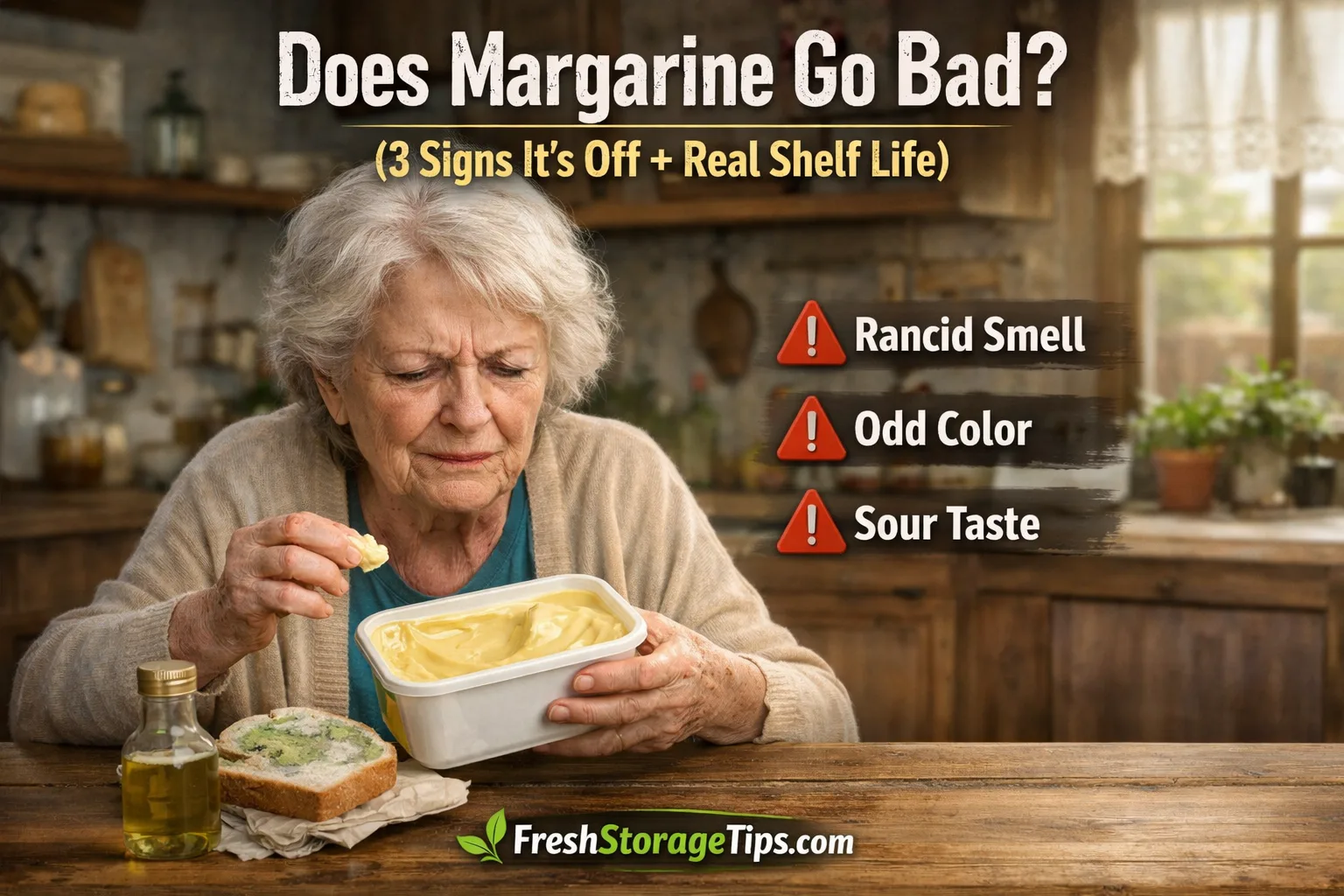
Does Margarine Go Bad? (3 Signs It’s Off + Shelf Life)
Yes, margarine goes bad. The 3 signs are a rancid or sour smell, orange or darkened colour, and a grainy or separated texture. Opened margarine lasts 1–2 months in the fridge, while unopened lasts up to 1 month past the best-by date.
Bottom line: Margarine goes bad through oxidation, not bacterial infection. It will not make you acutely sick the way raw meat does — but rancid fats are not good for you and the taste is unmistakably unpleasant. When it smells off, throw it out.
- Sign 1 — Smell (most reliable): Rancid, metallic, sour, or paint-like odour — discard
- Sign 2 — Colour (visible warning): Orange tinge, surface darkening, or yellow pooling — discard
- Sign 3 — Texture (late-stage): Oily separation, graininess, or sliminess — discard
- Opened fridge life: 1–2 months when stored correctly
- Unopened fridge life: Up to 1 month past the printed best-by date
I have thrown away margarine that looked perfectly fine but tasted metallic the moment it hit hot toast. That faint wrongness is oxidation — the same process that makes old cooking oil unpleasant, happening inside your margarine tub. Unlike butter, which spoils slowly because its dairy fat is chemically stable, margarine contains vegetable oils with a higher proportion of unsaturated fats that react with oxygen much faster. The result is a product that can go from fine to rancid without dramatic visible warning.
The unique challenge with margarine spoilage is that the three signs do not always appear together or in the same order. You can have texture separation without any smell change. You can have a colour shift before the smell develops. This article covers each sign individually so you know exactly what you are looking at — and the shelf life numbers so you know when to start checking. See also does margarine need refrigeration for the storage rules that determine how quickly spoilage develops in the first place.
Yes, margarine goes bad. Three signs: rancid or metallic smell, orange or darkened surface colour, oily separation or grainy texture. Opened fridge: 1–2 months when stored correctly. Unopened fridge: up to 1 month past the printed date. Freezer: up to 6 months in the freezer when stored correctly. Left out overnight: discard — the oils oxidise fast at room temperature. See how to store margarine for the method that maximises the 1–2 month window, and how long margarine lasts for the full shelf life breakdown by type.
Sign 1: Smell (the most reliable check)
Fresh margarine has almost no smell — a very faint, neutral, slightly creamy note at most. This is by design: commercial margarines are deodorised during production to give them that clean, bland profile. So any noticeable smell coming from a tub of margarine is already a red flag.
What rancid margarine smells like: metallic, like old coins. Sour, like stale cooking oil. Paint-like or chemical, similar to the smell of a hardware store. Sometimes faintly eggy or like cardboard. The smell comes from aldehydes and ketones produced when the unsaturated fatty acids in vegetable oil oxidise — the same chemical family that makes old nuts, old vegetable oil, and old cooking fat smell unpleasant.
Any metallic, sour, paint-like, chemical, or rancid odour. Even a faint version. Fresh margarine is nearly odourless — if it smells of anything beyond very mild creaminess, the oils have already begun oxidising. Do not taste it to confirm.
No smell, or a very faint neutral to slightly creamy scent. Some margarines — particularly those with added flavouring — have a mild buttery note which is normal. If it smells as it did when you first opened it, it is fine.
One important nuance: the smell of rancidity in margarine is not always immediately strong. Early-stage oxidation produces a faint metallic note that is easy to dismiss as imagined. Trust it. Margarine that smells even slightly off has already degraded. Cooking with rancid margarine concentrates the off-flavours and they transfer directly into food.
Sign 2: Colour (what normal looks like vs what does not)
Fresh margarine is a uniform pale to medium yellow. The colour comes from added beta-carotene or annatto — natural pigments used to give margarine its familiar appearance. This colour should be consistent throughout the tub and stable over time when correctly refrigerated.
Three colour changes that signal spoilage:
- Orange tinge on the surface — the most common visible sign of oxidation. The surface layer of fat has reacted with oxygen, shifting the pigment toward orange or burnt yellow. The deeper parts of the tub may still appear normal.
- Dark yellow or brown patches — particularly around the edges where the fat has been repeatedly exposed to air when the lid is removed.
- Visible white or grey film — rare but indicates either mould or severe emulsion breakdown. Discard immediately.
Any orange tinge on the surface, darkened edges, white or grey film, or mould spots. The surface layer is always the most oxidised — if it has changed colour, the oxidation has already progressed.
Uniform pale to medium yellow throughout. Some brands are deeper yellow than others — that is normal variation. The key is consistency and lack of change from when you first opened the tub.
“If I scrape off the orange top layer, the margarine underneath is still fine.”
This is not reliable. Colour change on the surface indicates that oxidation has been occurring in the oxygen-exposed zone — but the volatile oxidation products (the compounds that cause rancid taste and smell) are distributed throughout the fat matrix, not just on the surface. Scraping the top removes the visual evidence but not the rancid flavour compounds already present in the bulk of the product. If the surface has discoloured, the whole tub should be discarded.
Sign 3: Texture (what separation and graininess mean)
Fresh margarine has a smooth, homogeneous texture. It is a stable emulsion — water and oil held together by emulsifiers. When margarine begins to break down, that emulsion can destabilise, and the texture changes in detectable ways.
Three texture changes that signal spoilage or quality loss:
- Oily pooling on the surface — liquid oil separating from the emulsion, visible as a sheen or pool of clear or yellowish oil on the top. This can be caused by temperature fluctuation (not necessarily spoilage) or by the emulsion breaking down over time. Either way, the product quality has degraded.
- Grainy or gritty texture — feels like fine sand or grit when spread. This indicates fat crystal restructuring, usually from repeated temperature cycling or extended storage. The product is past its best.
- Slimy surface — rare in refrigerated margarine but possible if the tub has been stored without a lid or the opening has been contaminated. Sliminess indicates microbial activity. Discard immediately.
Oil pooling on the surface, grainy or gritty texture when spread, or any sliminess. These all indicate the emulsion has broken down or microbial activity has begun. Neither is safe or pleasant to eat.
Smooth, uniform, spreadable. Margarine that has been in a cold fridge for a while may be firmer than usual — this is normal. Leave it at room temperature for a few minutes and it should return to its normal spreadable consistency without becoming oily or grainy.
Can you use margarine past the best-by date?
Unopened, up to 1 month past the printed best-by date, yes — if it has been refrigerated continuously and the seal is intact. Best-by dates on margarine are quality dates, not safety dates. An unopened sealed tub that has been cold the entire time is generally still good for a few weeks past the printed date.
Opened, the date you opened it becomes your reference — not the best-by date. Once the seal is broken, the 1–2 month window starts. A tub opened the day before the best-by date still has 1–2 months of use after opening, provided it is properly refrigerated. Conversely, a tub opened 3 months ago that is still within the printed best-by date has likely already exceeded its safe open window.
This is the distinction most people miss. The best-by date assumes the product is unopened. Once you break the seal, proper refrigeration and the date you opened it are what matter. Label your tub with the opening date — it takes 5 seconds and removes all guesswork.
Shelf life at a glance
For a complete breakdown by brand type and format, see how long margarine lasts. The table below covers the core situations most people encounter.
| Situation | Method | How long | Primary signal to check |
|---|---|---|---|
| Unopened, fridge | Sealed tub, 40‑°F or below | Up to 1 month past best-by date | Smell on first opening. Any metallic note — discard. |
| Opened, fridge | Covered tub, 40‑°F or below | 1–2 months when stored correctly | Smell + colour check weekly. Label tub with opening date. |
| Counter (room temperature) | Any temperature | Generally safe for short periods (up to around 2 hours) | Quality declines quickly beyond that. Cumulative time counts. |
| Left out overnight | Any room temperature | Discard | Oils oxidise fast at room temperature. 8+ hours — discard regardless of appearance. |
| Freezer | Foil-wrapped tub in freezer bag | Up to 6 months in the freezer when stored correctly | Smell on thawing. Any off note — discard. |
Margarine spoilage infographic
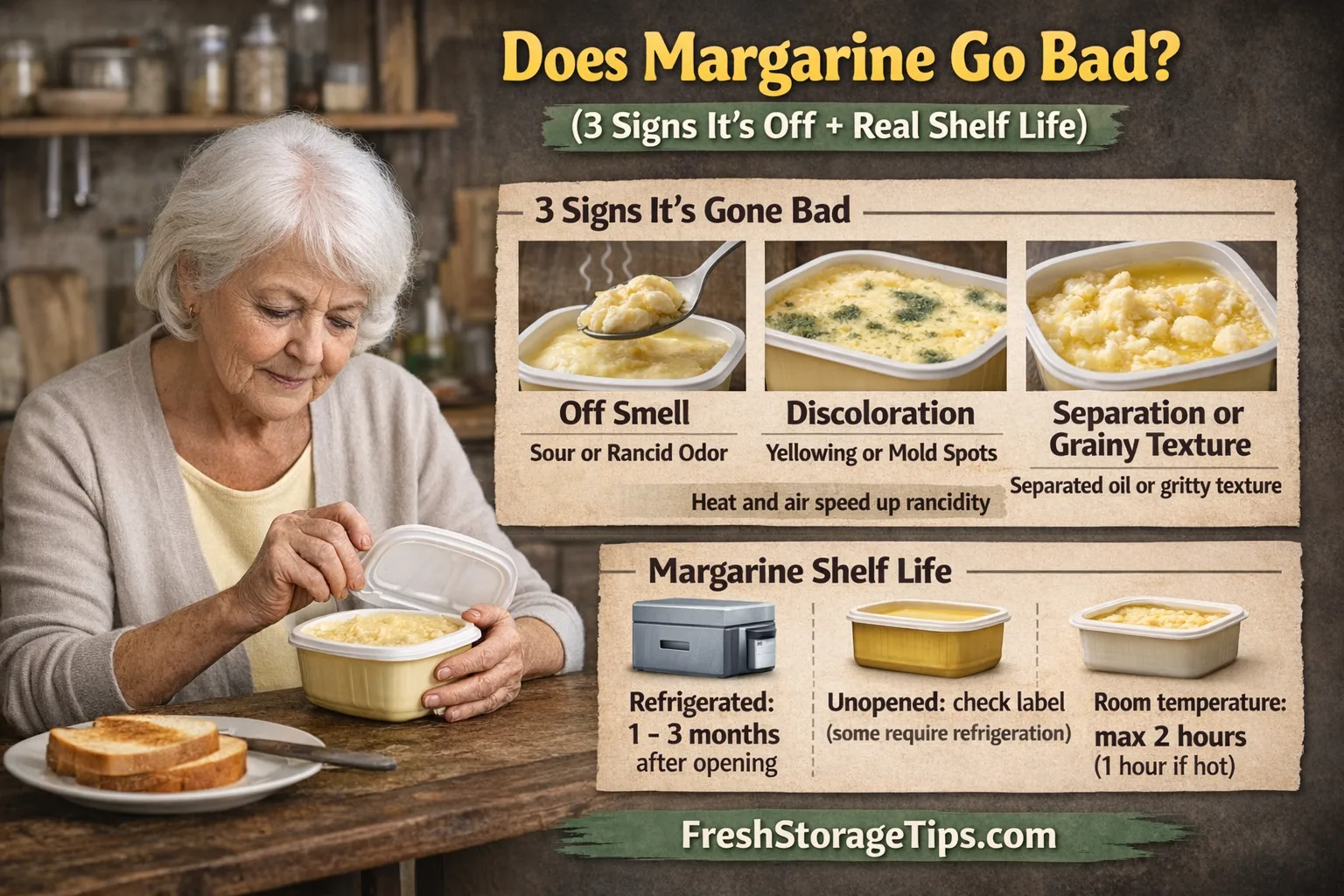
The infographic captures the three checks and the shelf life numbers in one place. The most important takeaway illustrated here is the relationship between the three signs: smell is the most reliable early indicator, colour change is the most visually obvious, and texture change is the latest-stage signal — by the time the texture has separated or gone grainy, the product has been deteriorating for a while.
If you only do one check, make it the smell. Margarine that smells fine but has minor colour change is borderline — use your judgement and consume soon. Margarine that smells off but looks normal should still be discarded — the oxidation is already there, just not yet visible. The nose leads.
Why margarine goes bad (the chemistry in plain terms)
Margarine goes bad primarily due to oxidation of its vegetable oils, which produces compounds that cause rancid smell, flavour, and texture changes.
Margarine is made primarily from vegetable oils — soybean, canola, sunflower, or palm — blended with water and emulsifiers to create a spreadable product. The oils contain a high proportion of unsaturated fatty acids, particularly in products made from sunflower or canola oil. These unsaturated bonds are the chemical vulnerability: they react with oxygen in a chain reaction called lipid peroxidation.
Lipid peroxidation produces three categories of compounds: primary oxidation products (lipid hydroperoxides — odourless but unstable), secondary oxidation products (aldehydes, ketones — these are the rancid smell and taste), and tertiary products (long-chain polymers — these contribute to texture changes). The progression from fresh to rancid follows this sequence, which is why smell is an early signal and texture change is a late one.
Commercial margarines contain antioxidants — typically TBHQ, BHA, BHT, or vitamin E (tocopherol) — that interrupt the oxidation chain reaction and significantly extend shelf life. This is why a tub of commercial margarine lasts 1–2 months opened in the fridge, while a home-made vegetable oil spread without antioxidants would go rancid within days. The antioxidants buy time — they do not prevent oxidation indefinitely.
My test: three tubs, three storage conditions, 8 weeks
I bought three identical tubs of the same brand of margarine and stored them differently for 8 weeks: one correctly refrigerated with the lid on, one refrigerated but left uncovered, and one partially used and left at room temperature for a full day before being refrigerated.
Correctly refrigerated, lid on — week 4: No change. Smell: neutral. Colour: uniform pale yellow. Texture: smooth. Exactly as opened.
Correctly refrigerated, lid on — week 8: Still good. Very faint note on close smell — not rancid, just slightly less neutral than week 1. Colour and texture unchanged. Within the 1–2 month window and still acceptable.
Uncovered, fridge — week 2: Surface had developed a faint orange tinge around the exposed edges. Smell was detectably different — faint metallic note. Texture still smooth. Discarded at week 2.
Left at room temperature for one day — week 1: Even after returning to the fridge, this tub developed a noticeable off-smell within the first week. The one-day room temperature exposure had accelerated oxidation enough to shorten the remaining fridge life significantly. Discarded at week 1.
The lesson: the lid and continuous refrigeration are not optional extras. A single day at room temperature measurably shortened the fridge life of the returned tub.
Six rules that prevent margarine going bad prematurely
The best-by date is for unopened product. Once you open the tub, write the date on the lid. The 1–2 month window starts from that day, not from the printed date. This one habit removes all guesswork.
Every minute the lid is off, the surface is exposed to oxygen and light — the two primary drivers of oxidation. Replace the lid immediately after use. It is the simplest and most effective thing you can do to slow rancidity.
Introducing bread crumbs, food particles, or moisture from a used knife contaminates the tub and creates sites for microbial growth. Always take a clean knife or spatula from the drawer. Never use a knife that has touched other food.
Door temperature fluctuates with every opening. The back of the middle shelf is coldest and most consistent. Temperature cycling accelerates emulsion breakdown and oxidation — stable cold is what you want.
Fresh margarine is nearly odourless. A quick sniff before use takes one second and catches early-stage rancidity before it reaches your food. Make it a habit — it becomes automatic within a week.
If you buy more than you will use within 2 months, freeze the extra tubs right away. Wrap in foil and seal in a freezer bag. Up to 6 months in the freezer when stored correctly — thaw overnight in the fridge when needed.
How margarine compares to other dairy and spreads
Understanding how margarine fits into the broader category of fridge spreads helps explain why its spoilage rules are stricter than some and more lenient than others.
Dairy and spread shelf life comparison — opened, refrigerated
“Margarine does not go bad like meat does. It goes bad like oil does. The smell check is your best tool — use it every time.”
Understanding the difference in fat composition between butter and margarine explains directly why margarine oxidises faster and why the spoilage signs are different from dairy products.
What I use to keep margarine fresh longer
Simple tools that prevent the early spoilage that most people experience.
Removable Date Labels
Write the opening date on the tub the moment you break the seal. The 1–2 month window starts from that day — not from the best-by date. Peel off cleanly, no residue.
View on AmazonFridge Thermometer
Confirm your fridge is actually running at 40‑°F or below. A fridge running at 45‑°F — common near the door — can cut margarine’s safe window in half. A simple fridge thermometer removes the guesswork.
View on AmazonAirtight Glass Containers
Transfer margarine into a smaller airtight glass container as the tub empties. Less headspace means less oxygen exposure, which directly slows oxidation. Glass does not absorb fat odours.
View on AmazonHeavy-Duty Freezer Bags
For freezing bulk margarine tubs. Wrap the original tub in foil first, then seal in a freezer bag. Prevents odour absorption from other frozen items. Label with the freeze date.
View on AmazonAs an Amazon Associate I earn from qualifying purchases — at no extra cost to you.
Questions people actually ask
Yes. Margarine goes bad through oxidation of its vegetable oils, not through bacterial infection like raw meat. The three signs: rancid or metallic smell, orange or darkened surface colour, and oily separation or grainy texture. Any one of these means discard. Opened margarine lasts 1–2 months in the fridge when stored correctly. For the full storage method see how to store margarine.
Check three things in this order: smell first (any metallic, sour, or rancid note — discard), colour second (any orange tinge or surface darkening — discard), texture third (any oily separation, graininess, or sliminess — discard). Fresh margarine is nearly odourless, uniform pale yellow, and smooth. Use the date you opened the tub as your primary reference alongside these checks. See also does margarine need refrigeration for the storage conditions that determine how quickly spoilage develops.
1–2 months in the fridge when stored correctly at 40‑°F (4‑°C) or below, kept in the covered original tub. Unopened margarine lasts up to 1 month past its printed best-by date. Label the tub with the date you opened it — the best-by date applies to sealed product only. For the full shelf life chart by type see how long margarine lasts.
No. Any off smell in margarine — metallic, sour, paint-like, or rancid — means the vegetable oils have oxidised. The smell is produced by aldehydes and ketones from lipid peroxidation. These compounds are not safe to consume in any meaningful quantity and the taste will transfer directly into whatever you are cooking or spreading on. Discard it. The smell check takes one second.
Yes. Margarine freezes well for up to 6 months in the freezer when stored correctly. Wrap the original tub in foil and place inside a heavy freezer bag to prevent odour absorption from other frozen items. Thaw overnight in the fridge. Texture may be slightly softer after thawing but quality is well-preserved. Ideal for bulk purchases — freeze what you will not use within 2 months immediately.

Marleen is a HACCP-certified food safety practitioner and founder of FreshStorageTips.com. She tests storage methods in her own kitchen and writes from real results — not from repeating what other food sites say.
22 comments
[…] margarine that lasts a full two months from margarine that turns rancid after three weeks. See also signs margarine has gone bad for the three checks that tell you it has already crossed the line, and how to store margarine […]
https://shorturl.fm/bJDMJ
https://shorturl.fm/VcpiF
vidalista 60 iskustva
vidalista 60 iskustva
avanafil cost per pill
avanafil cost per pill
finasteride woman use
finasteride woman use
doxycycline for colds
doxycycline for colds
https://shorturl.fm/KRpg4
what is a liraglutide
what is a liraglutide
ketoconazole cream for scaling
ketoconazole cream for scaling
ketoconazole biochemical action
ketoconazole biochemical action
ivermectin strongyloides patient outcomes
ivermectin strongyloides patient outcomes
What makes this post work so well is the combination of a simple structure and a natural tone, because together they create a discussion that feels insightful, smooth, and enjoyable to read from beginning to end.
kinghills
minoxidil hair regrowth guide
minoxidil hair regrowth guide
minoxidil clinical evidence
minoxidil clinical evidence
minoxidil men’s full overview
minoxidil men’s full overview
avanafil contraindication documentation
avanafil contraindication documentation
https://shorturl.fm/Pb7Pg
orlistat contraindication summary
orlistat contraindication summary
orlistat food interaction explanation
orlistat food interaction explanation
augmentin vs amoxicillin suspension
augmentin vs amoxicillin suspension
otitis media diagnosis
otitis media diagnosis