
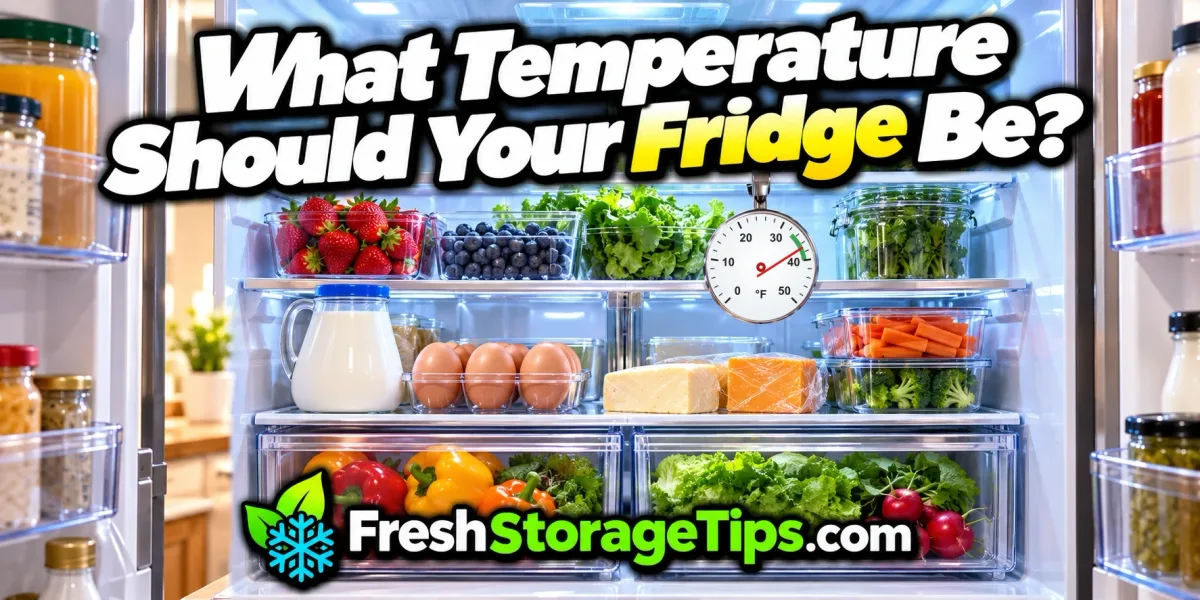
Keep your fridge at 40°F (4°C) or below and your freezer at 0°F (-18°C). That’s the FDA and USDA line. GE and Whirlpool set their fridges to 37°F (about 3°C) at the factory, which gives you a little room before you hit 40°F without freezing your lettuce. And don’t trust the dial: the only way to know is a fridge thermometer.
No thermometer yet? Two I’d look at (why these): TempPro TP110-2 (2-pack) Taylor 5924 dial (Amazon; as an Amazon Associate I earn from qualifying purchases)
Fridge Temperature Chart (°F and °C)
What your thermometer reading means, from the coldest to the warmest:
| Reading | °C | What it means |
|---|---|---|
| 0°F | -18°C | Freezer target (FDA). Frozen food stays safe; quality keeps longest here (USDA). |
| 34°F or lower | 1°C or lower | Fridge is too cold. Whirlpool says food near the air outlets can start to freeze. |
| 37°F | 3°C | Factory setting GE and Whirlpool use for the fridge. A comfortable middle. |
| 38 to 40°F | 3 to 4°C | The range USDA aims for when you check your fridge. |
| 40°F | 4°C | The upper limit. Above this you’re in the “Danger Zone”. |
| 41 to 45°F | 5 to 7°C | Too warm. Turn the control colder and check again (see below). |
°C values are rounded. 40°F is 4.4°C; the FDA rounds it to 4°C.
Why 40°F Is the Magic Number
The USDA calls 40 to 140°F the “Danger Zone”: bacteria grow fastest there, and some can double in number in as little as 20 minutes. Below 40°F that growth slows way down. That’s why the rule is “40°F or below”, not “around 40°F”.
There’s a sneaky part. The USDA separates two kinds of bacteria. Spoilage bacteria make food smell and look bad, so you notice them. Pathogenic bacteria, the ones that make you sick, usually don’t change the taste, smell or look of food at all. So a fridge that runs a bit warm can keep food looking fine while it isn’t. One more: Listeria can grow even at fridge temperatures, and the FDA says the longer food is stored, the more chance it has to grow, especially when the fridge is above 40°F. Ready-to-eat foods like deli meat are the ones to watch.
And the freezer? At 0°F, food stays safe as long as it stays frozen, the FDA says, although quality slowly drops over time. The USDA adds that frozen food keeps its top quality longest when the freezer holds 0°F.
How to Check Your Fridge Temperature (the USDA Way)
The dial numbers or the display on your fridge tell you what it’s set to, not what the air or the food really is. The USDA’s method uses a cheap appliance thermometer and a glass of water:
- Fill a glass with water and put the thermometer in it.
- Place it in the middle of the fridge.
- Wait 5 to 8 hours. Overnight is easiest.
- Read it. Is it between 38 and 40°F? Great. If not, adjust the temperature control (my advice: one step at a time).
- Check again after another 5 to 8 hours. Fridges need time to settle after a change; Whirlpool even says to wait a full day before you adjust again, so a full day is the safer choice.
For the freezer: put the thermometer between two frozen packages, wait 5 to 8 hours, and look for 0 to 2°F.
My tip: the glass of water gives a steadier reading than the air. The air in a fridge warms up for a moment every time you open the door, so a thermometer hanging in the air can show a high number right after you’ve been rummaging for cheese. The water changes much more slowly.
After that first check, the FDA’s advice is simple: keep a thermometer in the fridge and one in the freezer, in the front where you can read it easily, and look at it at least once a week. If your dial is confusing, I explain the numbers in fridge dial numbers explained.
Printable Fridge Temperature Log
Stick this on the fridge and fill in a line once a week. Fridge: 40°F (4°C) or below. Freezer: 0°F (-18°C).
| Date | Fridge °F | Freezer °F | OK? | Note (what I changed) |
|---|---|---|---|---|
From FreshStorageTips.com. Targets: FDA “Are You Storing Food Safely?”
Is 45°F Too Warm for a Fridge?
Yes. 45°F (about 7°C) is 5 degrees above the 40°F limit, so turn the control a step colder and check again after 5 to 8 hours.
What about the food that was in there? That depends on why the fridge was warm, because the USDA and the FDA give rules for two different situations. Don’t swap one for the other.
The USDA’s refrigeration page: “Foods held at temperatures above 40°F for more than 2 hours should not be consumed.”
The FDA’s power-outage advice: a closed fridge keeps food cold for about 4 hours. Throw out perishable food such as meat, poultry, fish, milk, eggs and leftovers that has been above 40°F for 4 hours or more. Perishable food that measures 45°F or below with a food thermometer should be safe, but cook and eat it as soon as possible.
So it depends on how long it was warm, and a fridge thermometer you check often is what tells you that. If you’re not sure, the FDA’s general line applies: if you’ve neglected to properly refrigerate something, “it’s usually best to throw it out.” I’ll cover power outages in more detail on their own page.
Five Things That Make a Fridge Run Warm
- The door is open a lot. The USDA says to keep fridge and freezer doors closed tightly and not to open them more often than needed.
- It’s packed solid. The FDA says not to crowd the fridge or freezer so tightly that air can’t circulate.
- A big pot of hot food. Hot food can go straight in the fridge, the USDA says, but split a big pot of soup or stew into small, shallow containers first so it cools fast.
- Food is stored in the door. Not a warm fridge, but a warm spot: the temperature in the door bins swings more than inside the cabinet (USDA). More in where to put food in your fridge.
- The condenser coils are dusty. The USDA recommends cleaning the coils several times a year with a brush or vacuum, and keeping the front grill free of dust so air can flow.
Too cold instead? If your lettuce comes out crunchy in the wrong way, read why your fridge is freezing food.
Quick Questions
What temperature should a refrigerator be in Celsius?
4°C or below, according to the FDA. The freezer should be at -18°C. GE and Whirlpool set their fridges to about 3°C (37°F) at the factory.
What is the best temperature for a refrigerator?
Anywhere from about 37°F to 40°F (3 to 4°C). The FDA’s limit is 40°F or below; GE and Whirlpool set their fridges to 37°F at the factory. Much colder and food near the air vents can freeze.
How do I check the temperature of my refrigerator?
Put an appliance thermometer in a glass of water in the middle of the fridge, wait 5 to 8 hours and read it. The USDA aims for 38 to 40°F. Adjust the control if needed and check again after another 5 to 8 hours, or a full day to be safe.
Is 42 degrees OK for a fridge?
No, it’s above the 40°F limit from the FDA and USDA. Turn the temperature control one step colder and check again after 5 to 8 hours.
What temperature should a freezer be?
0°F (-18°C). Food kept frozen at 0°F stays safe; the quality slowly drops over time, so date your packages.
Sources & Transparency
Targets, outage times, the 45°F line and Listeria: FDA, “Are You Storing Food Safely?”. Danger Zone, the 2-hour line, “40°F or below throughout”, door bins, hot food and coils: USDA FSIS, “Refrigeration and Food Safety”. Glass-of-water check: USDA FSIS, “Appliance Thermometers”. Factory settings: GE Appliances support, “Side-by-Side Refrigerator - External Temperature Controls” and “Bottom Freezer Refrigerator”, and Whirlpool Product Help. Tips marked as mine are my own advice.
Last updated: