
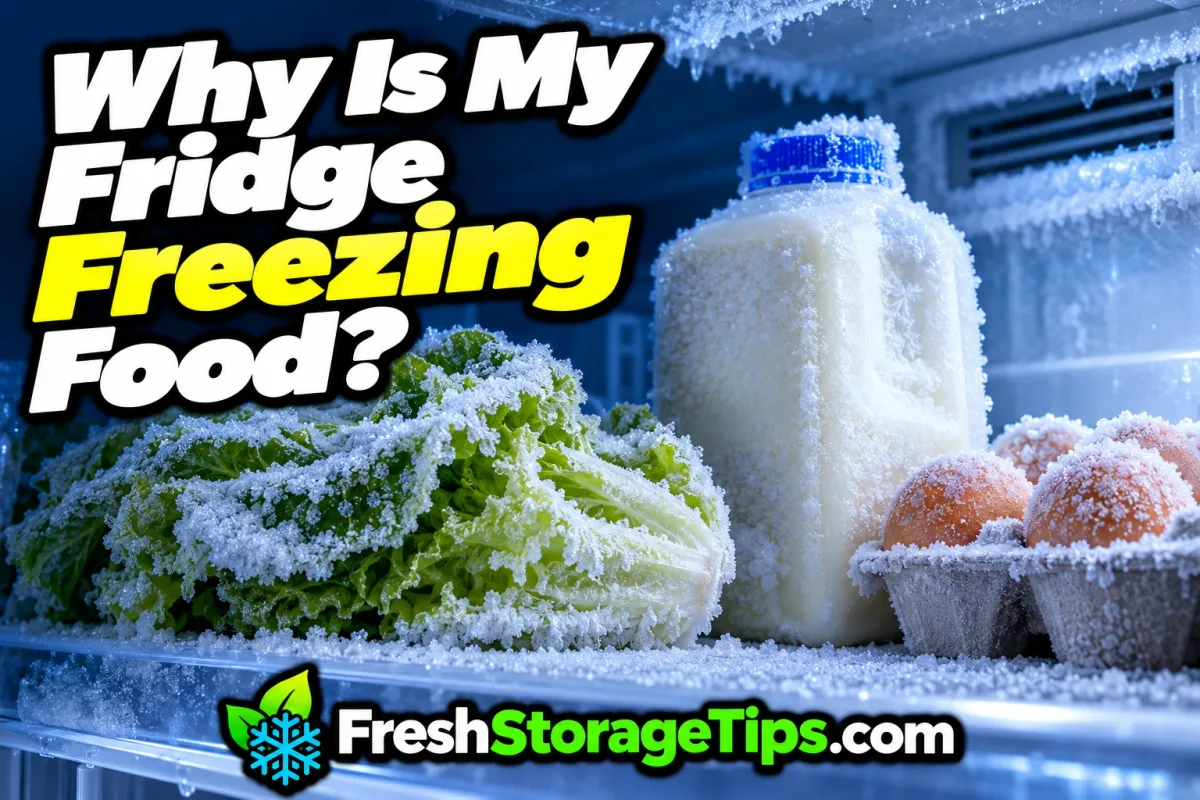
Start with three common causes Whirlpool lists: the fridge or freezer is set too cold, food is sitting right in front of an air vent, or an ice maker is switched on without a water line. Whirlpool says a fridge at 34°F or below can freeze food near the air outlets; aim for 37 to 40°F. Fix one thing at a time and give it a day.
First find out how cold it really is. Two thermometers I’d look at (why these): TempPro TP110-2 (2-pack) Taylor 5924 dial (Amazon; as an Amazon Associate I earn from qualifying purchases)
Where Is It Freezing? That’s Your First Clue
Before you touch the dial, look at which food froze.
- Only the things at the back, or near one spot? Think airflow: something is in front of a vent (causes 2 and 3).
- Food all over the fridge is icy? Think settings: the fridge or freezer is set too cold, or the room is very cold (causes 1, 4 and 6).
- It started after you moved in, or after the fridge was installed, and there’s an ice maker? Check cause 5 first.
The 6 Usual Causes
1. The fridge is set too cold
Whirlpool recommends 37 to 40°F and warns that at 34°F or below food can freeze near the air outlets. Check with a thermometer in a glass of water in the middle of the fridge, read after 5 to 8 hours (the USDA method). Below 37°F? Turn the control one step warmer. Not sure which way is warmer? See fridge dial numbers explained.
2. Food is blocking a vent
Cold air from the freezer blows into the fridge through vents; Whirlpool mentions rear and side vents, and where they sit differs per model. Whirlpool says items pressed against those vents can channel very cold air straight onto the food, and that items directly in the path of that airflow may freeze. Move food away from the vent and keep the airflow clear.
3. Eggs, milk or drinks are in the cold-air path
Whirlpool specifically says not to put temperature-sensitive items like eggs and liquids near those vents. Move them to the middle of a shelf (not the door; the door is too warm for them). Where everything else goes: where to put food in your fridge.
4. The freezer is set too cold
Fridge-freezers share cold air. Whirlpool says a freezer set far below 0°F can push too much cold air into the fridge, and when food freezes in the fridge it recommends adjusting the freezer control first, one level at a time. The freezer target is 0°F (FDA), not colder.
5. The ice maker is on, but there’s no water line
This one surprises people. If the fridge isn’t connected to a water supply but the ice maker is switched on, Whirlpool says it keeps trying to make ice, which can overcool the fresh food section. Switch the ice maker off; your owner’s manual shows how.
6. The fridge is packed tight, or the room is very cold
Whirlpool lists overpacked shelves and tall containers that block airflow, and very cold rooms such as garages and unheated spaces, which change how the fridge cycles. The FDA also says not to crowd the fridge so tightly that air can’t circulate.
Then wait. Change one thing, then give it time: Whirlpool’s help pages say 8 to 24 hours before the next change. Change three things at once and you’ll never know which one fixed it.
Your Food Froze. Is It Still OK?
If the food was safely refrigerated before it froze, the accidental freezing itself usually isn’t a safety problem; it mostly hurts the texture. Two things to keep in mind. Freezing doesn’t undo earlier mistakes: the USDA explains that freezing only makes bacteria inactive and that they become active again as food thaws, so treat thawed food like any fresh perishable. And the USDA names two clear exceptions: eggs whose shells cracked, and cans with rusted or burst seams.
| Food | What to do |
|---|---|
| Eggs, shell cracked | Throw them out (USDA). |
| Eggs, shell not cracked | The USDA says keep them frozen until you need them, then thaw in the fridge. They can be hard-cooked; for other uses the yolk gets thick and syrupy. |
| Lettuce and leafy greens | The USDA lists lettuce as a food that doesn’t freeze well. Thawed leaves go limp and watery: fine for soup maybe, not for salad. |
| Milk | It stayed cold the whole time, so there’s no safety problem; let it thaw in the fridge and shake it (my advice). The texture can change after freezing. |
| Raw meat | Let it thaw in the fridge. The USDA says food thawed in the fridge can be refrozen, with some loss of quality. |
| Canned drinks | If a can only swelled from freezing, the USDA says it may still be usable: thaw it in the fridge first. Rusted or burst seams, or anything that looks or smells off: throw it out, don’t taste it. |
| Mayonnaise, creamy sauces | The USDA says they don’t freeze well; expect them to separate. |
The Opposite Problem: Fridge Not Cold Enough
If your thermometer says above 40°F, flip the list around: the setting may be too warm, the door may not close tightly, the fridge may be packed too full, or the condenser coils may be dusty (the USDA suggests cleaning them several times a year). The full checklist is in what temperature your fridge should be.
When it’s more than a setting: if the temperature keeps jumping up and down, or food keeps freezing after you’ve checked everything above, contact the manufacturer’s service or a technician (my advice). Some problems, like a faulty sensor or a cooling fault, aren’t something to fix with a dial.
Frequently Asked Questions
Why is my fridge freezing food in the back?
On many fridges the cold air from the freezer comes in through vents at the back (or the sides; it differs per model). Whirlpool says food pressed against or sitting in the path of those vents can freeze. Move it away from the vent and keep the airflow clear.
What temperature should my fridge be to stop food from freezing?
Whirlpool recommends 37 to 40°F and warns that 34°F or below can freeze food near the air outlets. The FDA’s upper limit is 40°F.
Is food that froze in the fridge safe to eat?
Usually, if it was safely refrigerated before it froze: the accidental freezing mostly hurts the texture. Once thawed, treat it like any fresh perishable food. The USDA names two exceptions: throw out eggs whose shells cracked while frozen, and cans whose seams rusted or burst (or that look or smell abnormal).
Can an ice maker make my fridge too cold?
Yes. Whirlpool says an ice maker that is switched on without a water supply keeps trying to make ice and can overcool the fresh food section. Turn it off if it isn’t connected.
Sources & Transparency
Causes, temperatures and waiting times: Whirlpool Product Help, “What to Check if the Refrigerator Section is Too Cold” and “Preventing Food from Freezing in the Refrigerator” (these apply to Whirlpool fridges; other brands can differ). Frozen eggs, lettuce, refreezing and frozen cans: USDA FSIS, “Freezing and Food Safety”. Targets and crowding: FDA, “Are You Storing Food Safely?”. Thermometer check: USDA FSIS, “Appliance Thermometers”. Tips marked as mine are my own advice.
Last updated: