
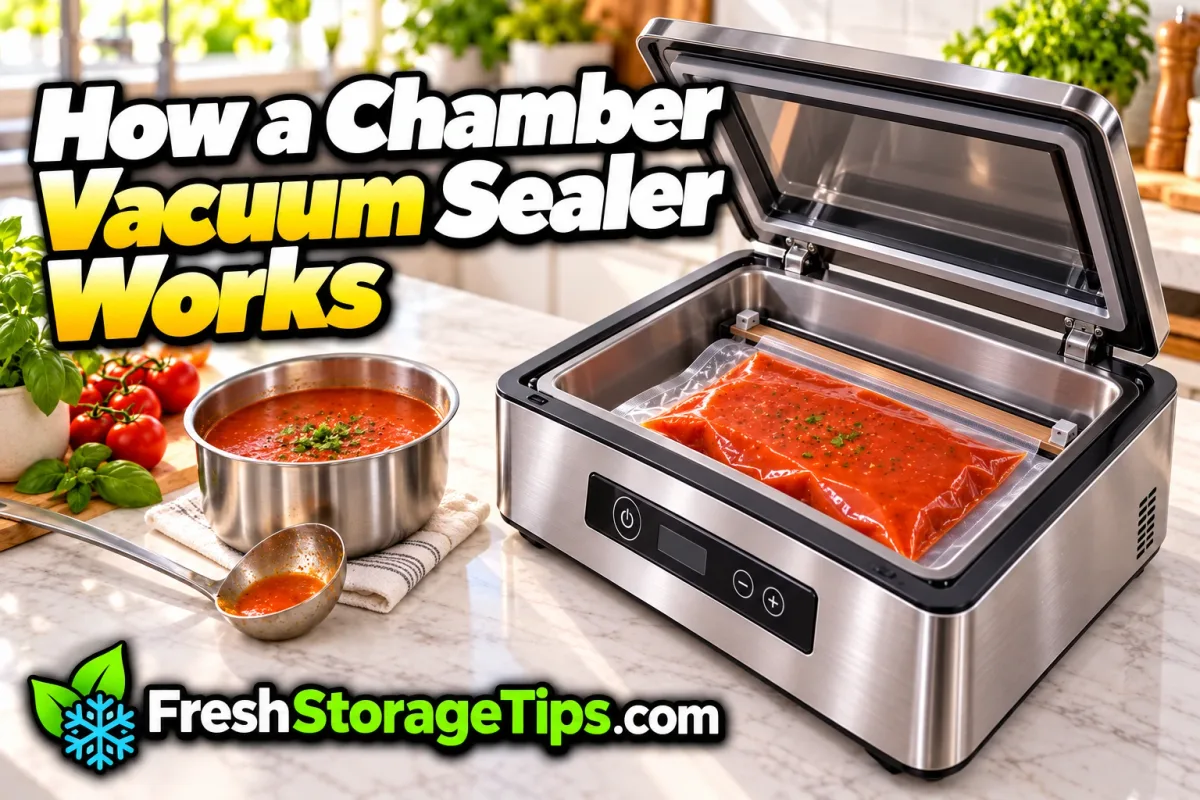
A chamber vacuum sealer puts the whole bag inside a closed box and pumps the air out of the box. Because the pressure drops inside and outside the bag at the same time, there’s no suction pulling the liquid toward a pump. (At very low pressure liquid can still bubble; more on that below.) Then a heated bar seals the bag and the chamber returns to normal pressure. A regular (suction) sealer works the other way around: it sucks the air out of the bag itself, and anything wet can travel with it.
Two Ways to Get the Air Out
Think of drinking a milkshake through a straw. Suck hard enough and everything comes up the straw, the good stuff included. That’s a suction sealer with a bag of chili: Anova, which makes both kinds, describes these “edge” sealers as machines that “simply suck the air directly out of the bag.”
A chamber sealer doesn’t use a straw at all. It takes the air away from around the bag, so there’s no straw pulling the soup out. The soup can still bubble when the pressure gets very low, which the machine has to manage (see below), but it isn’t sucked toward a pump.
What Happens Inside the Chamber, Step by Step
- The bag goes in. You place the filled pouch in the chamber with its open end lying across the seal bar, then close the lid.
- The pump empties the box. In Anova’s words, the pump “removes all air from the entire chamber, including inside the pouch.”
- The pressure stays even. Inside the bag and outside the bag, the pressure drops together. That’s the whole trick.
- The bar seals. “Once all of the air is removed, the sealer bar heats up and seals the pouch shut.”
- The air comes back. In Anova’s words, “the chamber will release the vacuum and return to normal atmospheric pressure.” Open the lid and your sealed bag is ready.
Chamber vs. Suction Sealer at a Glance
Suction (edge) sealer
- Where the air goes
- Sucked out of the bag
- Soups and marinades
- Tricky: liquid can be pulled toward the machine
- Bags
- Textured bags or rolls with air channels
- Bag size
- Long bags cut from a roll
Chamber sealer
- Where the air goes
- Pumped out of the whole box
- Soups and marinades
- Made for it
- Bags
- Smooth, clear pouches (textured bags usually work too)
- Bag size
- Has to fit inside the chamber
Size is not a fixed rule, by the way. Among the sealers we looked at, the Avid Armor chamber sealer weighs about 17 pounds, while the heavy-duty Weston suction sealer weighs 22.6. A small countertop sealer like the Nesco VS-12 is 6.
Wait, Why Is My Soup Bubbling?
Here’s the part that surprises people. When the pressure in the chamber gets low enough, liquids start to boil. Henkelman, a maker of chamber machines, puts it plainly: “Lowering the pressure in the vacuum chamber causes liquids to boil. Even if they are cold.”
It isn’t hot, it’s just low pressure. But if the machine keeps pumping, the bubbling liquid can climb toward the seal. That’s why many chamber sealers let you control the cycle. The Avid Armor USV20, for example, has a vacuum time you can set from 15 to 60 seconds, and on some models a sensor takes over. Henkelman, for example, offers a liquid sensor as an option on its machines: it stops pumping and starts sealing as soon as the liquid begins to boil. Not every chamber sealer has one.
The Bag Question
Bags for suction sealers have a texture on the inside. Anova describes it as a built-in mesh that channels the air out of the bag while the machine pulls. Chamber pouches are “completely clear and smooth”, because the chamber doesn’t need those channels: it empties the whole box.
One rule to remember, straight from Anova: chamber pouches don’t work in suction sealers, but regular textured bags can be used in a chamber sealer. Machines differ, so check your sealer’s manual before you rely on it. If it agrees, your old bags aren’t wasted when you switch.
Which One Fits Your Kitchen?
- You freeze soups, stews, chili or marinated meat often: a chamber sealer.
- You seal meat, cheese and dry food, sometimes in long bags: a suction sealer is simpler and cuts bags to any length from a roll.
- You only seal soup once in a while: a suction sealer still works if you freeze the soup first and seal the frozen block (FoodSaver’s FM2100 manual gives the same advice: freeze liquids before vacuuming).
Want names? I picked one of each kind, with what their listings say, in the vacuum sealers I’d pick for different kitchens.
Same Machine, Same Food Safety Rules
A chamber sealer removes air better from wet food, but it doesn’t change what the food needs afterwards. Clemson Cooperative Extension says vacuum packaging is “not a substitute for safely processing perishable foods to be stored at room temperature.” Sealed soup, meat and leftovers still belong in the fridge at 40°F or below, or in the freezer at 0°F. Thaw them in the fridge, not on the counter. More on that in what you can vacuum seal.
Quick Questions
How does a chamber vacuum sealer work?
The whole bag goes inside a closed chamber. A pump removes the air from the chamber and the bag at the same time, a heated bar seals the bag, and then the chamber returns to normal pressure.
Can you use regular vacuum sealer bags in a chamber sealer?
Usually. Anova says the textured bags made for edge (suction) sealers can be used in a chamber sealer; check your own machine’s manual to be sure. It doesn’t work the other way around: smooth chamber pouches are not compatible with suction sealers.
Why does liquid bubble in a chamber vacuum sealer?
Low pressure makes liquids boil, even cold ones, as the chamber maker Henkelman explains. That’s why many chamber sealers let you set the vacuum time, and some models, such as Henkelman machines with its liquid sensor option, stop pumping as soon as the liquid starts to boil.
Is a chamber sealer better than a suction sealer?
Better for liquids and wet food. A suction sealer is the easier choice for meat, cheese and dry food, and it can make long bags from a roll, while a chamber sealer limits the bag to the size of its chamber.
Does a chamber sealer make food last longer at room temperature?
No. Vacuum sealed perishable food still needs the fridge (40°F or below) or the freezer (0°F). Clemson Extension notes that vacuum packaging doesn’t replace safe processing for food stored at room temperature.
Sources & Transparency
How chamber and edge sealers work, and which bags fit which machine, comes from Anova Culinary, which makes both types. Liquids boiling at low pressure: Henkelman, “Liquid Control”. Freezing liquids first: the FoodSaver FM2100 owner’s manual. Food safety: Clemson Cooperative Extension, HGIC 3865 “Vacuum Packaging Foods at Home”. Weights and vacuum times come from the product listings of the sealers on our vacuum sealer page, read on October 25, 2026. I haven’t tested these machines; this page explains how they work.
Last updated: