
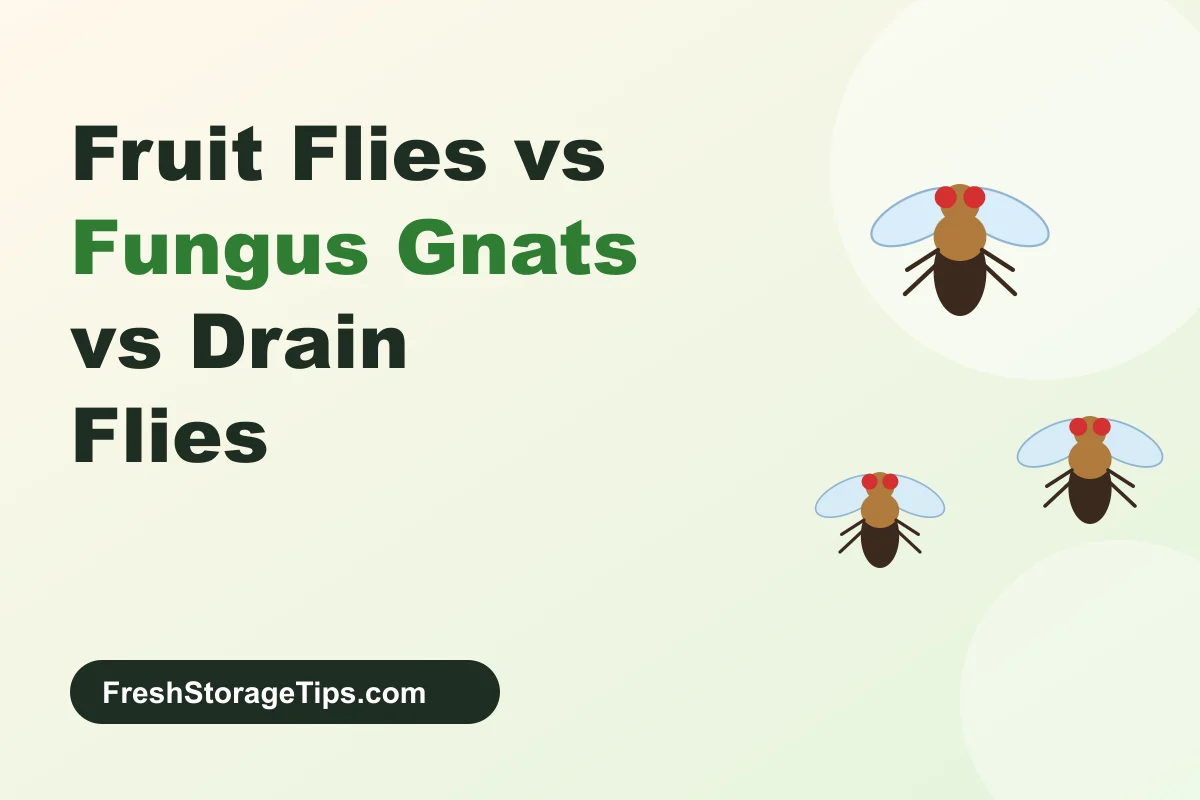
Look at where they hang out and what they look like. Fruit flies are tan with usually red eyes and gather around ripe fruit, trash and drains. Fungus gnats are dark, delicate and mosquito-like, and hover around houseplants with moist soil. Drain flies are fuzzy, moth-like and gray, and rest on walls near sinks and showers. Each one breeds somewhere else, so each needs a different fix.
A note on the word “gnat”: people use it for many different small flies. On this page it means fungus gnats, the ones that breed in moist potting soil (UC IPM). Biting gnats outdoors are a different group and aren’t covered here.
Not sure which fly you have? The two traps I’d pick (why these two): TERRO Fruit Fly Trap 4-Pack Zevo plug-in trap (Amazon; as an Amazon Associate I earn from qualifying purchases)
Tell Them Apart at a Glance
Fruit fly
- Size
- About 1/8 inch
- Looks
- Tan front, darker rear, usually red eyes
- Found
- Fruit bowl, trash, recycling, drains
- Breeds in
- Fermenting fruit and moist food film
- Fix
- Remove ripe fruit, clean the source, trap adults
Fungus gnat
- Size
- Usually 1/16 to 1/8 inch
- Looks
- Dark, delicate, mosquito-like, long legs
- Found
- Around houseplants and windows
- Breeds in
- Moist potting soil
- Fix
- Let the soil dry, yellow sticky traps
Drain fly
- Size
- About 1/10 inch
- Looks
- Fuzzy, gray, moth-like wings
- Found
- Walls and windows near sinks and showers
- Breeds in
- Slime inside drains
- Fix
- Scrub the drain, enzyme cleaner
Fruit Flies
The University of Kentucky describes adults as “about 1/8 inch long” with “usually red eyes,” and Clemson Extension calls the eyes bright red on a tan body. They’re drawn to ripe and fermenting fruit and vegetables, so you’ll see them over the fruit bowl, the trash and the recycling, but they also breed in drains, garbage disposals, mops and rags. A female can lay about 500 eggs and a new generation can grow up in about a week.
The fix: find and remove the breeding source, then trap the adults. The full plan is in how to get rid of fruit flies.
Fungus Gnats
UC IPM describes fungus gnats as “dark, delicate-looking flies similar in appearance to mosquitoes,” usually 1/16 to 1/8 inch long. Their larvae live in moist potting soil and decaying organic matter, so the giveaway is where you find them: around houseplants, seed trays and wet soil. Clemson Extension adds leaks in walls and ceilings as a possible breeding spot. At 75°F, UC IPM says one generation can take about 17 days.
The fix, according to UC IPM: avoid overwatering, let the surface of the soil dry between waterings, improve drainage, and use yellow sticky traps for the adults. UC IPM also notes that adults don’t bite people.
Drain Flies (Moth Flies)
Penn State Extension describes drain flies as about one-tenth of an inch long, dark gray with lighter wings, covered with long hairs that give them a fuzzy, moth-like look. You often find them resting on windows, sinks and walls near a drain. They breed in the gelatinous slime that builds up inside drains.
The fix, according to Penn State: remove that slime. Scrub sinks, drain pipes and traps with a stiff brush, or use a bacterial or enzyme product that breaks down the film. To find out which drain they come from, put a jar over the outlet or tape a plastic bag over the overflow opening and check it for flies. More in fruit flies in the drain or the fridge.
Why It Matters Which One You Have
A vinegar trap next to the fruit bowl won’t do much for gnats breeding in a houseplant, and scrubbing the drain won’t help if the flies come from a bag of potatoes. Getting the identification right saves you a week of guessing. If you’re still not sure, a plug-in light trap is a flexible option: Zevo says its trap catches fruit flies and gnats, but like any trap it only catches adults (see the fruit fly traps I’d pick).
Safety Notes
- No insecticide is needed for most of these. Washington State University lists none as recommended for fruit flies or for drain flies; removing the breeding site is the fix. Never spray near food.
- For drains, Penn State recommends brushing or enzyme products. Follow the label of any drain product, and don’t combine different drain cleaners (my advice).
- Sticky traps and plug-in traps belong out of reach of children and pets (my advice; Zevo’s FAQ says to keep its device away from children).
Still Not Sure?
Are fruit flies and gnats the same thing?
No. Fruit flies are tan with usually red eyes and breed in fermenting fruit and food film. Fungus gnats are dark and mosquito-like and breed in moist potting soil. They need different fixes.
How can I tell a drain fly from a fruit fly?
Drain flies are fuzzy and gray with moth-like wings and rest on walls near sinks and showers. Fruit flies are smooth and tan with usually red eyes and gather around fruit and trash.
Do gnats or fruit flies bite?
UC IPM says adult fungus gnats don’t bite people, and the University of Kentucky describes fruit flies as primarily nuisance pests. If you are being bitten, it is likely a different insect.
Why are there small flies in my bathroom?
Small fuzzy flies near the shower or sink are usually drain flies breeding in drain slime. Tape a plastic bag over the drain overnight to check, then scrub the drain or use an enzyme cleaner.
Sources & Transparency
Fruit flies: University of Kentucky Entomology, ENTFACT-621 “Fruit Flies” and Clemson Cooperative Extension, HGIC 2438 “Nuisance Flies”. Fungus gnats: UC IPM Pest Notes: Fungus Gnats (Publication 7448) and Clemson HGIC 2438. Drain flies: Penn State Extension, “Moth Flies in the Home”. Insecticides: Washington State University PestSense, fruit flies and moth flies. Tips marked as mine are my own advice.
Last updated: