
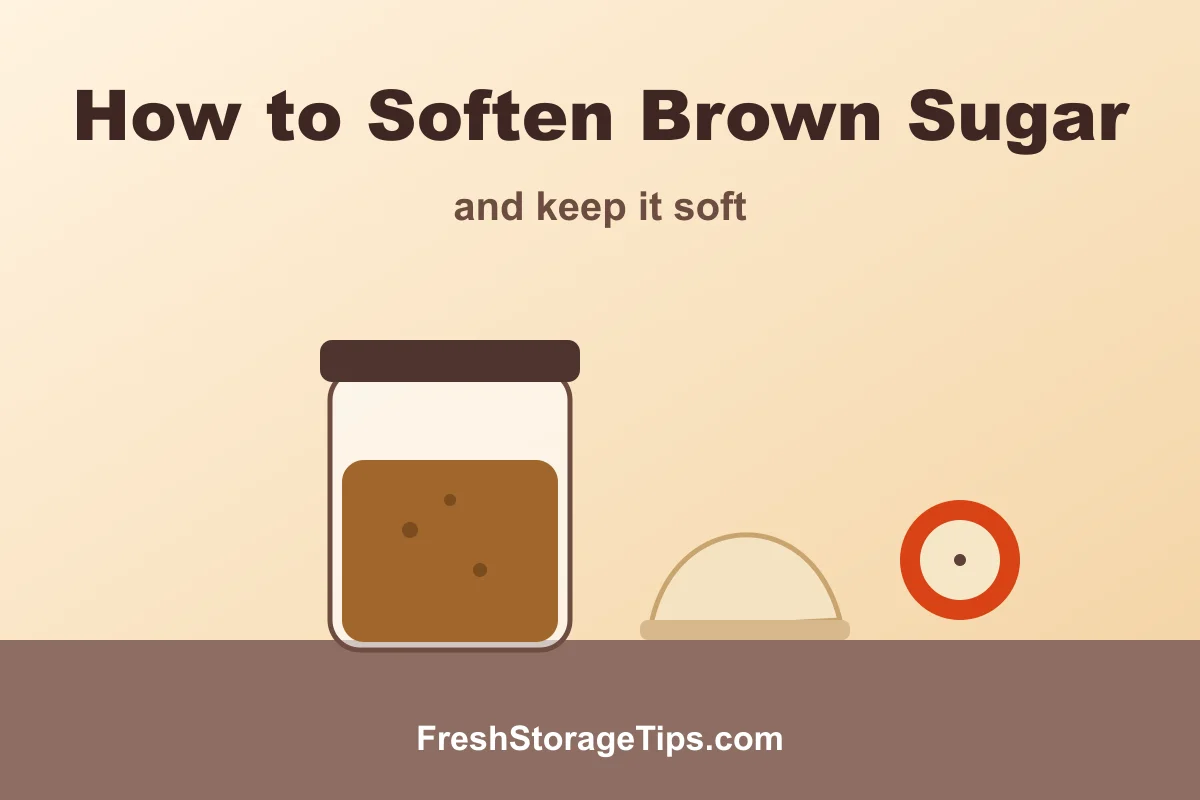
Brown sugar goes hard when its moisture evaporates. To fix it right now: cover it with a damp paper towel and microwave for 30 seconds, or warm it in a 250 to 300°F oven, then measure it while it’s warm (it hardens again as it cools). To soften it for longer: put a slice of bread or apple in the closed container, usually overnight (my estimate). To keep it soft: an airtight jar, not the original bag. And it’s still perfectly safe: the USDA says sugar never spoils.
Keep it soft next time: airtight pantry canisters (why these) terracotta brown sugar savers (Amazon; as an Amazon Associate I earn from qualifying purchases)
Cookie Season Tip: Check Your Brown Sugar Today
Holiday cookies, gingerbread and pecan pie all want soft brown sugar, and the bag in the back of the cupboard has often turned into a brick since last year. Check it a day before you bake: then the slow bread-or-apple method has time to work overnight, and you don’t need the microwave at the last minute (my advice).
Baking with spices too? Check those jars as well: are your spices still good?
Why Brown Sugar Gets Hard
K-State Research and Extension explains that brown sugar holds more moisture than white sugar. When that moisture evaporates, the crystals stick together into hard lumps. A loosely closed bag doesn’t stop that for long (my advice), and Ohio State University Extension notes that brown sugar will often still harden after a few months, even in an airtight container.
The good news: hard brown sugar isn’t spoiled. It just needs its moisture back.
5 Ways to Soften Brown Sugar
| Method | How | Time | Stays soft? |
|---|---|---|---|
| 1. Microwave + damp towel | Cover the bowl with a damp (not dripping) paper towel, microwave 30 seconds, fluff with a fork, then 10 seconds at a time (K-State) | About 1 minute (my estimate) | No: use it right away |
| 2. Microwave + bread | Bowl with a slice of bread, covered with plastic wrap, 10 to 20 seconds on high (Ohio State) | Under 1 minute | No: it hardens again as it cools |
| 3. Oven | Spread on a cookie sheet, 250 to 300°F until soft, measure while warm (Purdue) | A few minutes (my estimate) | No: it hardens when cool |
| 4. Slice of bread overnight | Put a slice of bread in the closed container with the sugar (K-State) | Overnight to a day or two (my advice) | Yes |
| 5. Apple slice | Slip an apple slice into the closed jar; check that it hasn’t dried out or turned moldy (Purdue) | Overnight to a day or two (my advice) | Yes |
Microwave times differ per microwave: start short and add 10 seconds at a time (my advice). Don’t let it get hot enough to melt (my advice).
Which Method Should You Use?
- You need it for a recipe in five minutes: the microwave with a damp paper towel. Measure it right away.
- You need a big batch for baking: the oven method, then measure while it’s still warm (Purdue).
- You want the whole bag soft again: bread or an apple slice in a closed container. Take the bread out once the sugar is soft, so it doesn’t go moldy in there (my advice).
My tip: terracotta “brown sugar savers” are small clay discs you soak in water and drop into the container, as an alternative to the bread slice. Follow the maker’s soaking instructions.
How to Keep Brown Sugar Soft
- Move it out of the bag. Purdue Extension says a plastic bag works, but a jar with a tight lid is “better yet.” K-State explains why: a container that’s truly airtight traps the moisture and gives it back to the sugar.
- Keep it cool and dry, not in the fridge. Utah State University Extension says to store sugar in a cool, dry place, not the refrigerator.
- Keep it away from strong smells. Utah State says sugar can absorb strong odors, even through plastic packaging. Not next to the onions or the coffee.
- Add a moisture helper. A slice of bread (K-State) or apple (Purdue), or a soaked terracotta disc (my tip). Swap the bread or apple before it dries out or molds.
- Buying a big bag? NDSU Extension’s freezing publication says brown sugar can be overwrapped and frozen, and it will be soft when thawed. Handy for a bulk bag you won’t open for months.
Need a jar that actually seals? Here are the airtight containers I’d pick (the 1.5-quart size, about 6 cups, should take a whole 2-lb bag of packed brown sugar: my estimate).
How Long Does Brown Sugar Last?
As long as you want, safety-wise. The USDA FoodKeeper says sugar “never spoils, but for best quality use within 2 years of opening.” Utah State University Extension agrees that commercial sugars have an indefinite shelf life and a best-by of about 2 years, purely for quality, and that sugar is “still safe to use even when lumpy.”
Brown sugar is the one that loses quality first. The USDA gives sugar 18 to 24 months for quality, but Ohio State and Purdue both recommend using brown sugar within about 4 months at room temperature, and Ohio State notes it will likely still harden after a few months, even airtight. Utah State notes that brown sugars don’t store as well for the long term because of their natural moisture. Hard isn’t bad, though. If it smells off, shows mold or has bugs in it, then it goes out (my advice; see pantry bugs).
White and Powdered Sugar: Quick Notes
- Granulated white sugar gets hard and lumpy from moisture, not from drying out (Utah State). Keep it in an airtight container. Lumpy already? Utah State suggests chopping the lumps in a food processor.
- Powdered (confectioners’) sugar: airtight container; Ohio State gives it 18 months at 70°F.
- All sugar keeps indefinitely for safety, according to the USDA FoodKeeper. More pantry times on the pantry food storage page.
Brown Sugar Questions
How do you soften brown sugar fast?
Cover the bowl with a damp paper towel and microwave for 30 seconds, then fluff with a fork and add 10 seconds at a time if needed (K-State Research and Extension). Use it right away, because it hardens again as it cools.
How do you keep brown sugar soft?
Store it in a jar with a tight lid instead of the bag (Purdue Extension), in a cool, dry place (Utah State), with a slice of bread (K-State) or apple (Purdue) inside to add moisture.
Is hard brown sugar still safe to eat?
Yes. The USDA FoodKeeper says sugar never spoils, and Utah State University Extension says sugar is still safe to use even when lumpy. Throw it out only if it smells off, has mold or has bugs.
Can you freeze brown sugar?
Yes. NDSU Extension’s freezing publication says brown sugar can be overwrapped and frozen, and it will be soft when thawed.
Should brown sugar go in the fridge?
No. Utah State University Extension says to store sugar in a cool, dry place, not the refrigerator. An airtight container in the pantry works better.
Sources & Transparency
Why it hardens, airtight storage, bread and microwave method: K-State Research and Extension, “Pantry Ponderings: Brown Sugar”. Microwave with bread, storage times: Ohio State University Extension, “Pantry Food Storage” (HYG-5401). Oven method, jar with a tight lid, apple slice: Purdue Extension, CFS-423-W. Cool and dry, odors, shelf life, lumpy sugar: Utah State University Extension, “Storing Sugars” (2025). Freezing: NDSU Extension, food freezing publication FN403 (2024). Shelf life: USDA FoodKeeper. Tips marked as mine are my own advice.
Last updated: