
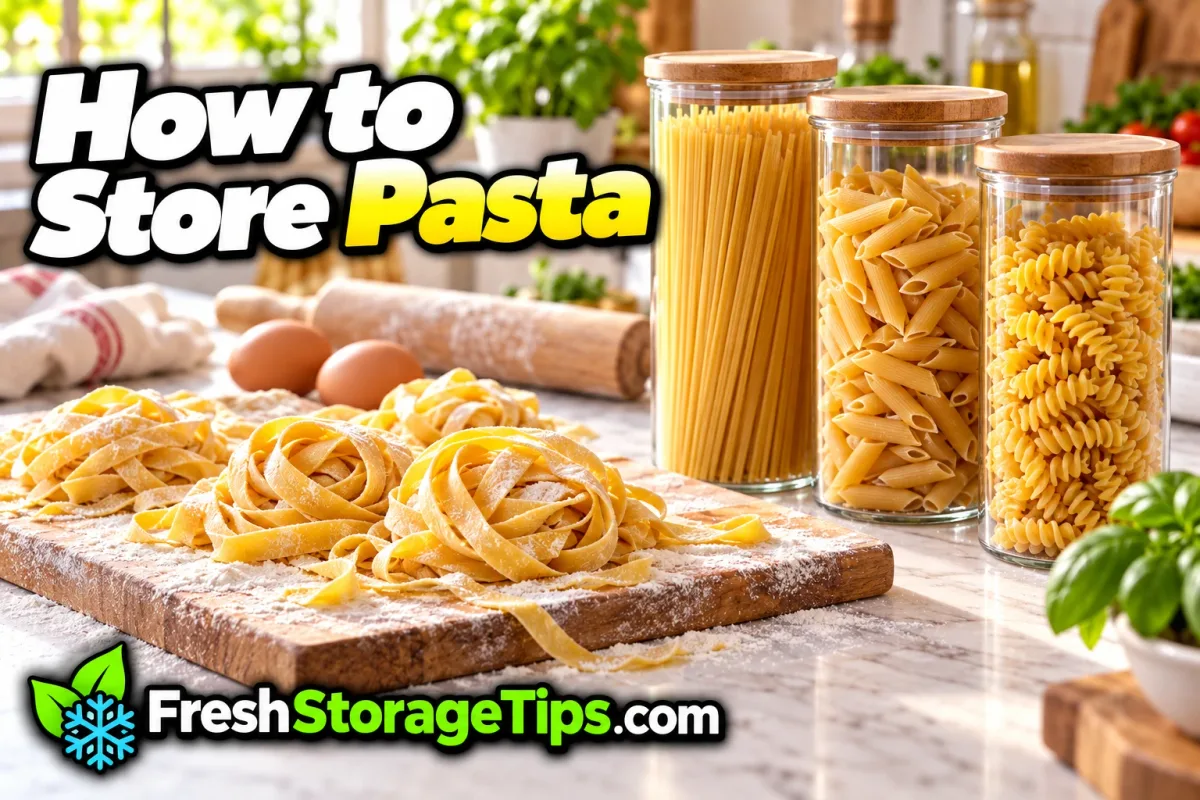
Dry pasta keeps about 2 years unopened and 1 year after opening in a closed container in the pantry (USDA FoodKeeper). Fresh or homemade pasta is a fridge food: use it within 1 to 3 days, or dry it briefly and freeze it: the USDA gives fresh pasta 2 months, Iowa State gives dried homemade noodles 3 to 6 months. Don’t store homemade egg noodles in the pantry, even dried: Iowa State University Extension says drying doesn’t kill bacteria; only cooking does.
Half-open pasta boxes everywhere? The canister set I’d pick (why this one): Vtopmart airtight containers, 24 pcs (Amazon; as an Amazon Associate I earn from qualifying purchases)
Pasta Storage Times
| Pasta | Where | How long | Source |
|---|---|---|---|
| Dry pasta (no egg), unopened | Pantry | 2 years | USDA FoodKeeper |
| Dry pasta, opened | Pantry, closed container | 1 year | USDA FoodKeeper |
| Dry egg noodles, opened | Pantry, closed container | 1 to 2 months | USDA FoodKeeper |
| Fresh pasta | Fridge | 1 to 2 days | USDA FoodKeeper |
| Fresh homemade noodles | Fridge | Up to 3 days | Iowa State Extension |
| Fresh pasta | Freezer | 2 months | USDA FoodKeeper |
| Homemade noodles, dried, then frozen | Freezer | 3 to 6 months | Iowa State Extension |
| Cooked pasta | Fridge / freezer | 3 to 5 days / 1 to 2 months | USDA FoodKeeper |
Dry pasta times are for best quality. Fresh pasta times are about safety: homemade egg noodles contain raw egg (Iowa State). When the two sources differ, I’d follow the shorter time (my advice).
How to Store Dry Pasta
Dry pasta is one of the easiest pantry foods: it has almost no moisture, so it keeps for a long time. What it needs:
- A closed container once the box or bag is open. UC IPM, the University of California’s pest program, advises containers with tight-fitting lids rather than plastic bags for dry food. Pantry beetles and moths happily move into an open pasta box: pantry bugs.
- A cool, dry spot, away from the stove and dishwasher (my advice).
- Don’t top up old pasta with new in the same jar. UC IPM says not to mix old and new food in one container.
- Egg noodles keep shorter once opened: 1 to 2 months, against 1 year for regular dry pasta (FoodKeeper). Close the bag tightly.
Spaghetti and long pasta: a tall container saves you from snapped noodles (my advice). Check the height before you buy: the Vtopmart listing gives volumes, not heights.
How to Store Homemade Pasta (Fresh Egg Noodles)
Homemade pasta is a different food from the dry pasta you buy: it’s made with raw eggs and raw flour, and Iowa State University Extension points out that both can carry bacteria like salmonella. Drying it doesn’t change that: “the ‘kill step’ for raw flour and eggs is cooking thoroughly.” That’s why Iowa State Extension no longer recommends keeping homemade noodles in the pantry, the way grandma did.
You have three safe options:
- Cook it right away. Fresh pasta cooks in minutes.
- Refrigerate it in a closed container and use it within 1 to 2 days (USDA FoodKeeper); Iowa State allows up to 3 days for fresh homemade noodles.
- Dry it briefly, then freeze it (Iowa State Extension):
- Air-dry for no more than 2 hours at room temperature, or 2 to 4 hours in a food dehydrator at 135°F.
- Spread the noodles on baking sheets and freeze them for a couple of hours so they don’t stick together.
- Pack them in an airtight container or freezer bag. They keep their best quality for 3 to 6 months.
- Cook them straight from frozen (my advice: add a minute or two to the cooking time).
Safety while making it: Iowa State says never to taste raw dough, to work on clean surfaces, and not to roll pasta on a cutting board that was used for raw meat or poultry.
Can You Make Fresh Pasta Ahead of Time?
Yes, a little. Shape it, dust it with flour so the strands don’t stick (my advice), and keep it covered in the fridge for up to 1 to 2 days (FoodKeeper). For anything longer, freeze it using the steps above. Don’t leave it out on the counter to “dry” for hours: Iowa State limits drying at room temperature to 2 hours.
And Cooked Pasta?
Leftover cooked pasta is a fridge food: 3 to 5 days in the fridge or 1 to 2 months in the freezer, according to the USDA FoodKeeper. The full details, including how to keep it from turning mushy, are in how to store cooked pasta.
More pantry staples, from rice to flour, are on the pantry food storage page.
Pasta Questions
How long does dry pasta last?
About 2 years unopened and 1 year after opening in a closed container, according to the USDA FoodKeeper. These are best-quality times. Dry egg noodles keep 1 to 2 months once opened.
How do you store homemade pasta?
Refrigerate it in a closed container and use it within 1 to 3 days, or dry it for no more than 2 hours and freeze it for 3 to 6 months (Iowa State University Extension). Don’t store homemade egg noodles in the pantry, even dried.
Can you freeze fresh pasta?
Yes. Dry the noodles briefly, freeze them on a baking sheet so they don’t stick, then pack them in an airtight bag. The USDA FoodKeeper gives fresh pasta 2 months in the freezer; Iowa State gives dried homemade noodles 3 to 6 months.
Why can’t you store homemade pasta in the pantry?
It’s made with raw eggs and flour, which can carry bacteria like salmonella. Iowa State University Extension says drying doesn’t kill bacteria; only cooking does, so homemade noodles should be used fresh or frozen.
Does dry pasta go bad?
It rarely becomes unsafe, but it can go stale or pick up pantry bugs. Throw it out if you see bugs, webbing, mold or dampness, or if it smells off (my advice).
Sources & Transparency
Homemade noodles, drying, freezing and safety: Iowa State University Extension AnswerLine, “Homemade Egg Noodles Made Safe” (reviewed February 2026), based on University of Illinois Extension. Storage times: USDA FoodKeeper. Containers and pests: UC IPM Pest Notes: Pantry Pests. Tips marked as mine are my own advice.
Last updated: