
How to Store Pizza Leftovers Without Ruining the Crust
Leftover pizza lasts 3 to 4 days in the fridge and 1 to 2 months in the freezer. The two things that ruin it are leaving it out too long before refrigerating, and storing it in the cardboard box. The box is not an airtight container. It dries the crust, lets fridge odours in and does nothing to slow bacterial growth on the cheese and toppings. According to the USDA FSIS guidelines on leftover food safety, cooked food with perishable toppings must be refrigerated within 2 hours. Pizza left on the counter overnight is not safe to eat, regardless of how it looks or smells.
Bottom line: Transfer slices to an airtight container within 2 hours. Fridge for up to 4 days. Freeze for up to 2 months. Reheat in a skillet for the best crust. Never eat pizza left out overnight.
- Fridge: 3 to 4 days in an airtight container
- Freezer: 1 to 2 months for best quality
- Room temperature limit: 2 hours maximum
- The cardboard box: Not a storage container. Transfer immediately.
- Left out overnight: Discard. Always.
 By
By Pizza is a surprisingly complex leftover from a food safety standpoint. It combines a bread base, a high-moisture tomato sauce, perishable cheese, and often meat toppings, each with slightly different spoilage timelines. The crust is relatively stable. The cheese and sauce are not. Bacteria do not die in the fridge or freezer — they slow down and then reactivate when the temperature rises. That is why reheating pizza correctly is just as important as storing it correctly. Both steps matter to keep it both crispy and safe.
Refrigerate within 2 hours in an airtight container, not the box. Eat within 3 to 4 days. Freeze wrapped individual slices for up to 2 months. Reheat in a dry skillet on medium heat for a crispy base without sogginess. The most important variable is timing: pizza left at room temperature for more than 2 hours enters the bacterial danger zone. See why food goes bad for the full science of what bacteria and moisture do to cooked food at different temperatures.
Full pizza leftover shelf life chart
Pizza shelf life depends on topping type, storage method and how quickly it was refrigerated after eating. The numbers below apply to pizza stored correctly within the 2-hour window.
| Situation | Storage method | How long | Key note |
|---|---|---|---|
| Standard pizza (cheese, veg, tomato sauce) | Airtight container, fridge | 3 to 4 days | Refrigerate within 2 hours. Quality best within 2 days. |
| Meat-topped pizza (pepperoni, chicken, sausage) | Airtight container, fridge | 3 to 4 days | Meat toppings are safe within the same window but check for off smells before reheating. |
| Seafood-topped pizza | Airtight container, fridge | 1 to 2 days | Seafood spoils faster than other toppings. Eat the next day or freeze immediately. |
| Any pizza, freezer | Individually wrapped slices, freezer bag | 1 to 2 months best quality | Safe indefinitely at 0‑°F but texture degrades after 2 months. |
| Pizza in the cardboard box, fridge | Original delivery box | Not recommended | Box is not airtight. Dries the crust and lets odours in. Transfer to a container. |
| Pizza left at room temperature | Any, above 40‑°F | 2 hours maximum | Bacteria multiply rapidly on cheese and sauce above 40‑°F. Overnight is unsafe. |
The right fridge storage method for leftover pizza
Why the box fails every time
Most people slide the pizza box into the fridge and call it done. This is the single most common leftover pizza mistake, and it has two distinct problems. First, cardboard is not airtight. Air continues to circulate around the slices, drying the crust progressively over the next 24 hours. Day-two pizza stored in the box tastes noticeably staler than pizza stored in a sealed container. Second, an open box inside a fridge allows the pizza to absorb surrounding odours from other foods, particularly anything acidic, heavily spiced or fermented.
The fix takes 90 seconds. Transfer slices to an airtight container or wrap each slice individually in cling film before placing in a sealed bag. Either method keeps moisture in, odours out and crust texture significantly better through day 3 or 4.
Stacking slices correctly
If you are stacking slices in a container, separate each one with a small sheet of baking paper or cling film. Slices stacked directly on top of each other fuse slightly as the cheese cools and re-sets, and pulling them apart tears the top layer of the slice below. Baking paper prevents this completely with no effect on storage quality.
Container size and headspace
Use a container sized close to the amount of pizza you have. A large container with only two slices has a significant air gap above the food that slows the moisture equilibration. The smaller the air pocket, the better the texture retention. This same principle applies to other leftover cooked foods: smaller containers with less headspace consistently outperform larger half-empty ones. The same logic behind storing cooked ground beef in well-fitting sealed containers applies directly here.
Freezing leftover pizza correctly
The individual wrap method
The biggest freezing mistake with pizza is putting slices directly into a bag without wrapping them first. Unwrapped slices freeze-bond together within hours and must be thawed as a block, losing the ability to pull out one slice at a time. They also develop freezer burn on the exposed surfaces within 2 to 3 weeks, which appears as dry white patches on the cheese and ruins the flavour.
The correct method: wrap each slice individually in cling film, pressing the wrap against the cheese and crust surfaces to remove air pockets. Then place the wrapped slices in a large freezer bag or airtight container, pressing out additional air before sealing. Label with the date. Stored this way, the slices stay separately usable and quality holds for 1 to 2 months. The same individual-portion approach used for long-term food storage of staple items applies here: portion control at the freezing stage determines ease of use at the thawing stage.
Freeze within the 3 to 4 day fridge window
Pizza that has already been in the fridge for 3 days should be frozen before day 4, not on day 4 or after. Freezing preserves the bacterial state of the food at the moment of freezing. Freezing on day 3 preserves a lower bacterial count than freezing on day 4. If you know on day 1 that you will not eat the remaining slices within 4 days, freeze them on day 1 rather than waiting. This is the same principle that makes understanding what freezing does to bacteria so important for anyone storing cooked food regularly.
Thawing frozen pizza
The safest thaw method is overnight in the fridge. A frozen slice moved to the fridge the evening before is fully thawed and ready to reheat the following morning. Counter thawing is faster but allows the cheese and sauce surfaces to enter the bacterial danger zone during the thaw period. If you need pizza faster, reheat directly from frozen in the oven or skillet at a slightly lower temperature for slightly longer.
How to reheat leftover pizza without sogginess
The skillet method: the best result for the crust
A dry skillet on medium heat is the best way to reheat pizza without making the base soggy. The direct contact between the crust and the hot pan recreates the crispy base that a pizza oven produces. Place the slice in a cold pan, turn the heat to medium and let it warm for 2 to 3 minutes. When the base is crispy, add 2 to 3 drops of water to the side of the pan away from the pizza, then cover with a lid for 60 to 90 seconds. The steam melts the cheese without steaming the base. This is by far the best reheating result for leftover pizza storage purposes.
Dry skillet
Crispy base, melted cheese, hot throughout. The only method that comes close to freshly made. Takes 4 to 5 minutes total.
Oven at 375‑°F
Crispy base, good all-round heating. Best for multiple slices at once. Place directly on the oven rack for the crispiest base.
Microwave
Hot but soft and soggy. The microwave heats moisture in the crust and releases steam from below. A cup of water next to the slice helps slightly but does not solve the fundamental problem.
Reheating from frozen
From frozen, the oven works better than the skillet because it provides time for the centre to thaw and heat through before the outside overcooks. Place the frozen slice on a baking tray at 325‑°F for 12 to 15 minutes. No need to thaw first. The lower temperature gives the inside time to catch up with the outside.
Safe reheating temperature
Reheat all leftover pizza to an internal temperature of 165‑°F throughout. This is the kill temperature for foodborne bacteria that may have grown on the toppings during refrigerated storage. A meat thermometer pressed into the thickest part of the topping layer confirms this. Hot to the touch on the surface does not guarantee 165‑°F at the centre, particularly in thick-crust or heavily topped slices.
The overnight pizza question answered properly
“Pizza is fine to eat in the morning if you left it out overnight. It has been cooked, so it is safe.”
This is one of the most persistent food safety myths. Cooking destroys bacteria present at the time of cooking. It does not prevent future contamination as the food cools. Once pizza drops below 140‑°F during cooling, bacteria from the environment, from hands, and from surfaces begin colonising the exposed cheese and sauce. At room temperature, bacterial populations can double every 20 minutes. By the 2-hour mark, contamination is significant. By morning, a slice left on the counter has had 8 to 10 hours at room temperature. No amount of reheating makes it safe because some toxins produced by bacteria, particularly those from Staphylococcus aureus and Bacillus cereus, are heat-stable and survive cooking. Discard overnight pizza. No exceptions.
Shelf life by topping type
Not all pizza toppings have the same shelf life. The base 3 to 4 day fridge rule applies to standard toppings, but some toppings narrow that window significantly.
Pizza fridge shelf life by topping
Pizza storage infographic
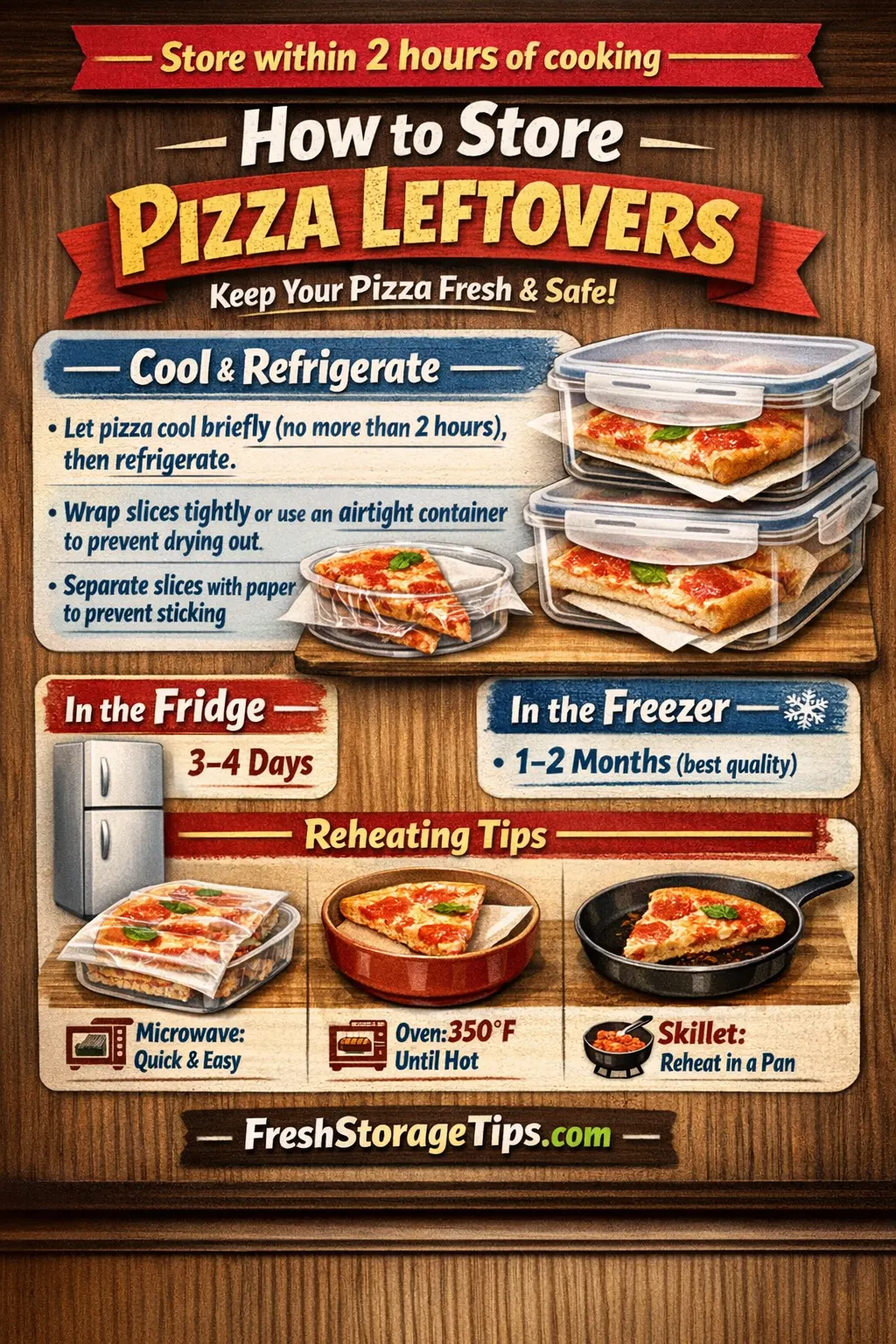
The infographic shows the full storage decision tree: the 2-hour window from delivery to fridge, container versus box, the fridge timeline broken down by topping type, and the freezer option for slices you know you will not eat this week. It also covers the three reheating methods side by side so you can pick the right one for how much time you have.
One thing the visual makes clear that often gets lost in text is how many separate decisions happen between receiving a pizza and eating the leftovers safely days later. The 2-hour clock, the container choice, the separation of slices, the freezing method, the thaw method and the reheat temperature are all individual checkpoints. Miss one and the others cannot compensate. This is why leftover pizza storage has more variables than most people expect, and why the same attention to detail given to perishable protein storage applies just as much to a pizza box sitting on the counter.
My cardboard box vs airtight container test over 3 days
I ordered two identical pizzas and stored the leftovers two ways: four slices in the original cardboard box in the fridge, and four slices in a sealed glass container with baking paper between each slice.
Box slices at day 2: Crust noticeably dry at the edges and slightly stale. Cheese had hardened into a firm layer with a slightly rubbery texture. A faint smell of the fridge had penetrated the toppings.
Container slices at day 2: Crust still pliable. Cheese retained its original texture and pulled cleanly when reheated. No off smells. Tasted close to day-one quality after 3 minutes in a dry skillet.
Both at day 4: Box slices were dry, stale and starting to smell. Container slices were still acceptable, though best quality had passed. Both were safe within the USDA 3 to 4 day window, but the container slices were genuinely enjoyable while the box slices were not.
The container wins every time. The difference between a good day-3 pizza and a dry, stale one is the box.
“The pizza box is for transport. The moment dinner is over, the box has done its job. What happens next determines whether the leftovers are worth eating.”
Six habits that keep leftover pizza worth eating
The 2-hour window is a food safety limit, not a quality guideline. Beyond 2 hours at room temperature, bacteria on the cheese and sauce have been multiplying for long enough to be a genuine risk. Transfer immediately after the meal.
Slices stacked directly fuse as the cheese cools. Baking paper between each slice keeps them individually removable. This matters especially when freezing, where fused slices must be thawed as a block.
Do not wait until day 3 to decide to freeze. Freezing at peak freshness on day 1 preserves the best quality and the lowest bacterial count. Day-3 freezing preserves a slice that is already past its best quality window.
A medium-heat dry skillet with a brief steam finish produces a crispy base and melted cheese in 4 to 5 minutes. The microwave produces a hot but uniformly soggy result. The skillet is worth the extra minute.
Seafood-topped pizza has a 1 to 2 day fridge window, not 3 to 4. Prawns, anchovies and tuna spoil significantly faster than cheese and vegetable toppings. If you have a mixed pizza, eat the seafood-topped slices first.
Overnight pizza has been in the bacterial danger zone for 8 to 10 hours. Some of the toxins produced by bacteria during that period survive reheating. There is no safe way to rescue overnight pizza. Discard it.
This video covers the practical reheating methods for leftover pizza including the skillet trick, oven method and why the microwave consistently produces the soggiest result.
Tools that make leftover pizza storage effortless
Simple equipment that keeps pizza fresh and makes reheating easy.
Airtight Glass Food Containers
The right size glass container with a rubber-sealed lid keeps pizza slices fresh for the full 3 to 4 day fridge window. Glass does not absorb food odours and shows you exactly what is inside without opening.
View on AmazonInstant-Read Thermometer
Confirm reheated pizza reaches 165‑°F at the centre of the toppings before eating. Hot on the surface does not mean safe throughout, particularly in thick-crust slices.
View on AmazonHeavy-Duty Freezer Bags
After wrapping individual slices in cling film, a heavy freezer bag adds a second airtight layer that prevents freezer burn for the full 1 to 2 month storage window. Thinner bags allow frost to penetrate within weeks.
View on AmazonFreezer Labels
Label every wrapped slice or container with the date stored and the topping type. Seafood-topped slices need a different use-by date to cheese slices. A label removes the guesswork entirely.
View on AmazonAs an Amazon Associate I earn from qualifying purchases — at no extra cost to you.
Questions people actually ask
Leftover pizza lasts 3 to 4 days in the fridge when stored in an airtight container or tightly wrapped. It must be refrigerated within 2 hours of cooking or delivery. After 4 days, discard it regardless of how it looks or smells.
Yes. Leftover pizza freezes well for 1 to 2 months for best quality. Wrap each slice individually in cling film, then place in a freezer bag or airtight container. Separate slices with a sheet of baking paper to prevent sticking. After 2 months quality declines but it stays safe indefinitely at 0‑°F.
A dry skillet on medium heat for 2 to 3 minutes is the best method for a crispy base. Place the slice in a cold pan, heat to medium, then add a few drops of water to the side of the pan and cover with a lid for 1 minute to melt the cheese. The oven at 375‑°F for 8 to 10 minutes also works well. The microwave is the fastest but produces the soggiest result.
No. Pizza left at room temperature for more than 2 hours enters the bacterial danger zone and should be discarded. Overnight is well beyond that limit. The toppings, cheese and sauce are all perishable and support bacterial growth rapidly above 40‑°F. Do not eat pizza left out overnight.
No. Pizza boxes are cardboard and are not airtight. Storing pizza in the box dries out the crust and allows fridge odours to penetrate the toppings. Always transfer slices to an airtight container or wrap them tightly in cling film before refrigerating.