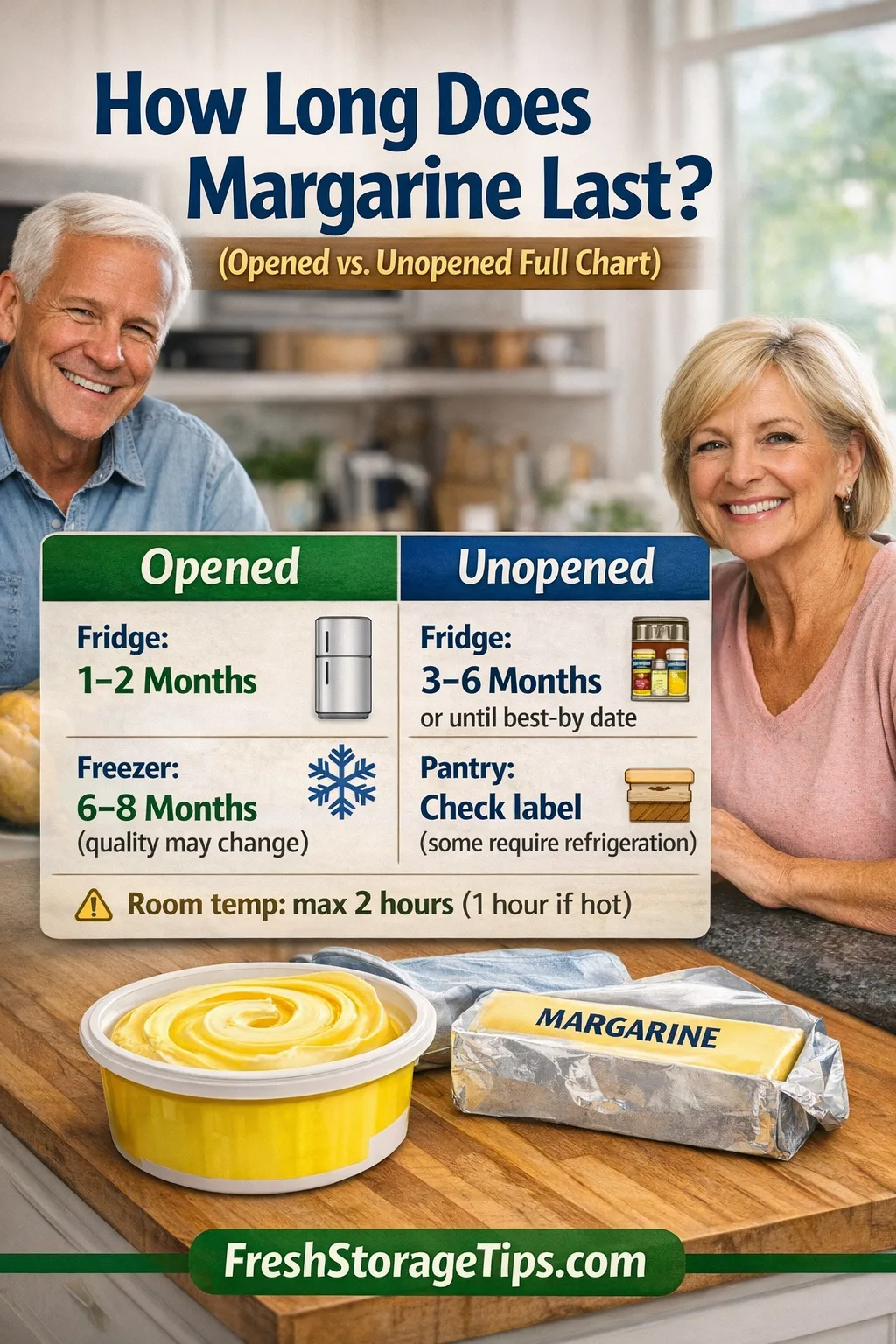
How Long Does Margarine Last? (Opened vs Unopened + Full Shelf Life Chart)
Margarine lasts 1–2 months opened in the fridge, up to 1 month past the best-by date unopened, generally safe for short periods (up to around 2 hours) at room temperature, and up to 6 months in the freezer when stored correctly.
Quick answer: Opened margarine: 1–2 months (fridge). Unopened: up to 1 month past best-by date. Freezer: up to 6 months. Room temperature: up to around 2 hours.
Opened margarine lasts 1–2 months in the fridge when stored correctly. Unopened margarine lasts up to 1 month past its printed best-by date. At room temperature, it is generally safe for short periods (up to around 2 hours) before quality declines. In the freezer, margarine keeps for up to 6 months when stored correctly.
Bottom line: The opened vs unopened distinction matters more than most people realise. Once you break the seal, the best-by date no longer applies — your opening date does. Label the tub.
- Opened, fridge: 1–2 months when stored correctly at 40‑°F
- Unopened, fridge: Up to 1 month past best-by date when stored correctly
- Counter (room temperature): Generally safe up to around 2 hours
- Freezer: Up to 6 months in the freezer when stored correctly
- Left out overnight: Discard — oxidation occurs fast at room temperature
 By
By Most people treat the best-by date on their margarine tub as the answer to this question. It is not. The best-by date is a quality estimate made by the manufacturer for an unopened, continuously refrigerated product. The moment you break the seal, a different clock starts — one based on how often you open the lid, where in the fridge you store it, and whether you are using a clean knife each time. Understanding this distinction is what separates margarine that lasts a full two months from margarine that turns rancid after three weeks. See also signs margarine has gone bad for the three checks that tell you it has already crossed the line, and how to store margarine properly — a product with similar shelf life numbers but a very different spoilage mechanism.
The unique angle here: shelf life for margarine is not a fixed number. It is a range that depends heavily on the type of margarine (tub spread vs stick vs light), brand formulation, and storage habits. A standard tub margarine and a light margarine with higher water content behave quite differently. This article covers both, plus the freezer option that almost no one uses but that effectively removes the shelf life problem entirely. See does margarine need refrigeration for why the fridge is non-negotiable and what happens when it is skipped.
Opened: 1–2 months in the fridge when stored correctly. Unopened: up to 1 month past best-by date. Freezer: up to 6 months when stored correctly. Counter: generally safe for short periods (up to around 2 hours) — quality declines quickly beyond that. The number that matters most is not the best-by date — it is the date you opened the tub. Label it the day you break the seal. See does margarine go bad for the smell, colour, and texture checks that tell you when it is time to discard, and how to store margarine for the exact method that keeps it fresh for the full 1–2 month window.
Full shelf life chart (opened vs unopened)
Margarine shelf life depends on three variables: whether it is opened or sealed, where it is stored, and the type of margarine. The chart below covers every situation most home cooks encounter. For spoilage signs to check alongside these numbers, see signs margarine has gone bad.
Times are based on USDA guidelines, manufacturer recommendations, and real kitchen testing.
These are conservative safety-based estimates — quality may decline earlier depending on storage habits.
| Situation | Storage method | How long | Key note |
|---|---|---|---|
| Opened, fridge | Original covered tub, 40‑°F or below | 1–2 months when stored correctly | Label with opening date. Clean utensil every use. |
| Unopened, fridge | Sealed tub, 40‑°F or below | Up to 1 month past best-by date | Must be continuously refrigerated. Check seal on opening. |
| Opened, light margarine | Original covered tub, 40‑°F or below | 3–4 weeks when stored correctly | Higher water content shortens window vs standard tub. |
| Stick margarine (baking) | Wrapped, 40‑°F or below | 1–2 months when stored correctly | Higher fat, lower moisture — similar to standard tub. |
| Counter (room temperature) | Any, room temperature | Up to around 2 hours | Quality declines quickly beyond that. 1 hour max above 90‑°F. |
| Left out overnight | Any room temperature | Discard | 8+ hours — oils have oxidised. Discard regardless of appearance. |
| Freezer (any type) | Foil-wrapped tub in freezer bag | Up to 6 months in the freezer when stored correctly | Thaw overnight in fridge. Smell on thawing before use. |
Opened margarine: why the 1–2 month window (the real reason it varies)
Opened margarine lasts 1–2 months in the fridge when stored correctly — but that range is not arbitrary. The difference between one month and two months comes down to how the product is handled after opening. Three habits determine which end of the range you get.
Correct habits
Lid replaced immediately after every use. Clean utensil taken from the drawer each time. Tub stored at the back of a middle shelf where temperature is most stable.
Typical habits
Lid left off for a few minutes sometimes. Same knife used occasionally after touching bread. Stored wherever convenient in the fridge. Most households land here.
Poor habits
Lid left off for extended periods. Knife from toast used repeatedly. Stored in the fridge door where temperature fluctuates with every opening. Rancidity develops fast.
The single biggest accelerant is the fridge door. Door temperature fluctuates 5–8‑°F every time the fridge opens, and most fridges open at least 10–15 times per day. That repeated temperature cycling drives both oxidation and emulsion breakdown. Moving the tub from the door to a back shelf is the easiest single change that extends margarine life.
Unopened margarine and the best-by date (what it actually means)
Unopened margarine lasts up to 1 month past its printed best-by date when stored correctly — provided it has been continuously refrigerated, the seal is intact, and it has not been exposed to temperature abuse during transport or storage.
The best-by date printed on the tub is a manufacturer’s quality estimate, not a safety cut-off. It represents the date by which the product should be at peak quality assuming ideal storage conditions. A tub that has been sitting at room temperature in a warehouse for a week before reaching the supermarket shelf may already be closer to its actual quality limit than the date suggests. Conversely, a tub stored perfectly cold since manufacture can reasonably be used a few weeks past the printed date.
“I can use my opened margarine until the best-by date printed on the tub.”
This is the most common margarine shelf life mistake. The best-by date applies to the sealed product only. Once you open the tub, the 1–2 month window starts from your opening date, not from the date on the label. A tub opened two months before the best-by date has already exceeded its safe open window even though the label still shows a future date. Label your tub with the opening date — it is the only number that matters once the seal is broken.
The practical rule: check the best-by date when buying (avoid products within a few weeks of their date if you will not use them quickly), and then record your opening date. From that point, the best-by date is irrelevant to your decision-making.
Room temperature: the 2-hour rule and what happens after
Margarine goes bad faster at room temperature than almost any other spread in a standard kitchen. The vegetable oils in margarine contain a high proportion of unsaturated fatty acids that react with oxygen significantly faster than the saturated dairy fats in butter. At 70‑°F (21‑°C), oxidation is measurably active. At 90‑°F (32‑°C), the rate roughly doubles.
The USDA’s 2-hour guideline reflects the point at which perishable foods have been at room temperature long enough for meaningful quality degradation and, in some cases, microbial growth to occur. For margarine specifically, the primary concern is oxidation rather than bacterial infection — but the timeline is the same. Beyond 2 hours at room temperature, quality declines quickly. Beyond 4–6 hours, the product is likely already noticeably rancid. Overnight is beyond recovery.
One practical point most guides miss: the 2-hour rule is cumulative across the day, not per session. If you take the margarine out for breakfast, put it back, and then take it out again for lunch, both periods count. A tub taken out for 90 minutes at breakfast and 45 minutes at lunch has used its daily room-temperature budget. See does margarine need refrigeration for a full breakdown of what happens at each temperature point and why the fridge is the only correct daily storage location.
Freezer: the underused option that solves the shelf life problem
Margarine freezes exceptionally well. Up to 6 months in the freezer when stored correctly — and unlike many frozen dairy products, margarine thaws without significant quality loss. The texture may be marginally softer, but the flavour and functionality for spreading and cooking are preserved.
Most people never freeze margarine because it feels unnecessary when a tub lasts 1–2 months in the fridge. The case for freezing is bulk purchasing: if you buy two or three tubs at once (common when on promotion), freezing the extra tubs immediately eliminates any shelf life concern. A frozen tub taken out two months later and thawed overnight in the fridge is as good as a freshly purchased tub.
The correct freezer method
- Wrap the original tub in foil — margarine readily absorbs freezer odours through the tub walls. Foil provides a barrier.
- Place in a heavy freezer bag and squeeze out excess air before sealing.
- Label with the freeze date — up to 6 months in the freezer when stored correctly from that date.
- Thaw overnight in the fridge — never on the counter. Counter thawing exposes the product to room temperature for extended periods, which defeats the preservation.
- Check on first use after thawing — smell the tub before using. Any rancid note means discard. Correctly frozen and thawed margarine should smell neutral.
My freeze-thaw test: 3 months frozen vs 3 months in fridge
I froze one opened tub of standard margarine (wrapped in foil, sealed in a freezer bag) and kept one identical tub in the fridge at the same time. After 3 months I compared both.
Fridge tub at 3 months: Noticeably past peak. A faint metallic note on smell. Colour slightly darker at the edges. Still technically within the 1–2 month window if it had been opened recently — but this tub had been open from day one, so it was at the outer edge. The taste was flat and slightly rancid on hot toast.
Frozen tub at 3 months (thawed overnight): Essentially identical to opening day. Neutral smell, uniform colour, smooth texture. The taste was clean on hot toast. Marginally softer than fresh from the shop but functionally indistinguishable in use.
The conclusion was clear: for anything beyond a 6–8 week use window, freezing is significantly better than extended fridge storage. The freezer completely pauses the oxidation clock. The fridge only slows it.
Shelf life by margarine type (not all margarines are equal)
Standard tub margarine gets most of the attention, but the shelf life numbers vary meaningfully by formulation. The key variable is water content: higher water content means a less stable emulsion and shorter shelf life after opening.
Margarine shelf life by type — opened, refrigerated
Shelf life infographic

The infographic captures the key numbers from the full chart in a format you can screenshot and save. The most important visual relationship it shows is the ratio between the three storage methods: fridge (weeks to months), freezer (months), counter (hours). The gap between fridge and counter life is the entire argument for keeping margarine refrigerated and only taking it out briefly for use.
One thing the infographic makes obvious that text sometimes obscures: the opened vs unopened distinction is a much bigger jump than most people expect. Unopened margarine in a sealed tub at the back of a cold fridge is essentially stable. Opened margarine in the same fridge, used daily, has a clock running from the day you first pulled back the foil. Those are fundamentally different products from a shelf life perspective.
Margarine vs butter shelf life (the comparison that surprises people)
Most people assume margarine lasts longer than butter because it is a more processed, preservative-containing product. The reality is the opposite: opened butter lasts 1–3 months in the fridge — a slightly longer window than margarine’s 1–2 months.
The reason is fat chemistry. Butter is approximately 80% saturated dairy fat. Saturated fats have no carbon-carbon double bonds — they are chemically stable and resist oxidation. Margarine is made from vegetable oils that contain substantial proportions of unsaturated and polyunsaturated fatty acids. These contain double bonds that react readily with oxygen, driving rancidity faster than butter’s dairy fat does.
The preservatives in commercial margarine (typically TBHQ, BHA, or vitamin E) partially compensate for this chemical vulnerability, bringing the shelf life close to but not quite matching butter. The preservatives buy time — they do not change the underlying chemistry. For the full comparison including counter storage rules, see how to store butter.
“The best-by date tells you when to buy it. Your opening date tells you when to finish it. These are two different numbers — and only one of them matters after the seal is broken.”
Six habits that keep margarine fresh for the full window
Write the date you break the seal directly on the lid. The 1–2 month window starts from that day. The best-by date is irrelevant once opened — your opening date is the number that matters from this point.
Door temperature fluctuates with every fridge opening. A back middle shelf is 5–8‑°F colder and more stable. That difference can extend the usable window by several weeks. It is the easiest single storage upgrade.
Every second the lid is off, the surface is exposed to oxygen and light — the two primary drivers of rancidity. Make lid replacement the last step of every use, not an afterthought when you remember.
Bread crumbs and food particles from a used knife contaminate the surface and introduce organic material that accelerates spoilage. Always use a clean utensil taken directly from the drawer. Never double-dip from another food.
Fresh margarine is nearly odourless. Spending two seconds sniffing the tub when you reach for it weekly catches early rancidity before it reaches your food. Once the smell changes, the taste has already changed even if you cannot detect it yet.
Buy two tubs on promotion? Freeze the second one right away. Do not wait until the first runs out. A frozen tub thawed on the day you open your last tub is fresher than a fridge tub that has been open for 6 weeks.
Understanding butter’s shelf life and spoilage signs helps put margarine’s 1–2 month window in context. The spoilage mechanisms are different (dairy fat vs vegetable oil oxidation), but the practical checks — smell, colour, texture — are very similar.
Tools that make margarine storage effortless
Simple, inexpensive items that extend shelf life and remove the guesswork.
Removable Date Labels
Write your opening date on the tub the moment you break the seal. The 1–2 month window starts then — not from the best-by date. Peel off cleanly, no sticky residue left behind.
View on AmazonFridge Thermometer
Confirm your fridge runs at 40‑°F or below. A fridge at 45‑°F — common near the door — can cut margarine’s shelf life significantly. A simple fridge thermometer removes the guesswork entirely.
View on AmazonHeavy-Duty Freezer Bags
Essential for the correct freezer method. Wrap the tub in foil first, then seal in a freezer bag to block odour absorption. Up to 6 months in the freezer when stored correctly — label the bag with the freeze date.
View on AmazonAirtight Glass Containers
Transfer margarine into a smaller container as the tub empties. Less headspace means less oxygen exposure, which directly slows oxidation. Glass does not absorb fat odours unlike plastic.
View on AmazonAs an Amazon Associate I earn from qualifying purchases — at no extra cost to you.
Questions people actually ask
1–2 months in the fridge when stored correctly at 40‑°F (4‑°C) or below, kept in the original covered tub. The range depends on storage habits — fridge door storage and infrequent lid use push you toward the shorter end. Label the tub with your opening date immediately. For the spoilage signs that tell you when it has gone off, see does margarine go bad.
Unopened margarine lasts up to 1 month past its printed best-by date in the fridge when stored correctly and continuously refrigerated. The best-by date assumes a sealed product — once you open it, the 1–2 month opened window applies regardless of what the label says. Check seal integrity when buying, and avoid tubs that are within a few weeks of their date if you will not open them soon.
Yes. Margarine freezes very well for up to 6 months in the freezer when stored correctly. Wrap the tub in foil and seal in a heavy freezer bag to prevent odour absorption. Thaw overnight in the fridge. Texture may be marginally softer after thawing but quality is well-preserved. Ideal for bulk purchases — freeze extra tubs immediately rather than letting them sit in the fridge.
Margarine is generally safe for short periods at room temperature — up to around 2 hours based on USDA food safety guidelines. Quality declines quickly beyond that. In a warm kitchen above 90‑°F, return it to the fridge within 1 hour. The 2-hour limit is cumulative across the day — multiple short sessions add up. See does margarine need refrigeration for the full room temperature breakdown.
No — butter actually lasts slightly longer. Opened butter lasts 1–3 months in the fridge when stored correctly, while opened margarine lasts 1–2 months. Butter’s saturated dairy fats are more chemically stable than margarine’s vegetable oils, meaning butter resists oxidation better. The preservatives in margarine compensate partially but do not fully close the gap. See how to store butter for the comparison in full.